
The Lithium Reset
What Spodumene Prices Mean for Critical-Minerals Investors

Investment conclusion
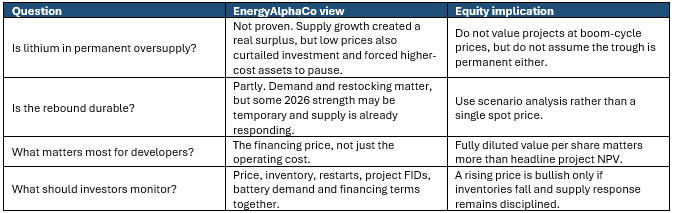
The lithium market is no longer priced for the 2021-2022 shortage, but it is also no longer the same market that produced the 2024-2025 capitulation. The evidence points to a commodity reset rather than a simple permanent glut. Prices collapsed because supply, inventories and expectations moved ahead of near-term demand. Prices later recovered because demand continued growing, inventories normalized, and supply disruptions removed some material from the market.
For investors in critical-minerals equities, the key question is not whether lithium demand grows. It probably does. The harder question is what price is required to finance the next unit of supply, how quickly idled mines return when prices recover, and how much of a project’s value remains with common shareholders after financing, dilution, offtake obligations and construction risk.
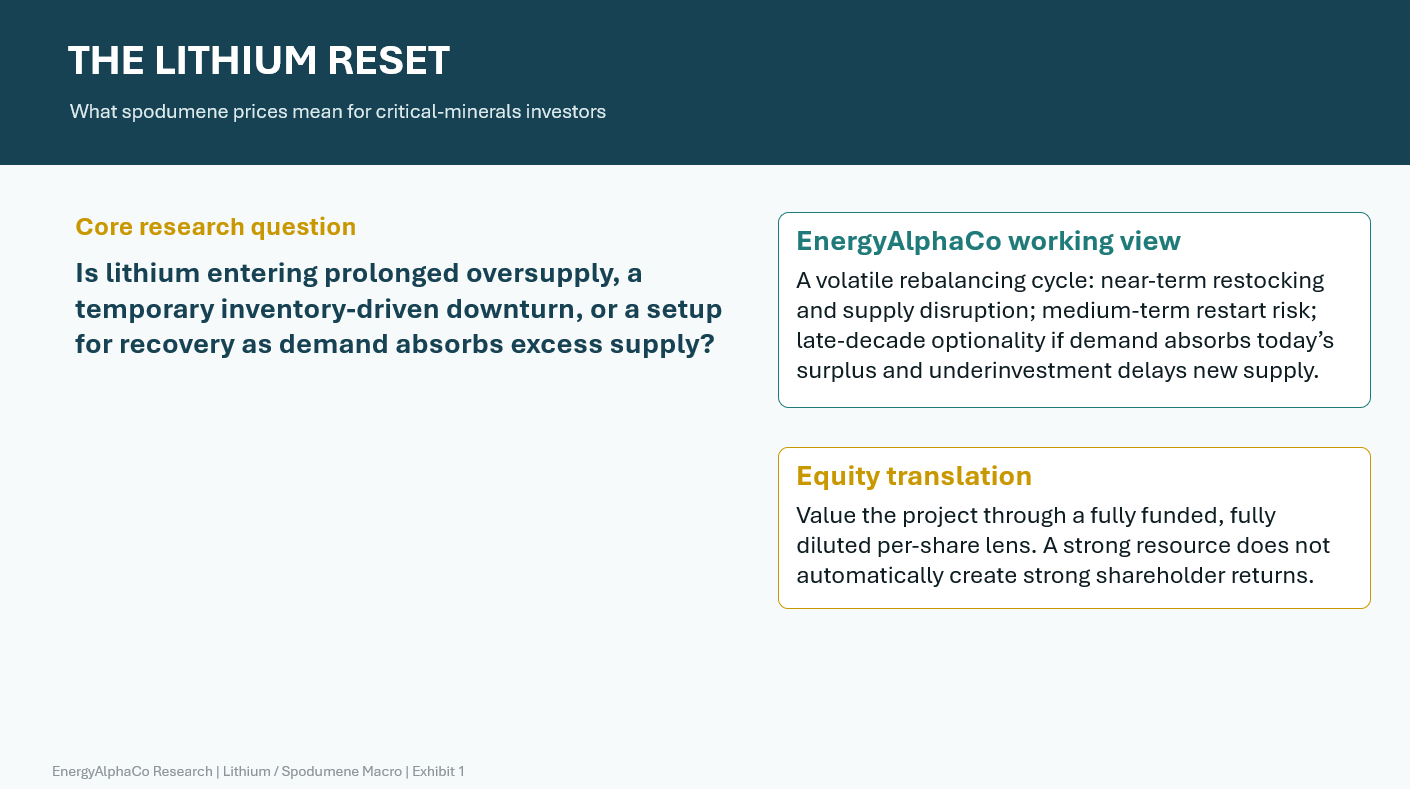
EnergyAlphaCo’s working conclusion is that the most reasonable base case for 2026-2030 is not a straight-line lithium boom. It is a volatile rebalancing cycle: near-term prices supported by restocking and supply interruptions; medium-term pressure as idled mines, brownfield expansions and delayed projects respond; and late-decade optionality if demand growth absorbs today’s excess capacity while the downturn delays enough future supply.
That framework is especially important for development-stage lithium companies. These equities do not merely need higher commodity prices. They need financeable commodity prices, credible funding, disciplined dilution and timely execution. A strong resource is not the same thing as strong fully diluted per-share value.
EnergyAlphaCo summary view
The company-level relevance of a commodity reset
Lithium research often begins with a macro question: how many electric vehicles will be sold, how many gigawatt-hours of batteries will be deployed, and how much lithium will be required? For equity investors, that is only the first layer. The second layer is whether the commodity price needed to satisfy that demand is high enough to reward the companies funding new supply.
The lithium cycle has already exposed the danger of confusing resource value with shareholder value. A project can screen well at $2,000 per tonne spodumene and look marginal at $900. A feasibility study can show a strong NPV while the stock still performs poorly if the company must issue equity at distressed prices, accept restrictive offtake terms, or absorb capital-cost inflation before first production.
This article therefore treats lithium pricing as an input into a per-share valuation framework. The objective is not to predict the exact 2030 spot price. It is to identify the price ranges under which a project can operate, finance construction, repay capital and leave an attractive result for common shareholders.
How the lithium supply chain works
Lithium reaches battery buyers through several distinct steps. Hard-rock producers mine pegmatite and process it into spodumene concentrate, usually quoted as SC6 or adjusted back to a 6% lithium oxide equivalent. Brine producers extract lithium-rich brines and process them into lithium carbonate or other intermediate products. Converters then produce battery-grade lithium carbonate or hydroxide for cathode manufacturers, which supply cell producers, battery-pack manufacturers, automakers and stationary-storage integrators.
The distinction matters because a hard-rock developer typically sells spodumene concentrate, not battery-grade lithium carbonate or hydroxide. A lithium carbonate price, a hydroxide price and an SC6 price are related, but they are not interchangeable. Grade, recovery, payability, freight, insurance, penalties, contract timing and conversion margins all affect realized value.
For EnergyAlphaCo, the correct starting point is therefore not a broad statement that lithium is at a certain price. The starting point is: which product, in which market, under what benchmark, and under what contract mechanism?
The boom, collapse and reset
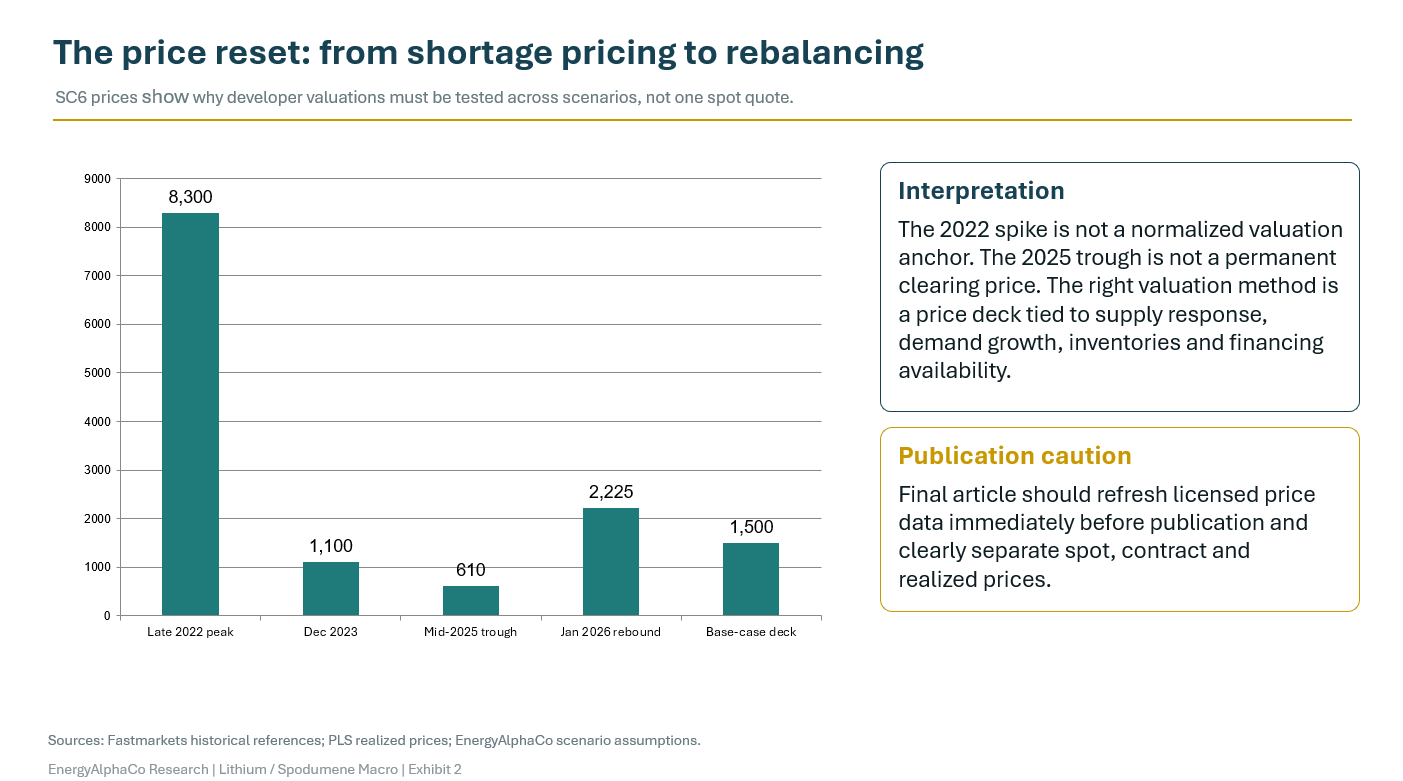
Fastmarkets historical references show that spodumene prices reached extraordinary levels during late 2022, with reported SC6 references near or above $8,000 per tonne. That was shortage pricing. It reflected aggressive EV growth expectations, constrained raw-material availability, converter demand and buyer fear of being short supply.
By 2023 and 2024, the market moved in the other direction. New mine supply, Chinese conversion capacity, downstream destocking and slower-than-expected demand growth relative to bullish expectations overwhelmed the market. By mid-2025, public price references showed SC6 near the low hundreds of dollars per tonne. That price environment forced curtailments, project delays and capital discipline.
The collapse was not merely sentiment. USGS estimated that global lithium mine production rose materially faster than lithium consumption in 2025. That imbalance explains why demand growth did not protect prices. A commodity can have excellent long-term demand and still be oversupplied at the wrong point in the cycle.
The 2026 rebound also has a real foundation. Government and market sources have attributed the recovery to supply disruptions, continued battery demand, restocking and the impact of earlier curtailments. But that does not mean the next cycle should be modeled as a repeat of 2022. Prices do not only stimulate demand confidence. They also stimulate supply response.
What caused the downturn?
The downturn had five overlapping causes. First, mine supply expanded rapidly. Second, Chinese conversion capacity and inventory had been built for a stronger near-term growth path than the market immediately delivered. Third, battery buyers destocked after over-ordering during the shortage period. Fourth, EV demand still grew but did not match the most aggressive assumptions embedded in peak-cycle pricing. Fifth, capital markets continued to fund projects long enough for supply to arrive after the shortage had already eased.
A common mistake is to treat the downturn as proof that the energy transition failed. That interpretation is too simple. EVs and storage continued to grow. The problem was that supply, inventories and expectations had been built for even stronger growth. Lithium did not need weak demand to collapse. It only needed demand to fall short of peak-cycle expectations while supply arrived on time.
Demand: EVs are still central, but the mix is changing
The IEA estimates that EV battery deployment continued to expand rapidly in 2025, with EVs still representing the majority of global lithium-ion battery deployment. That is a large and growing demand base. But the composition is changing. China remains the largest market, plug-in hybrids are taking share in some regions, battery sizes vary substantially by vehicle type, and exports increasingly matter for Chinese battery and auto manufacturers.
Investors should not model lithium demand from EV unit sales alone. Battery size per vehicle, the mix between battery-electric and plug-in hybrid vehicles, commercial-vehicle electrification, export demand and regional chemistry choices all affect lithium intensity. A market with strong EV unit growth can still disappoint a lithium model if average battery size declines or if production mix shifts in unexpected ways.
Stationary storage is now a serious demand engine
Battery energy storage is no longer a rounding error. The IEA identifies EVs and stationary storage as the dominant end markets for lithium-ion batteries, with storage becoming a material second demand engine. Grid storage, renewable integration, commercial storage, data-center reliability requirements and lower battery costs all support this channel.
This is important for lithium because stationary storage can absorb battery capacity even when auto markets are uneven. It also creates a demand channel where battery cost declines can stimulate additional deployment. The risk, however, is substitution. Sodium-ion batteries, alternative storage technologies and system-level duration choices could reduce lithium intensity in some storage applications over time. That risk should be monitored, not ignored.
Battery chemistry: LFP changes product mix, not the lithium thesis
LFP batteries are now central to the market. The IEA estimates that LFP accounted for a majority of EV batteries deployed globally in 2025 and an even larger share of stationary battery-storage installations. LFP is structurally negative for nickel and cobalt demand relative to high-nickel chemistries, but it does not remove lithium from the battery. It may actually support lithium demand by lowering battery costs and increasing adoption.
The more precise implication is that LFP adoption may favor lithium carbonate relative to lithium hydroxide and increase the importance of low-cost Chinese battery supply chains. That matters for spodumene developers because their concentrate must be converted into the chemical products demanded by cathode producers.
Supply: why the recovery may cap itself
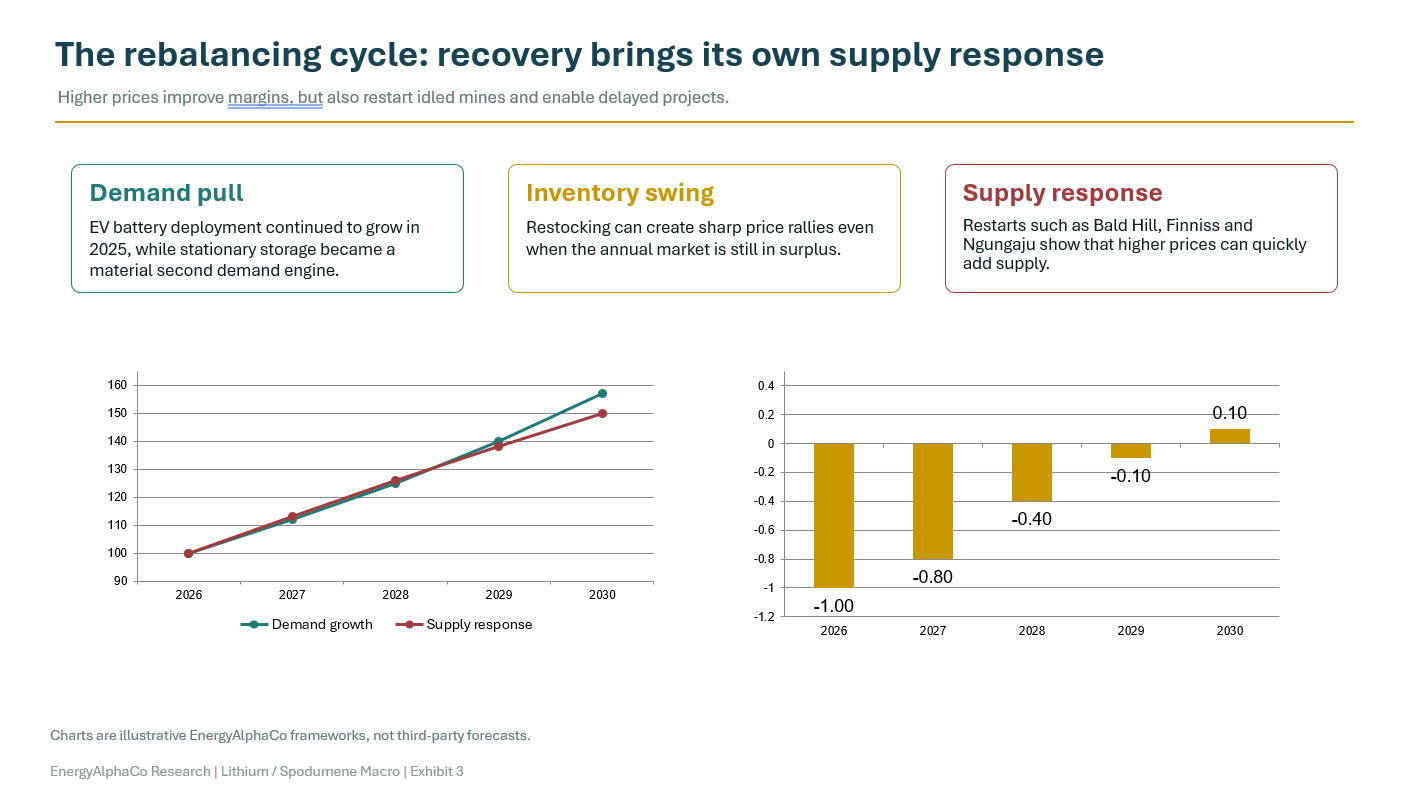
Lithium supply is highly cyclical because higher prices do two things at once. They improve margins and project economics, but they also reactivate the very supply that was removed during the downturn. Market-balance estimates from S&P Global and government forecasters suggest that 2026 can show improving prices even while the annual chemical market remains in surplus, because inventory location, product availability and supply interruptions matter.
Company evidence supports the supply-response risk. Mineral Resources moved to restart Bald Hill after prices improved. Core Lithium approved a restart at Finniss. Pilbara Minerals continued to demonstrate the advantage of scale, cash and established operations. These examples show that price recovery can quickly improve supply availability before greenfield projects are even needed.
This is the core reason the base case should not assume a vertical price recovery. A healthy demand market can still generate moderate prices if restarted supply, brownfield expansions and delayed projects arrive fast enough.
China conversion capacity and inventory: the hardest part to verify
The weakest area in public lithium analysis is Chinese inventory. Market commentary often refers to inventory as if there is one visible stockpile. In reality, inventory can sit as spodumene concentrate at ports, raw material at converters, lithium carbonate or hydroxide at chemical producers, cathode material, battery cells or finished vehicles and storage systems.
That matters because price rallies can be driven by inventory rebuilding rather than final demand. A restocking cycle can look like a demand boom for several months. Conversely, downstream destocking can make end demand look weaker than it really is. EnergyAlphaCo should therefore avoid using one unsupported China-inventory number unless the product, location, unit, reporting source and time period are clear.
The cost curve: cash cost is not incentive price
Lithium investors need to separate four different price thresholds. Cash cost determines whether an existing mine keeps operating. All-in sustaining cost determines whether the asset earns an acceptable operating return. Restart price determines whether a suspended mine returns. Incentive price determines whether a new project can attract capital and earn an adequate full-cycle return.
This distinction is critical for development-stage companies. A feasibility study that shows low operating cost does not automatically prove that the project can be financed without destroying per-share value. Lenders and offtake partners care about construction risk, execution history, capex contingency, jurisdiction, cost inflation, product qualification, ramp timing and downside commodity prices.
Contract versus spot pricing
Spot prices are useful for sentiment and margin direction, but realized prices depend on contract terms. Spodumene contracts can include index linkage, lagged pricing, floors and ceilings, grade adjustments, moisture adjustments, penalties, freight treatment, insurance, take-or-pay terms and prepayment structures. Producer realized prices can therefore differ materially from daily spot references.
Albemarle’s 2026 scenario framework provides a useful cross-check. The company modeled lithium market-price cases of roughly $10/kg, $20/kg and $30/kg LCE, assumed spodumene pricing averaged about 10% of the LCE price, and disclosed very different EBITDA outcomes across those cases. That convention is useful for sensitivity work, but it should not be treated as a universal conversion formula.
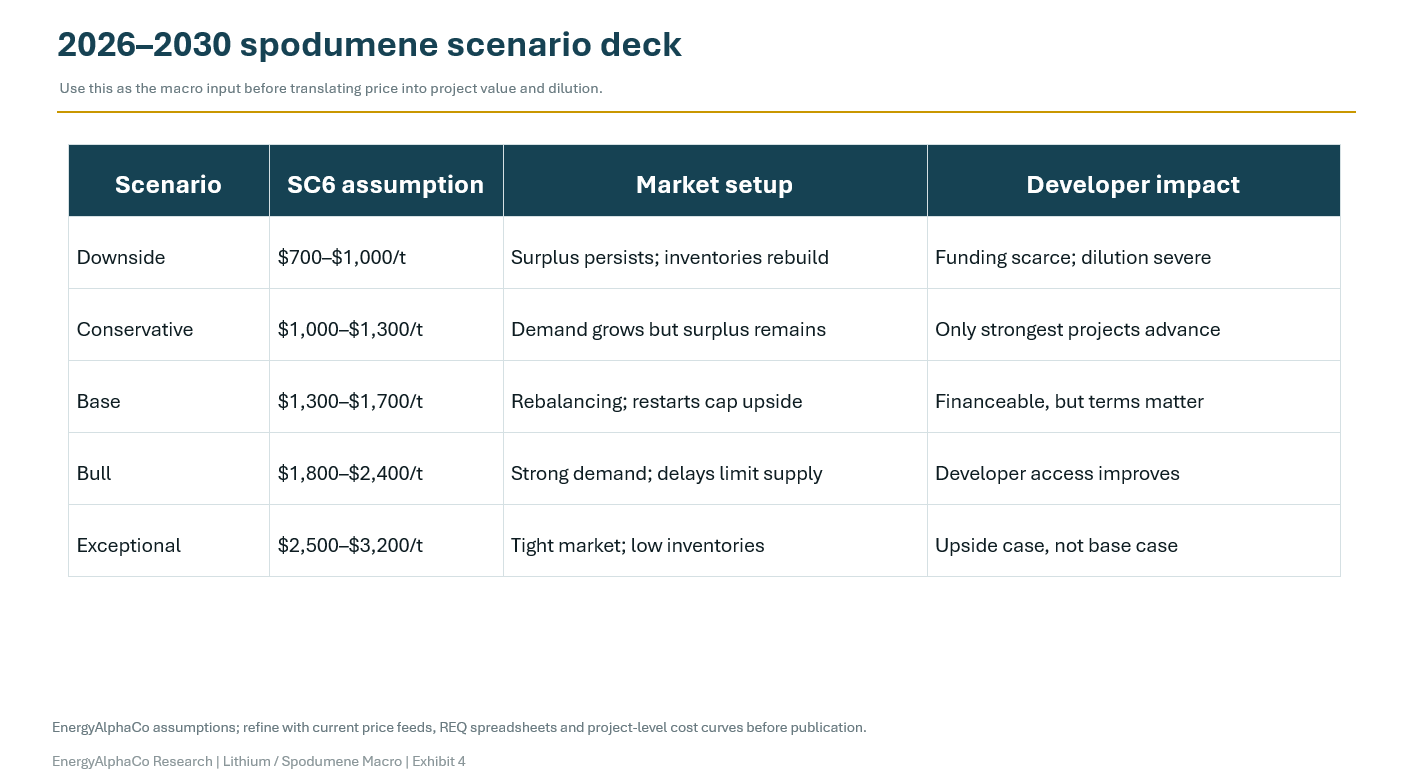
EnergyAlphaCo 2026-2030 price framework
EnergyAlphaCo should not publish one deterministic lithium price forecast. The better approach is a scenario deck. The following ranges are working assumptions for equity modeling and must be refined against licensed price data, updated government forecasts, producer realized prices and project-level cost curves before publication updates.
What the lithium reset means for development-stage companies
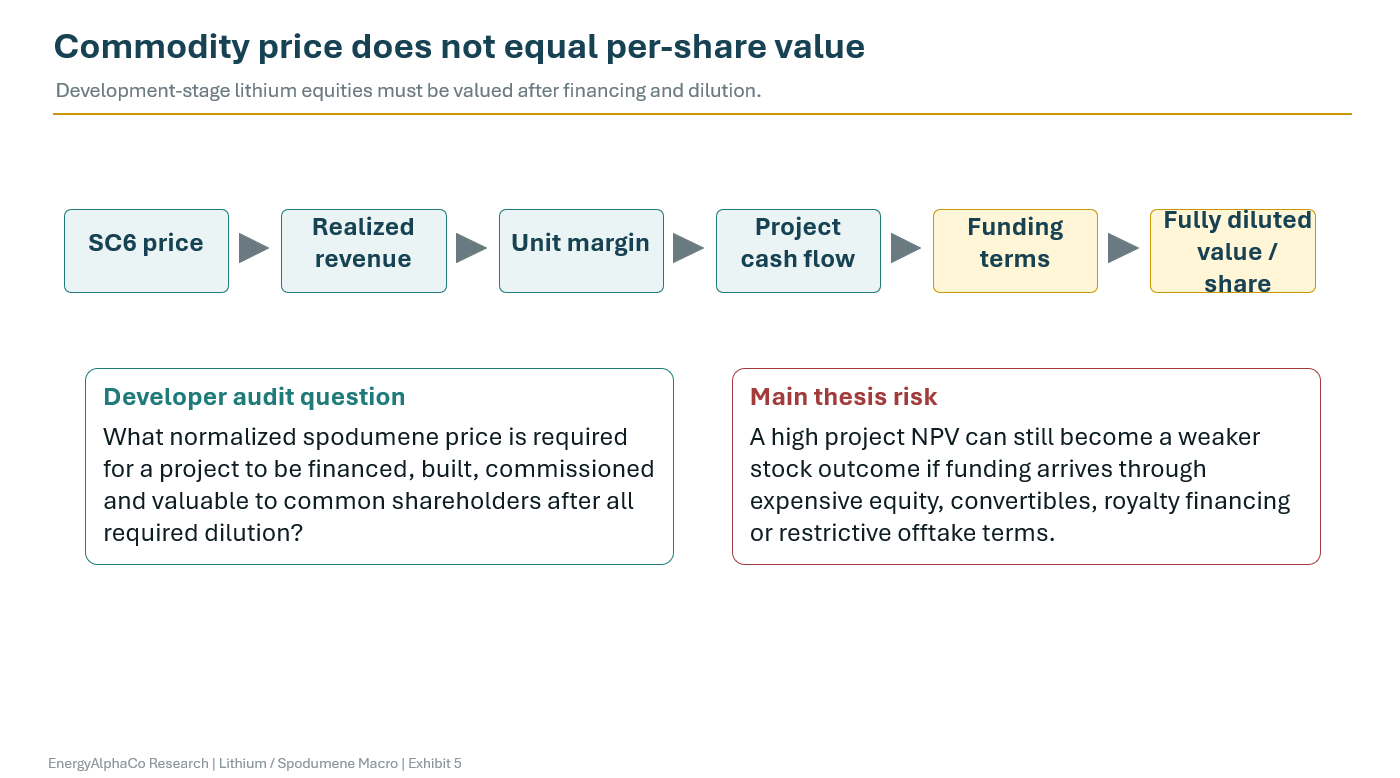
Development-stage lithium equities are leveraged not merely to the commodity price, but to the relationship between commodity price and the project’s financing requirement. A rising spodumene price can improve project economics without creating equivalent value for existing shareholders. The outcome depends on when financing is secured, how much equity must be issued, whether capital costs have risen, and how much of the project economics remain with common shareholders after offtake, royalty, debt or strategic-investor claims.
The analytical chain is straightforward but often skipped: spodumene price to realized revenue; realized revenue to unit margin; unit margin to project cash flow; project cash flow to project value; project value to financing availability; financing availability to funding terms; funding terms to dilution; and dilution to fully diluted value per share.
Developers should therefore be grouped by funding quality rather than only by resource size. Fully funded projects under construction deserve a different risk treatment than permitted but unfunded projects. Partially funded projects with credible strategic support deserve a different treatment than exploration-stage optionality. A company with the greatest percentage price sensitivity may not have the best risk-adjusted equity outcome if it cannot finance the project without surrendering too much upside.
What must be true for the constructive lithium thesis
The constructive thesis requires several things to be true at the same time. EV demand must continue growing despite policy volatility and affordability concerns. Stationary storage must keep absorbing battery supply. Inventories must normalize rather than rebuild into another overhang. High-cost producers must remain disciplined. Marginal projects must be delayed or cancelled rather than all arriving into the same window. Capital markets must fund attractive projects, but not so aggressively that a new surplus is recreated.
That is a demanding list. It does not invalidate the thesis, but it argues for scenario analysis rather than a single bullish forecast.
What investors should monitor
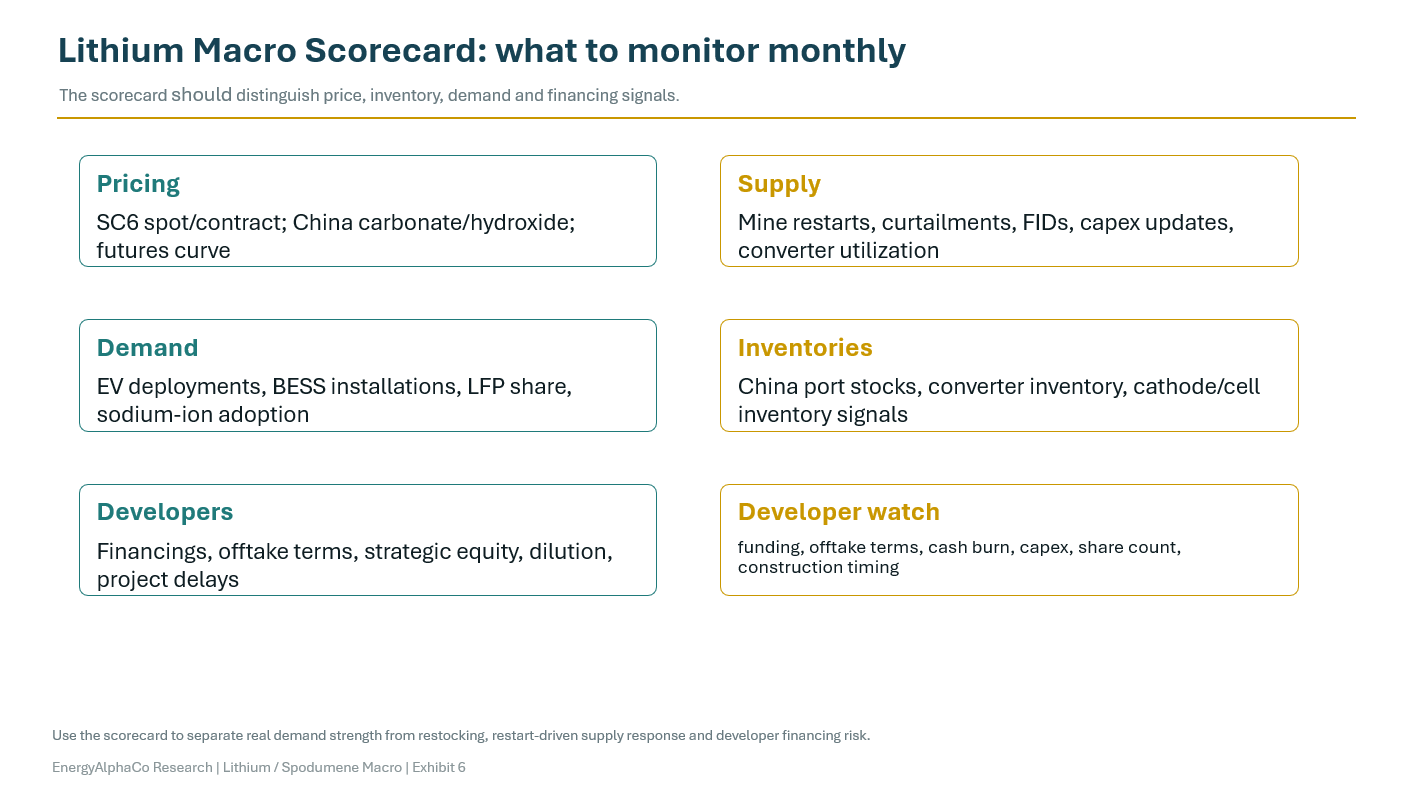
The Lithium Macro Scorecard should monitor twelve items: Fastmarkets SC6 spot and contract prices; China carbonate and hydroxide prices; SC6 futures curves; producer realized prices; China port and converter inventories; EV and storage deployments; LFP and sodium-ion adoption; mine restarts and curtailments; converter utilization; project FIDs; developer financings; and capex revisions.
The most important tell will not be price alone. It will be the combination of price, inventory and supply response. A rising price with falling inventories and limited restarts is bullish. A rising price with accelerating restarts and inventory rebuilding is less bullish. A falling price with project cancellations and investment cuts can be the beginning of the next recovery setup.
Thesis breakers
The macro thesis weakens if supply growth consistently exceeds demand growth, if Chinese swing supply restarts faster than expected, if African and Brazilian projects ramp without delays, if sodium-ion gains large share in stationary storage, if global EV growth slows materially, or if inventory rebuilding is mistaken for sustainable end demand.
For development-stage equities, additional breakers include inability to secure construction funding, materially worse offtake terms, capex escalation, production delays, disappointing grade or recovery, excessive equity issuance, or a sustained spodumene price environment below the level required to finance new capacity on reasonable terms.
Final assessment
Lithium remains a structurally important mineral with credible long-term demand support from EVs, grid storage and battery supply-chain growth. But the last cycle showed that commodity demand growth does not guarantee equity returns. Timing, cost position, balance-sheet strength, financing structure and dilution matter as much as the commodity thesis.
The best lithium equities in the next cycle are unlikely to be the most promotional or the most levered to a heroic price forecast. They will be the companies that can operate or build through volatility, finance projects without surrendering too much of the upside, and preserve fully diluted per-share value when the cycle turns.
For EnergyAlphaCo, the lithium macro framework should serve one purpose: to prevent a project-level thesis from leaning on an unrealistic price deck. Future Thesis Audits can apply this framework to individual lithium producers and development-stage projects, testing project economics, financing requirements and fully diluted per-share value under the commodity scenarios established here.
Sources used and verification notes
· Australian Government Department of Industry, Science and Resources, Resources and Energy Quarterly: June 2026: lithium export earnings, mine-output growth, demand/supply growth and balance expectations.
S&P Global Commodity Insights: 2026 chemical surplus estimate, consumption and supply growth, energy-storage demand, and supply-response commentary.
IEA, Global EV Outlook 2026 and Global Critical Minerals Outlook 2026: EV battery deployment, LFP penetration, battery-storage role, battery prices, capital spending and critical-minerals supply risks.
USGS, Mineral Commodity Summaries 2026: world lithium mine production and consumption growth estimates.
Fastmarkets and CME Group spodumene benchmark materials: SC6 benchmark definitions, historical volatility and futures settlement mechanics.
Albemarle Q1 2026 results: lithium price scenario sensitivity and contract/pricing commentary.
Pilbara Minerals March quarter FY26 results and presentation: realized spodumene pricing, production and cash-balance context.
Mineral Resources Bald Hill restart release and Core Lithium Finniss restart materials: restart behavior, funding structures and supply-response evidence.
Investment-risk disclosure
This material is provided for informational and educational purposes only and does not constitute individualized investment advice, an offer to sell, or a solicitation to buy any security. Commodity prices, project economics, financing conditions and equity valuations are inherently uncertain and may change materially.
EnergyAlphaCo may discuss companies or securities in which the author has a financial interest. Any such interest will be disclosed when a specific security is the subject of an EnergyAlphaCo investment article or Thesis Audit. Readers should conduct their own due diligence and consider their financial circumstances and risk tolerance before making any investment decision.