
The Five Energy Signals That Mattered This Week
Week ended August 7, 2026
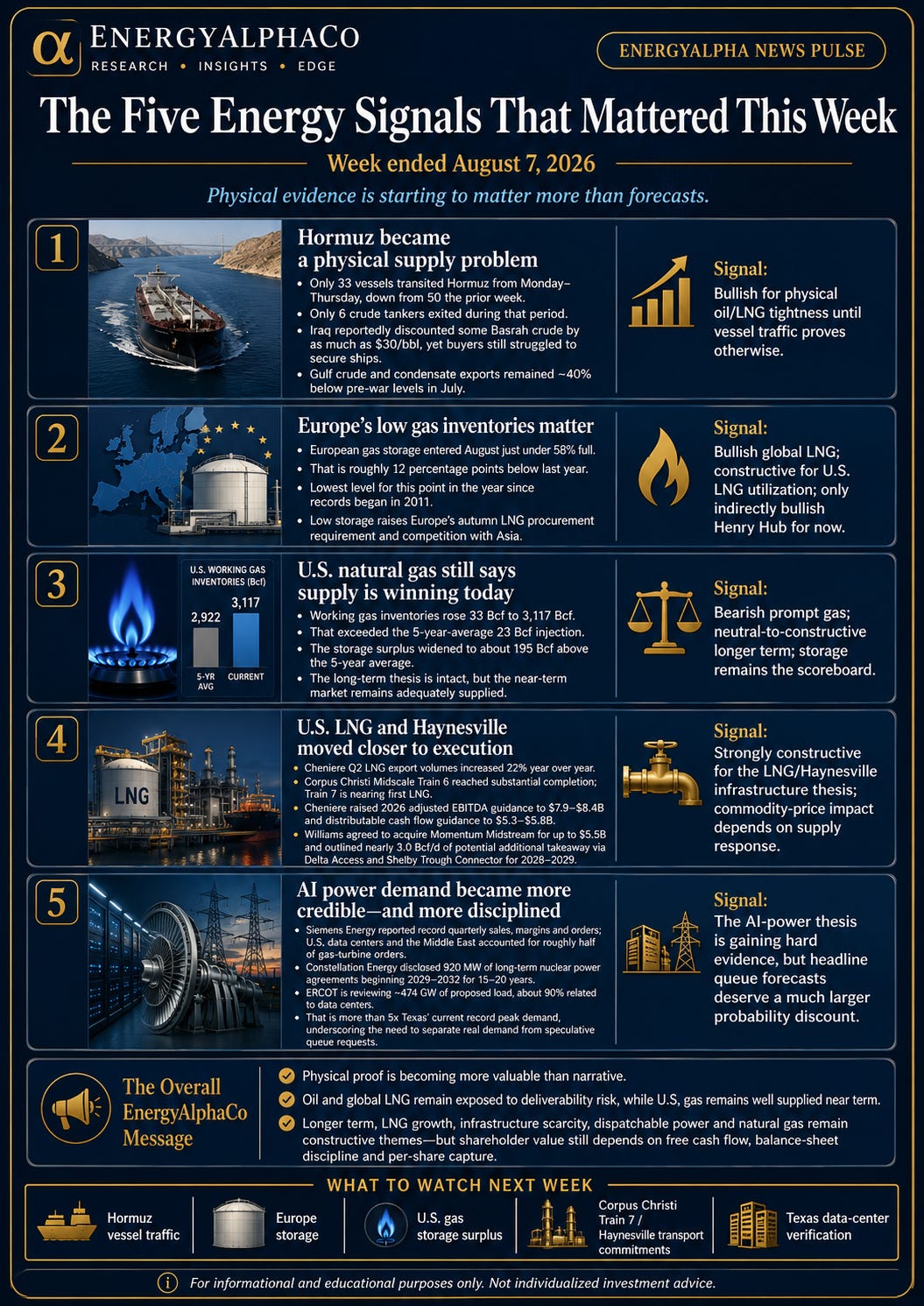
Physical evidence is starting to matter more than forecasts.
Energy investors had no shortage of headlines this week: geopolitics, LNG disruptions, data-center power demand, earnings, pipeline deals and another volatile stretch for oil and natural gas.
But five developments stood out because they moved beyond narrative and provided something more useful: measurable evidence.
Ships either moved through Hormuz or they did not. Gas either went into storage or it did not. LNG trains either produced cargoes or they did not. Pipelines, turbines and power contracts either attracted capital or remained conceptual.
That distinction matters.
This week’s overarching EnergyAlphaCo read is that several long-term energy theses are strengthening—but the near-term commodity signals remain far more mixed than the headlines suggest.
1. Hormuz became a physical supply problem, not just a geopolitical headline
What happened
Shipping traffic through the Strait of Hormuz deteriorated materially.
Only 33 vessels transited the strait from Monday through Thursday, down from 50 during the same period the prior week. Only six crude tankers exited during that period.
Perhaps the most revealing datapoint: Iraq reportedly offered discounts of as much as $30 per barrel on some Basrah crude, yet buyers still struggled to secure ships willing to enter the region because of security concerns.
Separately, Gulf crude and condensate exports remained roughly 40% below pre-war levels in July.
Why it matters
This exposes the difference between oil in the ground, oil available at a terminal and oil that can actually reach the buyer.
Cheap crude trapped behind a maritime bottleneck is not the same thing as abundant global supply.
The Thesis Audit chain is:
geopolitical risk
→ shipowner reluctance
→ fewer transits
→ stranded cargoes
→ lower effective exports
→ tighter delivered supply.
A $30 discount does not clear the market if the transportation link is broken.
EnergyAlphaCo read
The most important Hormuz metric is no longer political rhetoric.
It is physical export throughput.
The market can remove geopolitical risk premium quickly when negotiations improve. But sustainable normalization requires tanker traffic, LNG-carrier movements, insurance availability and Gulf exports to recover.
For now, they have not.
Signal: Bullish for physical oil/LNG tightness until vessel traffic proves otherwise.
2. Europe’s low gas inventories are creating a real winter LNG procurement problem
What happened
European gas storage entered August at just under 58% full, roughly 12 percentage points below last year and the lowest level for this point in the year since records began in 2011.
Europe has reduced its winter storage objective, but the region still faces a significant refill requirement at a time when Qatari LNG availability remains impaired and Asian buyers are competing for flexible cargoes.
Why it matters
Europe does not need to literally “run out of gas” for this to affect global LNG pricing.
It only needs to become the aggressive marginal buyer.
The chain is:
low storage
→ greater autumn procurement requirement
→ competition with Asia
→ higher LNG clearing prices
→ stronger U.S. LNG netbacks
→ maximum U.S. terminal utilization.
The risk becomes increasingly nonlinear as winter approaches. A storage level that is manageable under mild weather can become inadequate very quickly under a cold winter, Norwegian outages or continued Gulf LNG disruption.
EnergyAlphaCo read
This is supportive of the global LNG thesis, but investors should be careful about jumping directly from low European inventories to higher Henry Hub.
Europe first has to purchase the LNG.
U.S. terminals then have to physically liquefy and export it.
And incremental U.S. feedgas demand ultimately has to exceed domestic production growth before the Henry Hub balance tightens.
Signal: Bullish global LNG. Constructive for U.S. LNG utilization. Only indirectly bullish Henry Hub—for now.
3. The U.S. natural-gas market is still telling us: supply is winning today
What happened
The latest EIA report showed working gas inventories rising 33 Bcf to 3,117 Bcf.
That was larger than the five-year-average 23 Bcf injection and increased the surplus to approximately 195 Bcf above the five-year average.
The build occurred despite strong summer electricity demand.
Why it matters
This is an important counterweight to the increasingly bullish long-term natural-gas narrative.
We can simultaneously believe:
LNG demand will rise materially;
data centers will increase electricity consumption;
gas-fired generation will remain critical;
Haynesville infrastructure will expand;
and still conclude that the current U.S. gas market is adequately supplied.
The Thesis Audit chain for a durable gas re-rating remains:
new LNG + power demand
→ sustained feedgas/power burn
→ demand growth exceeds supply growth
→ below-normal storage builds
→ shrinking inventory surplus
→ stronger forward Henry Hub pricing.
We have not completed that chain.
EnergyAlphaCo read
The widening storage surplus is not a thesis breaker for the 2027–2029 natural-gas case.
It is a timing signal.
The long-term demand side continues to gain evidence. The near-term supply side—particularly Permian associated gas and resilient Lower-48 production—has not yet surrendered.
That makes the coming shoulder season particularly important.
If injections remain above normal after cooling demand fades, Henry Hub may stay under pressure longer than structural bulls expect.
Signal: Bearish prompt gas. Neutral-to-constructive longer term. The storage trajectory remains the scoreboard.
4. U.S. LNG and Haynesville infrastructure moved another step from forecast toward execution
What happened
Two developments reinforced each other.
First, Cheniere reported that second-quarter LNG export volumes increased 22% year over year, Corpus Christi Midscale Train 6 reached substantial completion, and Train 7 is approaching first LNG.
Cheniere raised 2026 adjusted EBITDA guidance to $7.9–$8.4 billion and distributable cash-flow guidance to $5.3–$5.8 billion.
Second, Williams agreed to acquire Momentum Midstream for up to $5.5 billion, substantially expanding its Haynesville gathering and transportation footprint. Williams also outlined the 2.25-Bcf/d Delta Access project and 750-MMcf/d Shelby Trough Connector—nearly 3 Bcf/d of potential additional takeaway targeted for 2028–2029.
Why it matters
This is where the natural-gas thesis becomes more investable.
The evidence chain is increasingly visible:
LNG construction
→ train commissioning
→ higher feedgas
→ more exported cargoes
while upstream:
future LNG/power demand
→ firm transportation needs
→ pipeline investment
→ additional Haynesville takeaway
→ greater required basin production.
Cheniere is demonstrating demand at the water’s edge.
Williams is preparing the infrastructure upstream.
EnergyAlphaCo read
This is constructive for the Haynesville and Gulf Coast LNG thesis—but it is also why we should avoid simplistic conclusions about gas prices.
Additional pipelines improve producer access.
They can also unlock more production.
The natural-gas bull case ultimately requires LNG and power demand to grow faster than the supply response those same pipelines enable.
That remains particularly important for Western Haynesville producers.
Pipeline capacity validates the corridor.
Well economics, transportation costs, basis differentials and a stronger forward Henry Hub strip determine whether producers capture the value.
Signal: Strongly constructive for the LNG/Haynesville infrastructure thesis. Commodity-price impact depends on supply response.
5. AI power demand became simultaneously more credible—and more disciplined
What happened
Three developments told different parts of the same story.
Siemens Energy reported record quarterly sales, margins and orders, with U.S. data centers and Middle East customers accounting for roughly half of its quarterly gas-turbine orders.
Constellation Energy disclosed another 920 MW of long-term nuclear power agreements with investment-grade customers, beginning between 2029 and 2032 and extending for 15–20 years.
At the same time, Texas ordered ERCOT to audit data-center projects seeking grid connections. ERCOT is currently reviewing approximately 474 GW of proposed load, about 90% related to data centers—and more than five times Texas’ current record peak demand. ERCOT postponed its Batch Zero transmission-planning study while the audit proceeds.
Why it matters
At first glance, these developments appear contradictory.
They are not.
They are helping distinguish real demand from speculative demand.
The AI-power evidence hierarchy now looks something like:
data-center announcement
→ interconnection request
→ verified tenant and financing
→ long-term power agreement
→ turbine/equipment order
→ transmission and fuel contracts
→ construction
→ energized load.
Texas is challenging the earliest and weakest part of the chain.
Siemens and Constellation are producing evidence farther down it.
EnergyAlphaCo read
This may ultimately make the AI-power thesis stronger.
If Texas removes speculative or duplicated requests from the queue, the headline megawatt number will fall—but the remaining projects should become more credible.
Meanwhile, turbine manufacturers and existing nuclear operators are already seeing orders and contracts.
That tells us some portion of the demand is absolutely real.
The investable question is shifting from:
“How many gigawatts are in the queue?”
to:
“Which gigawatts already have capital, equipment, generation and fuel attached?”
That is a much better question.
Signal: The AI-power thesis is gaining hard evidence, but headline queue forecasts deserve a much larger probability discount.
The Overall EnergyAlphaCo Message
This week reinforced one principle across almost every energy market:
Physical proof is becoming more valuable than narrative.
In oil, the proof is tanker traffic.
In LNG, it is storage, cargoes and feedgas.
In U.S. natural gas, it is weekly inventory builds.
In Haynesville, it is contracted pipeline capacity.
In AI power, it is turbines, PPAs and projects that survive regulatory verification.
And that produces an interesting market setup.
Near term
The U.S. natural-gas market remains well supplied.
Oil and global LNG remain exposed to severe physical-deliverability risks.
Europe enters the final portion of refill season with an unusually weak gas-storage buffer.
Longer term
The infrastructure needed for LNG exports and electricity demand is increasingly moving from PowerPoint slides into capital commitments.
That is constructive for:
Gulf Coast LNG infrastructure;
Haynesville and other scalable dry-gas resources;
midstream assets;
operating nuclear generation;
gas turbines and grid equipment;
and dispatchable generation.
But the equity lesson remains the same.
Industry growth does not automatically create shareholder value.
Each company still has to translate demand into:
free cash flow
→ lower net debt
→ controlled dilution
→ disciplined capital allocation
→ higher value per fully diluted share.
That is where the Thesis Audit begins.
What to Watch Next Week
The highest-value signals are increasingly clear.
Hormuz: Does vessel traffic recover, and do Gulf crude and Qatar LNG exports actually increase?
Europe: Does the storage deficit begin closing—or does Europe have to bid LNG prices higher to accelerate injections?
U.S. natural gas: Does the 195-Bcf storage surplus start contracting before shoulder season, or does production keep winning?
LNG/Haynesville: Does Corpus Christi Train 7 reach first LNG, and what additional firm transportation commitments emerge from the expanding Haynesville-to-Gulf Coast network?
AI power: Which data-center projects survive Texas’ verification process, and which projects move into binding PPAs, turbine orders, pipeline contracts and actual construction?
Those datapoints will tell us considerably more than another week of headlines.
Final Assessment
The week was broadly supportive of EnergyAlphaCo’s longer-term themes—LNG growth, infrastructure scarcity, dispatchable power and the rising strategic value of natural gas.
But the current U.S. gas balance remains the important check against getting too far ahead of the evidence.
The long-term thesis is gaining confirmation.
The near-term commodity market is still demanding patience.
That tension may be one of the most important energy setups to follow through the remainder of 2026.
Sources: U.S. Energy Information Administration; Cheniere Energy; Reuters reporting and shipping data; Williams; Siemens Energy; Constellation Energy; European gas-storage data cited by Reuters.