
Short-Term AI Fear, Long-Term Compute Scarcity
What the AI bottleneck means for power demand, natural gas, LNG, grid infrastructure and energy investors

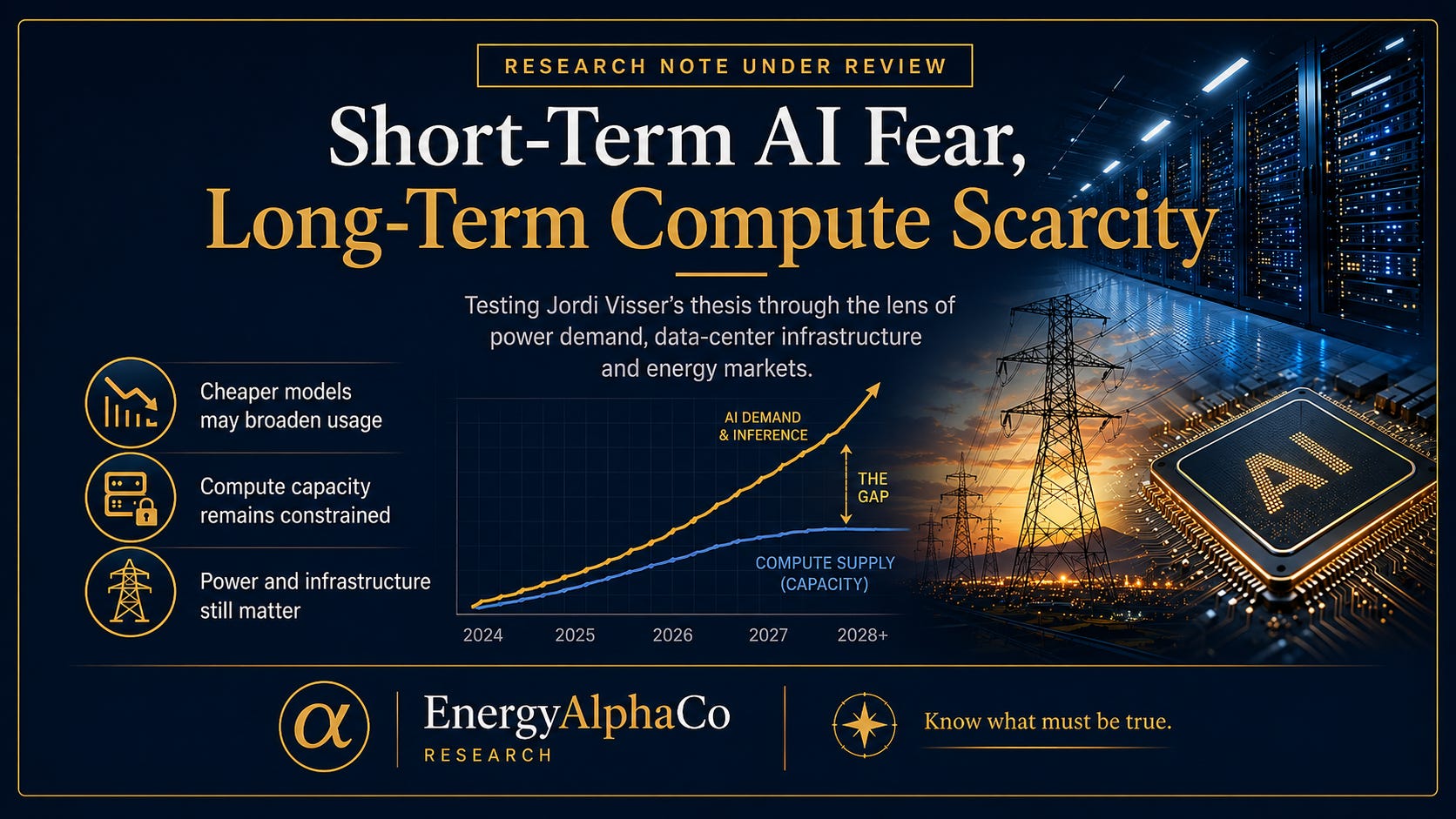
Investment conclusion: The transcript’s strongest insight is not simply that AI is growing. It is that cheaper intelligence may increase total usage while the physical systems required to deliver that intelligence - chips, networking, data centers, cooling, grid interconnections, firm power and fuel - remain slow, capital-intensive and location-specific. For EnergyAlphaCo, the edge is translating compute scarcity into power demand, gas burn, LNG competition, grid infrastructure and per-share equity outcomes.
The edge is not “AI is big.” The edge is that compute demand requires physical power, and physical power requires fuel, infrastructure, permitting, capital and time.
Source note: This article reviews Jordi Visser’s video/transcript, “Short-Term AI Fear, Long-Term Compute Scarcity,” as a third-party thesis. EnergyAlphaCo has not reproduced proprietary charts or long excerpts. The analysis below is original and independently frames the energy-market implications.
The thesis under review
This Research Note Under Review examines the central argument presented by Jordi Visser in his July 2026 video, “Short-Term AI Fear, Long-Term Compute Scarcity.” Visser heads AI Macro Nexus Research for 22V Research, which describes the product as a framework for investors to evaluate the intertwined dynamics of AI-driven innovation and economic transformation. [1]
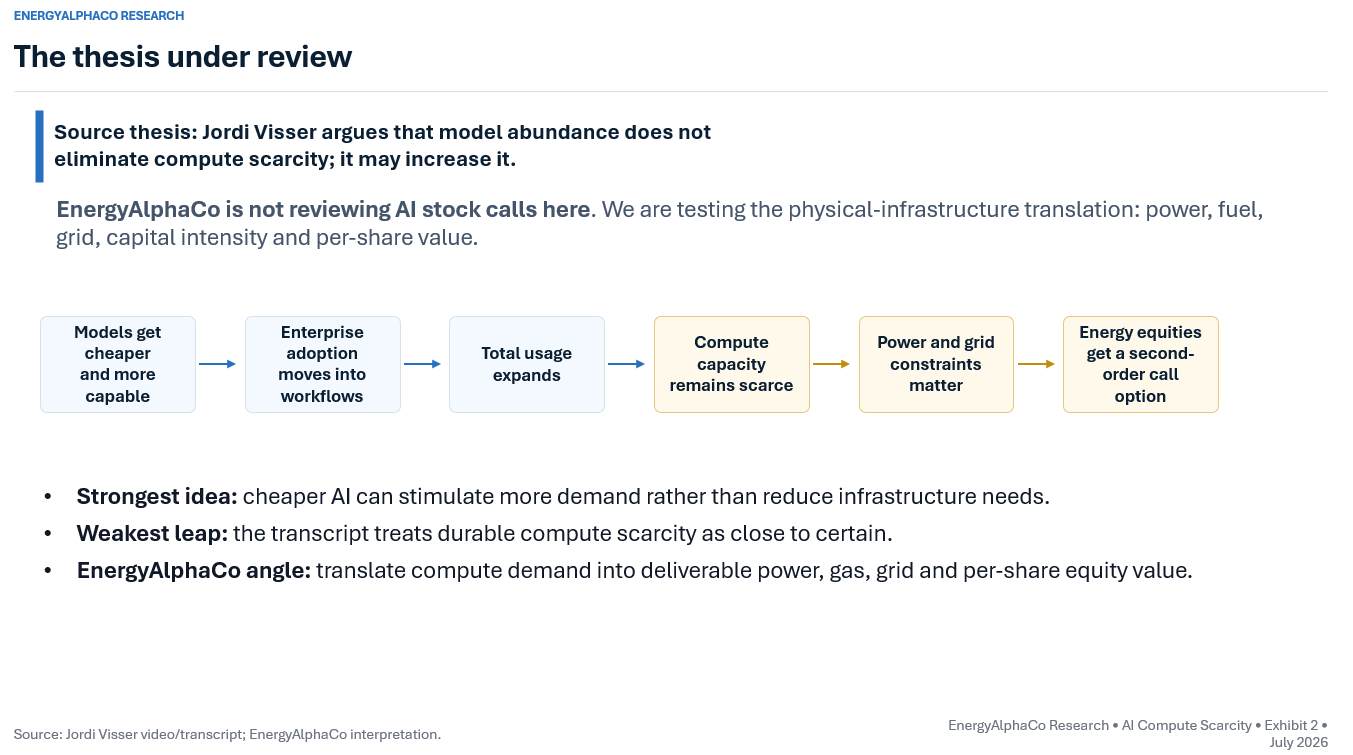
The article is not a review of Visser’s AI-equity recommendations. EnergyAlphaCo is using the transcript to identify the core thesis and then independently testing the physical-infrastructure translation: power demand, natural gas demand, LNG interaction, grid constraints, utilities, data centers, nuclear and energy-related equities.
The thesis under review can be summarized this way: AI models are becoming more capable, cheaper and more abundant, but the physical capacity required to run them at scale remains scarce. If lower model costs lead to more usage, then efficiency gains may not reduce total infrastructure demand. They may broaden it.
Why the argument matters for energy investors
Energy investors do not need another generic essay explaining that artificial intelligence is important. The investable question is narrower and more physical: where does incremental AI usage become real electric load, and which public companies can convert that load growth into free cash flow per share?
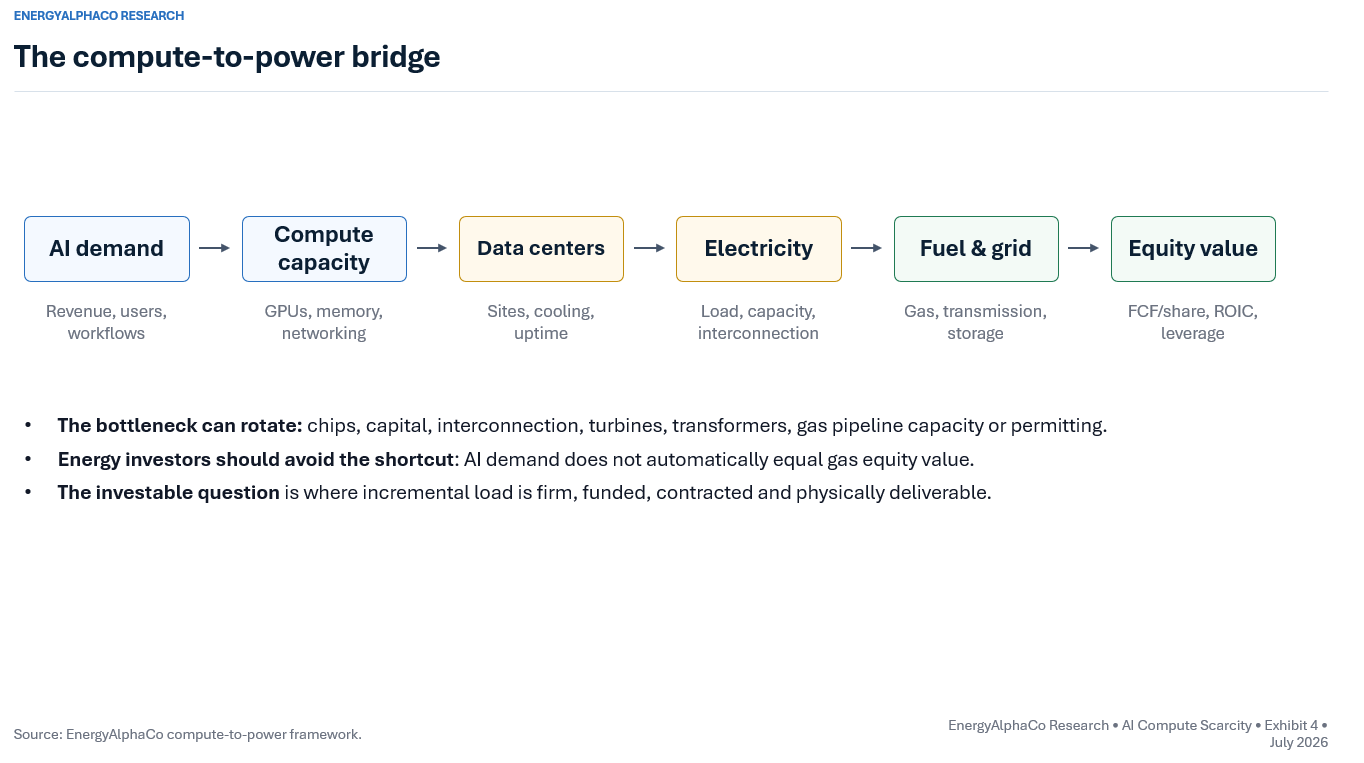
The compute-to-power chain has several links: AI demand must become paid usage; paid usage must require additional training or inference capacity; that capacity must be installed in data centers; those data centers must obtain sites, cooling, transformers and interconnection; the grid must supply reliable electricity; and, in many regions, firm generation must be supported by natural gas, nuclear, storage, transmission or other infrastructure.
If any link breaks, the broad AI narrative may still be true while the energy-equity thesis disappoints. This is why the article should be framed as a Thesis Audit rather than a thematic endorsement.
What the video gets right
1. The physical layer is harder to scale than software
The strongest part of the argument is the distinction between software abundance and physical scarcity. Models can be copied, fine-tuned, routed and distributed quickly. Power plants, transmission lines, substations, transformers, turbines, pipelines, data-center shells and cooling systems cannot be deployed at software speed.
This is not just a conceptual point. The IEA notes that a data center can be operational in two to three years, while the broader energy system often requires longer lead times, extensive planning, long build times and high upfront investment. The IEA also projects global data-center electricity consumption to double to roughly 945 TWh by 2030 in its base case. [2]
2. Efficiency can stimulate demand rather than destroy it
Visser’s argument uses a Jevons-paradox framework: when the cost of intelligence falls, users consume more of it. That is plausible. Cheaper inference, better routing and more efficient models may lower the unit cost of tasks while expanding the total number of tasks performed.
This matters for energy because investors often assume that efficiency improvements will offset load growth. That may happen in some use cases. But if falling AI costs unlock enterprise workflows, video generation, robotics, consumer agents and persistent memory, total electricity demand can still rise even as energy per task falls.
3. Backlog and capex are evidence, but not proof
Alphabet’s Q2 2026 results provide a useful example of the debate. Alphabet reported consolidated revenue growth of 24% to $119.8 billion, while Google Cloud revenue rose 82% to $24.8 billion. [3] Its Form 10-Q also disclosed $519.5 billion of remaining performance obligations, of which $513.9 billion related to Google Cloud. [4]
At the same time, Alphabet reported $39.1 billion of operating cash flow and $44.9 billion of capital expenditures in the quarter, producing negative free cash flow. [5] The data support Visser’s claim that demand is real and capex is being pulled forward. They do not, by themselves, prove that every dollar of incremental AI infrastructure spending will earn an attractive return.
What requires verification
The transcript is useful because it defines a debate. It is not sufficient as an evidentiary base. EnergyAlphaCo should verify every material claim through filings, grid data, utility forecasts, market data and project-level disclosures.
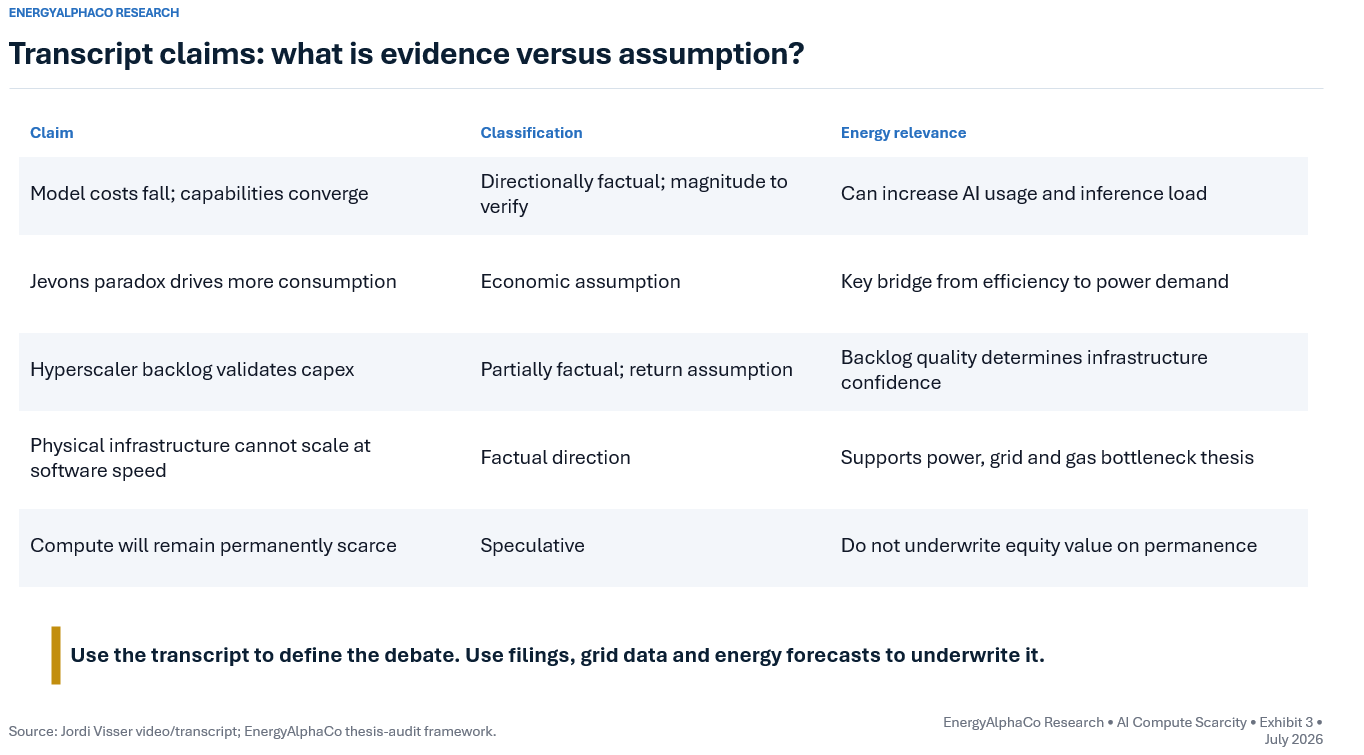
The most important skepticism is that the bottleneck can rotate. At one point it may be GPUs. At another it may be HBM memory, optical networking, transformer availability, power interconnection, turbine lead times, water, local opposition, financing or customer credit. Power is increasingly important, but it is not always the only constraint.
The compute-to-power bridge
The EnergyAlphaCo framework should translate compute demand in the following sequence:
1. AI services attract paying demand.
2. Those services create sustained training and inference workloads.
3. Workloads require additional servers, memory, networking and storage.
4. That equipment is installed in data centers with cooling, uptime and interconnection requirements.
5. Electric load rises at specific grid nodes.
6. Utilities, independent power producers, gas suppliers, midstream companies and equipment providers respond.
7. Equity value is created only if the capital deployed earns adequate returns after leverage, dilution and execution risk.
The thesis is strongest at the conceptual level and weaker at the project level. Many data-center announcements will not become energized load. Some projects will be delayed, resized or canceled. Others may be supplied by onsite generation, renewable PPAs, nuclear restarts, storage, demand response or locations with existing surplus capacity.
That means the investable question is not “how much AI demand exists?” The investable question is: where is incremental load firm, funded, contracted, physically deliverable and profitable for public equity holders?
Natural gas, LNG and grid implications
Natural gas: practical bridge, not guaranteed winner
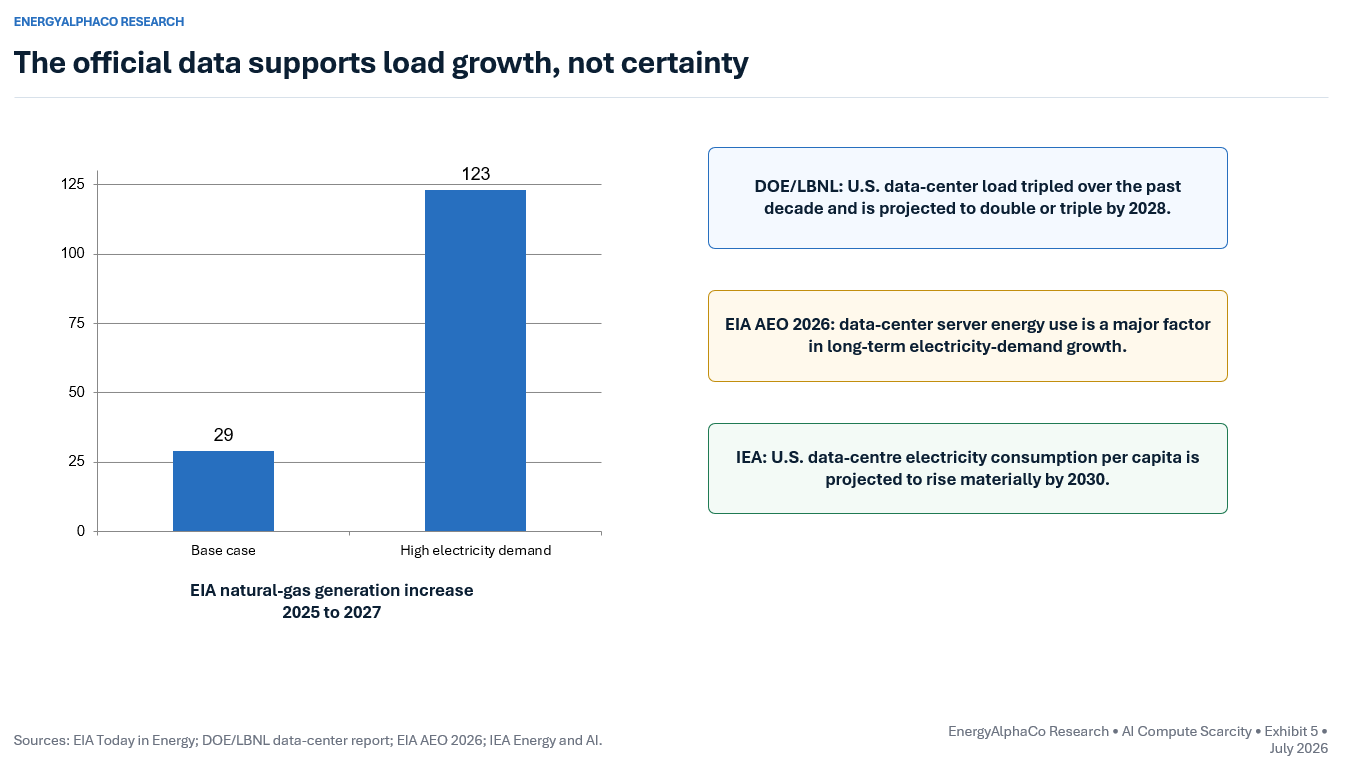
Natural gas is the practical near-term beneficiary of AI-driven power demand because it is dispatchable, familiar to utilities and developers, and already the largest source of U.S. electricity generation. EIA’s March 2026 analysis modeled faster-than-expected data-center power demand and concluded that the incremental generation would primarily come from increased utilization of natural-gas-fired plants under its high-demand scenario. [6]
In EIA’s February 2026 base case, U.S. natural-gas generation rises by 29 BkWh between 2025 and 2027. Under EIA’s high-electricity-demand scenario, the increase rises to 123 BkWh. ERCOT is the largest driver: EIA estimates ERCOT gas generation increases by 105 BkWh in the high-demand scenario versus 68 BkWh in the base case. [6]
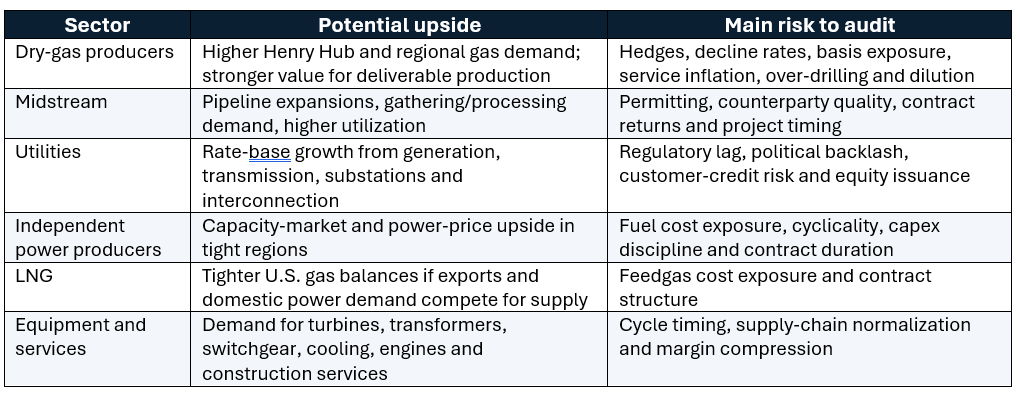
This is constructive for gas, but it is not automatically constructive for every gas producer. Equity outcomes depend on basis exposure, inventory quality, decline rates, well costs, hedges, gathering and transportation commitments, balance-sheet strength and capital discipline. A producer can benefit from a higher commodity price and still fail to create per-share value if it overcapitalizes growth or issues equity at the wrong time.
LNG: indirect but important
AI data centers do not create LNG export demand directly. The link is domestic competition for U.S. gas supply. If LNG exports rise while AI-related power demand also rises, Henry Hub balances tighten unless production, storage, pipeline capacity and associated gas supply respond adequately.
That can support U.S. gas prices and raise the value of deliverable supply, but LNG equity impacts are mixed. A tolling model, a commodity-exposed model and an integrated upstream-LNG model will respond differently. Contract structure matters more than the headline theme.
Grid and utilities: location matters more than national totals
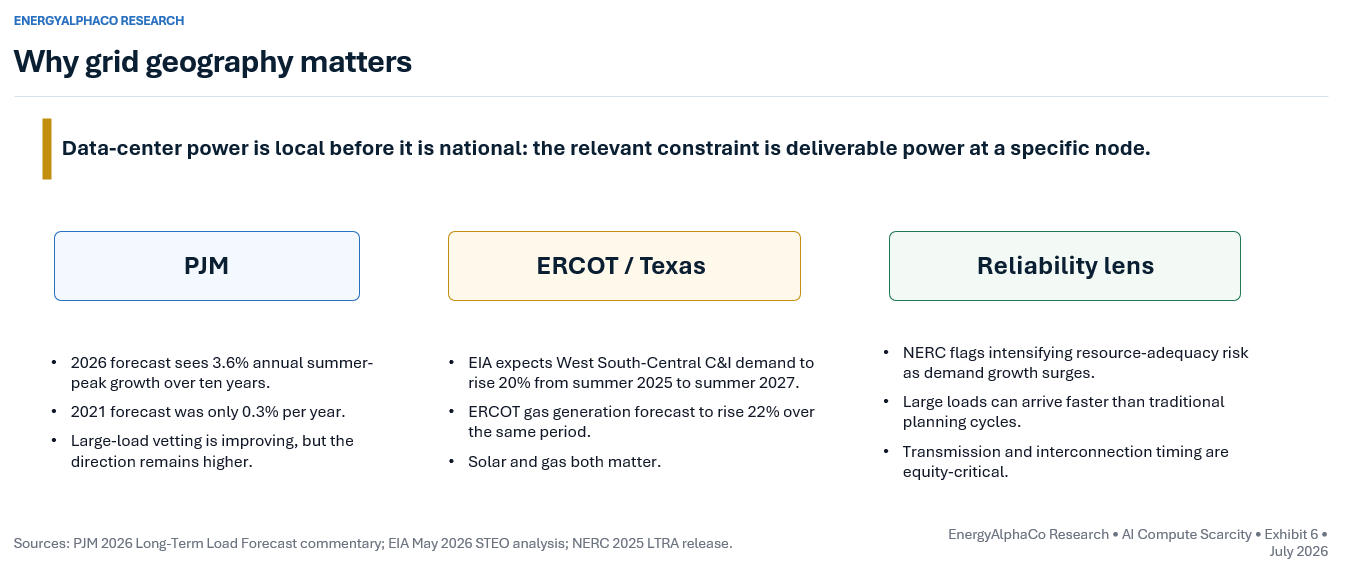
Data-center load is local before it is national. The IEA makes the same point: despite strong data-center growth, the challenge is often local concentration rather than the global share of electricity demand. [2]
PJM’s 2026 long-term forecast is one clear example. PJM expects summer peak load growth of 3.6% per year over the next ten years, compared with only 0.3% per year in its 2021 forecast. PJM explicitly identifies growth in data-center load across multiple zones as a major input to the forecast. [7]
NERC’s 2025 Long-Term Reliability Assessment provides the reliability lens. It states that North American summer peak demand is forecast to rise by more than 224 GW over the ten-year assessment period, 69% higher than the prior year’s 10-year growth projection. NERC also says new data centers for AI and the digital economy account for most of the projected increase in North American electricity demand over the next decade. [8]
For utilities, the opportunity is not just load growth. It is rate-base growth through generation, transmission, substations, interconnections, storage, distribution upgrades and grid-hardening. But the risk is that utilities spend capital for speculative load, face regulatory lag, issue equity, or fail to protect ordinary ratepayers through customer contributions and minimum-demand commitments.
Nuclear and microreactors: future solution or proof of scarcity?
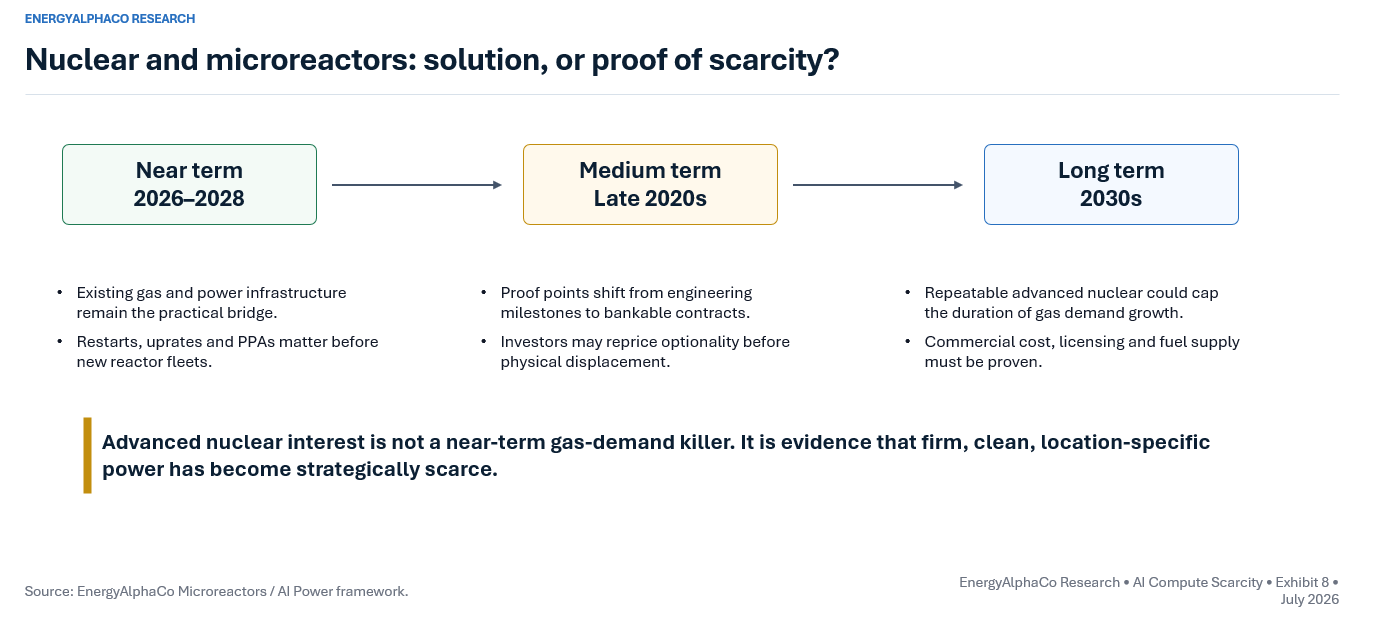
Advanced nuclear interest should not be treated as an immediate bearish signal for gas. It is better understood as proof that large technology customers are searching for firm, location-specific power that can support long-duration compute needs.
Existing nuclear plants, uprates, restarts and long-term power-purchase agreements can matter sooner than new reactor fleets. Small modular reactors and microreactors may become more important in the 2030s, but licensing, fuel supply, manufacturing repeatability, delivered cost and bankable contracts still need to be proven.
For gas equities, the nuclear risk is more likely a terminal-value risk than a near-term volume risk. If advanced nuclear becomes repeatable, investors may shorten the duration they assign to AI-driven gas demand. But until then, nuclear interest reinforces the core scarcity point: the market is looking for firm power because firm power is scarce.
Commodity-to-equity implications
The likely beneficiaries are not simply companies labeled as “AI power” winners. EnergyAlphaCo should evaluate each sector based on free cash flow per diluted share, balance-sheet trajectory, capital intensity and the degree to which incremental load is contracted and deliverable.
What must be true
The AI compute-scarcity thesis becomes an energy-investment thesis only if several conditions hold simultaneously:
AI usage must become economically productive and paid, not merely experimental.
Hyperscaler backlog and RPO must convert into durable revenue and cash flow.
Incremental servers must be installed in data centers that actually receive power.
The relevant grids must require incremental firm capacity rather than absorbing demand through existing surplus or efficiency.
Natural gas must capture a meaningful portion of the firm-power need in key regions.
Infrastructure providers must secure contracts that produce attractive returns on invested capital.
Equity holders must benefit on a fully diluted per-share basis after leverage and issuance.
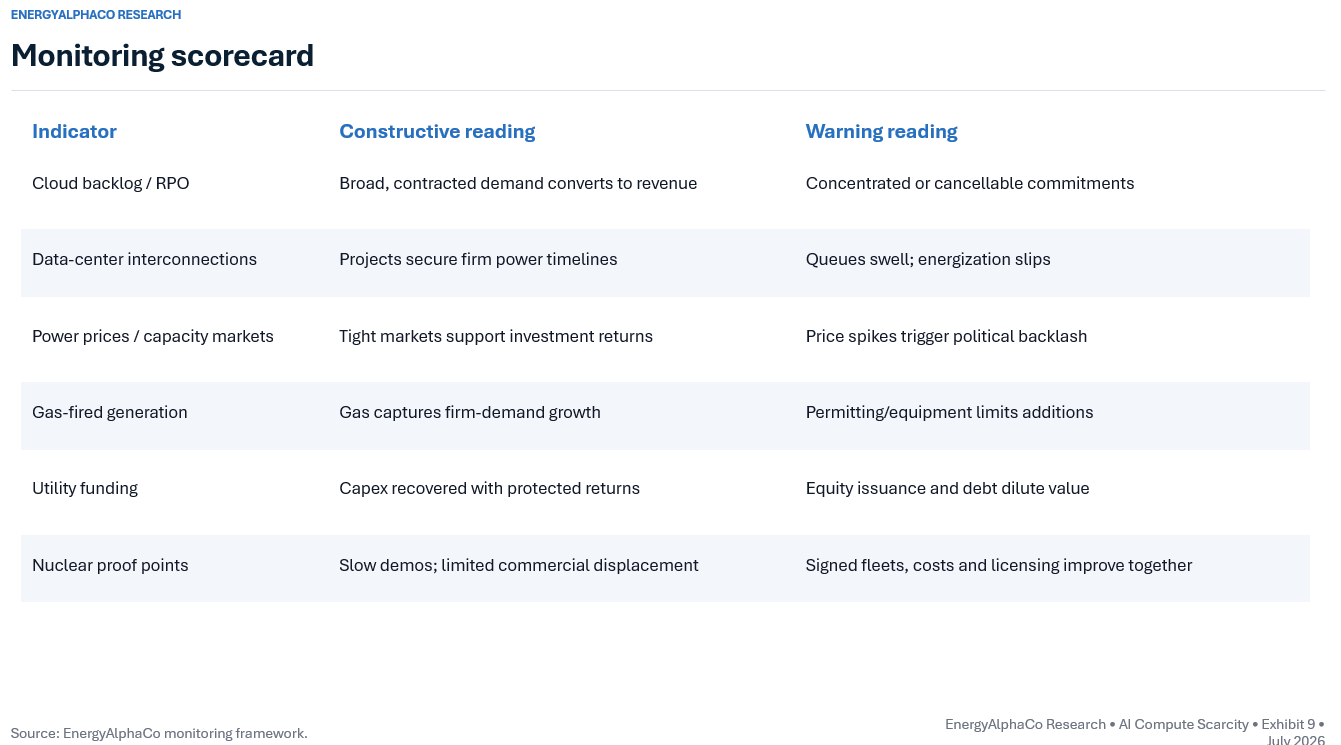
What investors should monitor
Thesis breakers
The thesis would weaken if AI monetization disappoints, backlog fails to convert, efficiency gains overwhelm usage growth, capital markets stop funding the buildout, data-center queues prove speculative, gas infrastructure cannot be permitted, utilities fail to earn adequate returns, or nuclear/storage solutions scale faster than expected.
The most important thesis breaker for energy investors is not an AI-stock correction. It is evidence that compute demand can grow without requiring materially more deliverable firm power in the regions where public energy companies have investable exposure.
Final assessment
The video gets the big conceptual point broadly right: software intelligence can become abundant while physical compute infrastructure remains scarce. That is a legitimate energy-market research question.
Where EnergyAlphaCo should remain skeptical is certainty. “Compute scarcity” is not one bottleneck. It is a stack of bottlenecks that can move among chips, memory, networking, land, interconnection, equipment, fuel, financing and customer credit. The strongest EnergyAlphaCo article will not argue that AI guarantees higher gas prices. It will show what must happen for AI demand to become power demand, and what must happen for power demand to become per-share value in energy equities.
Bottom line: AI compute scarcity may create a durable call on firm power. Natural gas is positioned to serve part of that need first, while grid infrastructure, utilities, equipment providers and existing nuclear assets also matter. The winners will be determined by location, contracts, balance sheets and per-share capital discipline - not by AI headlines alone.
Sources
1. 22V Research, Jordi Visser biography: https://22vresearch.com/team-member/jordi-visser/
2. International Energy Agency, Energy and AI - Energy demand from AI: https://www.iea.org/reports/energy-and-ai/energy-demand-from-ai
3. Alphabet Inc., Exhibit 99.1, Q2 2026 Results, July 22, 2026: https://www.sec.gov/Archives/edgar/data/1652044/000165204426000066/googexhibit991q22026.htm
4. Alphabet Inc., Form 10-Q for the quarter ended June 30, 2026: https://www.sec.gov/Archives/edgar/data/1652044/000165204426000071/goog-20260630.htm
5. Alphabet Inc., Exhibit 99.1, free-cash-flow reconciliation, Q2 2026: https://www.sec.gov/Archives/edgar/data/1652044/000165204426000066/googexhibit991q22026.htm
6. U.S. Energy Information Administration, “Fossil generation could rise with faster-than-expected growth in data center power demand,” March 12, 2026: https://www.eia.gov/todayinenergy/detail.php?id=67344
7. PJM Inside Lines, “PJM’s Updated 20-Year Forecast Continues To See Significant Long-Term Load Growth,” January 14, 2026: https://insidelines.pjm.com/pjms-updated-20-year-forecast-continues-to-see-significant-long-term-load-growth/
8. North American Electric Reliability Corporation, 2025 Long-Term Reliability Assessment: https://www.nerc.com/globalassets/our-work/assessments/nerc_ltra_2025.pdf
9. U.S. Department of Energy / Lawrence Berkeley National Laboratory, 2024 Report on U.S. Data Center Energy Use: https://www.energy.gov/articles/doe-releases-new-report-evaluating-increase-electricity-demand-data-centers
10. Jordi Visser, “Short-Term AI Fear, Long-Term Compute Scarcity,” YouTube video/transcript, July 2026:
Investment-risk disclosure
This material is for informational and educational purposes only and does not constitute individualized investment advice or a recommendation to buy, sell or hold any security. EnergyAlphaCo may discuss securities in which the author has a financial interest. When applicable, ownership will be disclosed in the relevant article. All estimates and interpretations are subject to change as new filings, company disclosures, commodity data and market prices become available.
This article evaluates a third-party investment thesis originally presented by Jordi Visser. The discussion reflects EnergyAlphaCo’s independent interpretation and verification work. No affiliation with or endorsement by Jordi Visser, AI Macro Nexus or 22V Research is implied. No proprietary charts or research materials have been reproduced.