
RTB Digital: The Merger Changed the Name - Not the Burden of Proof
The first combined filing shows very little operating scale, low-quality liquidity, aggressive capital allocation and a capitalization that is far more diluted than a simple quote-screen market value
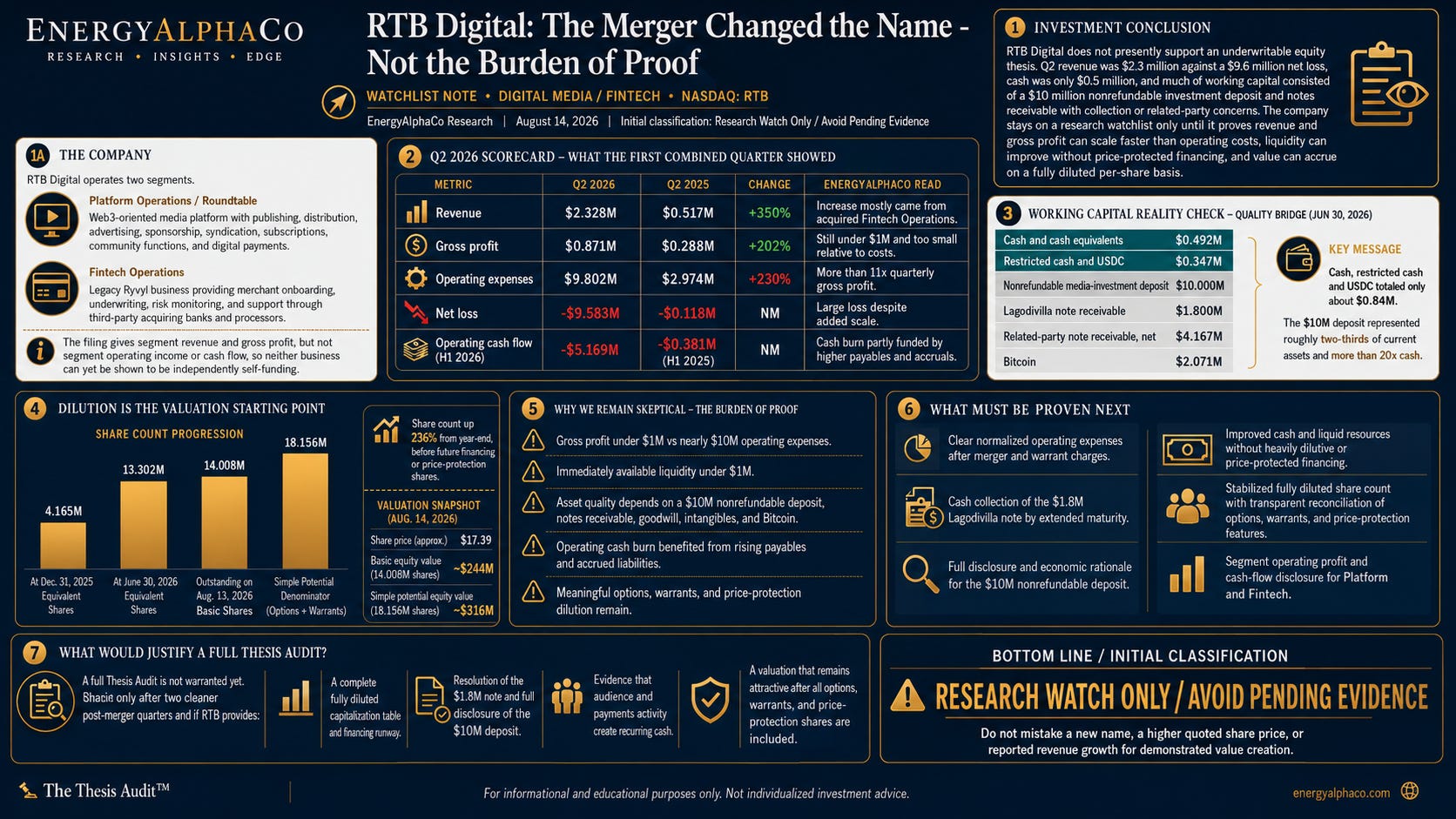
Initial classification: Research Watch Only / Avoid Pending Evidence
INVESTMENT CONCLUSION RTB Digital does not presently support an underwritable equity thesis. Q2 revenue was $2.3 million against a $9.6 million net loss, cash was only $0.5 million, and much of reported working capital consisted of a $10 million nonrefundable investment deposit and notes receivable with collection or related-party concerns. The renamed company should remain on a research watchlist only until it proves that revenue and gross profit can scale faster than operating costs, liquidity can improve without price-protected financing, and value can accrue on a fully diluted per-share basis.
Why RTB is on the watchlist
RTB Digital is on this watchlist because the merger creates a new public-company story around assets that are difficult to value and a capital structure that has changed dramatically. It is not on the watchlist because the current filing presents an attractive entry point.
The former Ryvyl investment case effectively ended with the May 12 merger. The legal public company survived, changed its name and ticker from RVYL to RTB, and acquired the private RTB Digital business in a reverse acquisition. The legacy history did not disappear: the combined company inherited Ryvyl’s payment-processing operations, litigation, settlements, warrants, leases and regulatory history. Investors now have to analyze both a lightly scaled Web3 media platform and a legacy fintech operation inside a much larger and more complex diluted-share structure.
The company in one paragraph
RTB Digital operates two segments. Platform Operations, branded Roundtable, supplies a Web3-oriented media platform that combines publishing, distribution, advertising, sponsorship, syndication, subscriptions, community functions and digital payments. Fintech Operations is the legacy Ryvyl business and provides merchant onboarding, underwriting, risk monitoring and support through third-party acquiring banks and processors. Management calls Platform Operations the core business and says the long-term role of Fintech will depend on profitability and strategic fit. The filing provides segment revenue and gross profit, but not segment operating income or cash flow, making it impossible to determine whether either business is independently self-funding.
The basic investment question
THE QUESTION Can RTB turn its media audience, partner network and inherited payments infrastructure into recurring gross profit before operating losses, weak asset conversion and further dilution consume the existing shareholders’ claim?
What the first combined quarter actually showed
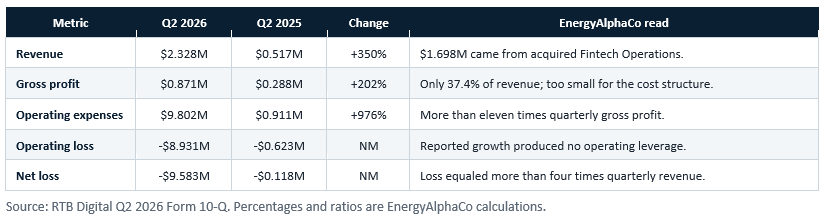
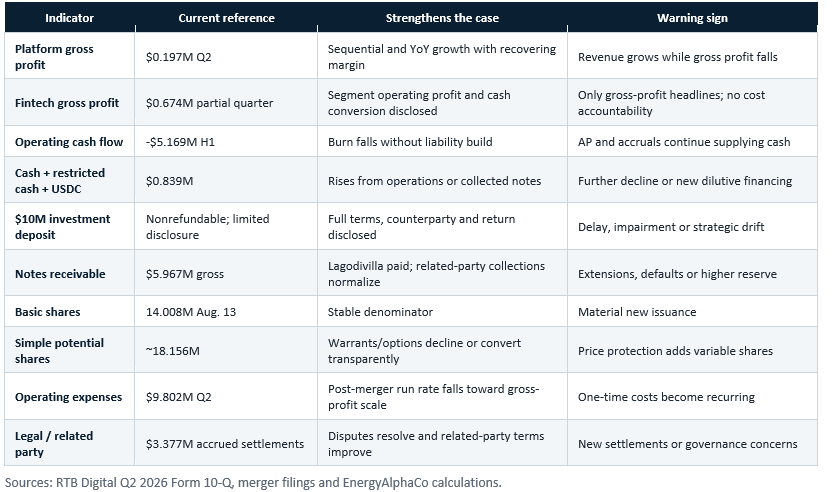
The reported revenue increase is mostly acquisition accounting. Fintech contributed $1.698 million after the May 12 closing. Platform revenue grew 21.9%, from $0.517 million to $0.630 million, but Platform gross profit fell from $0.288 million to $0.197 million. The core business therefore added revenue while losing gross-profit dollars and compressing gross margin.
The filing includes unusual merger and warrant costs. Q2 general and administrative expense included a $1.2 million merger advisory fee and a $3.3 million charge to modify and settle legacy Ryvyl warrants, $2.7 million of which was noncash. Even removing those two identified items, operating expenses would still have been roughly six times consolidated gross profit. This is not merely a one-time accounting-loss problem.
The pro forma figures are equally unhelpful. Had the merger occurred on January 1, the combined company would have generated $3.711 million of Q2 revenue and a $10.192 million net loss. The acquired business adds scale, but the first filing does not show a credible path to consolidated profitability.
The balance sheet looks more liquid than it is
RTB reported $15.1 million of current assets against $11.0 million of current liabilities, or approximately $4.1 million of positive working capital. That headline is not a good measure of immediately usable liquidity.
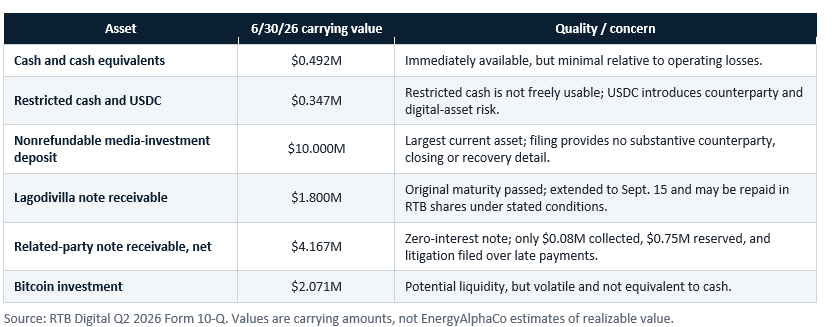
Cash, restricted cash and USDC totaled only about $0.84 million. The $10 million nonrefundable deposit represented roughly two-thirds of current assets and more than twenty times cash, yet the 10-Q does not explain the counterparty, asset being acquired, milestones, expected closing date or remedies if the investment does not complete. That disclosure gap is material.
Asset quality is also weakened by the notes receivable. The $1.8 million Lagodivilla loan was originally due June 3 and was extended to September 15. The $5 million zero-interest related-party note has produced only approximately $0.08 million of cumulative payments, carries a $0.75 million reserve and is now the subject of RTB’s own late-payment litigation. Neither balance should be treated as cash until collected.
Goodwill and acquired intangibles totaled approximately $22.0 million - half of total assets. Their value depends on future cash flows that have not yet been demonstrated. The company also maintains a full valuation allowance against its deferred tax assets, and potential Section 382 limitations may restrict use of the inherited tax losses.
Cash flow and capital allocation raise more questions
RTB used $5.2 million of operating cash during H1. That result benefited from a $5.6 million increase in accounts payable and accrued liabilities, including $3.4 million of accrued legal settlements. The company did not fund itself through recurring operating cash flow; it deferred cash obligations and relied on capital transactions.
During H1, RTB sold $10.2 million of crypto assets, acquired $4.2 million of cash in the Ryvyl merger and raised $2.0 million through a convertible note and warrants. It then placed $10.0 million into the nonrefundable digital-media deposit, advanced the $1.8 million Lagodivilla note using cash and USDC, and capitalized $0.7 million of software development costs. The allocation of scarce liquidity into deposits, loans and crypto-linked assets is difficult to reconcile with only $0.5 million of remaining cash and large operating losses.
Management states that existing liquidity should meet working-capital needs for at least twelve months. Elsewhere, the company explicitly states that it will need additional capital to fund operations beyond 2026. Those disclosures create an important tension. Until cash conversion improves, investors should assume that another financing is likely rather than optional.
The diluted-share count is the valuation starting point
The post-merger share count changed so quickly that third-party market-capitalization services may not yet reflect the current denominator. RTB reported 4.165 million equivalent shares at December 31, 13.302 million at June 30 and 14.008 million outstanding on August 13. That is a 236% increase from year-end.
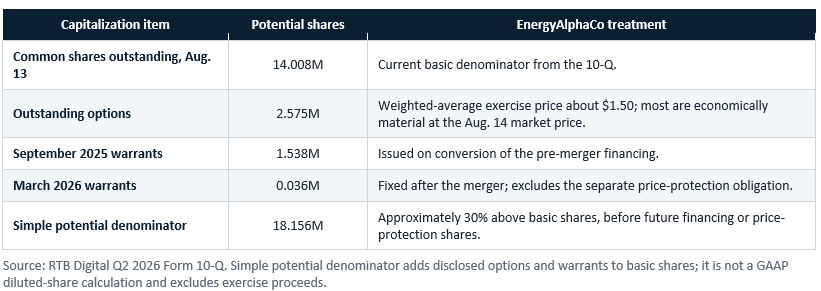
The March 2026 financing also includes a price-protection feature under which the investor may receive additional shares if market capitalization falls below specified thresholds as restricted shares become transferable. The feature is capped at $15 million. This structure places more dilution pressure on existing holders when the share price weakens - precisely when shareholders are least able to absorb it.
At approximately $17.39 on August 14, the 14.008 million basic shares imply an illustrative equity value of approximately $244 million. The simple 18.156 million potential denominator implies approximately $316 million before considering option or warrant exercise proceeds and before any price-protection or future-financing shares. Against annualized Q2 pro forma revenue of only about $14.8 million, that represents roughly 16 times sales on basic shares and more than 21 times on the simple potential denominator. These are not valuation targets; they show that the stock does not screen as inexpensive relative to the reported operating scale.
Related-party and inherited governance issues matter
The $5 million zero-interest note to an entity associated with a former director is already reserved and in litigation. RTB also entered into an advisory agreement with BFF Ltd., an entity affiliated with the current CFO and director. The agreement calls for a $275,000 mobilization fee, a $50,000 monthly retainer, a $225,000 success fee upon a financing of at least $143 million and an equity-based award with terms still to be determined.
Those amounts are material for a company with only $0.5 million of cash. They do not prove misconduct, but they increase the need for independent-board oversight, precise disclosure of services delivered and clear evidence that terms are competitive and aligned with shareholders.
The combined company also inherited numerous legal matters and $3.4 million of accrued legal settlements. The SEC action concerning Ryvyl’s historical registration and reporting was resolved without a monetary penalty, but it remains part of the governance record investors should not erase simply because the corporate name changed.
What is potentially interesting
There are a few facts worth monitoring rather than dismissing outright:
• Platform revenue grew 21.9% year over year, and the company says more than 150 sports reporters and team publishers joined during 2026.
• The acquired Fintech operation contributed $0.674 million of gross profit during the partial post-merger quarter and may provide recurring transaction revenue.
• Reported funded debt is modest at approximately $0.6 million, so the central financial risk is liquidity and dilution rather than a conventional near-term debt wall.
• Nasdaq approved the post-merger listing, and reported stockholders’ equity was approximately $30.3 million at June 30.
None of those points is sufficient today. Audience and partner growth must convert into gross profit; fintech must demonstrate segment-level operating profit and cash flow; reported equity must be adjusted for asset quality; and the company must fund operations without transferring most of the upside to new security holders.
What must be proven before reconsideration
Two consecutive quarters of platform revenue and gross-profit growth, with gross margin recovering rather than falling as partner count expands.
Clear disclosure of normalized operating expenses after merger and warrant charges, followed by a credible path from gross profit to operating breakeven.
Collection of the $1.8 million Lagodivilla note in cash or equivalent value by the extended maturity date, without another extension.
Transparent terms, counterparty, valuation support, closing timeline and expected return for the $10 million nonrefundable digital-media deposit.
Improved cash and liquid resources without selling additional price-protected or heavily discounted securities.
A stabilized fully diluted share count and a reconciliation of all options, warrants, price-protection features and equity awards.
Resolution or material improvement in the related-party note dispute and evidence that related-party agreements are reviewed independently.
Segment operating-profit and cash-flow disclosure sufficient to determine whether Fintech or Platform can stand on its own.
Automatic pass conditions
The $10 million deposit is impaired, delayed without adequate disclosure, or converted into another illiquid or related-party asset.
The Lagodivilla note is extended again or the related-party note deteriorates beyond the existing reserve.
RTB completes another financing with material down-round, variable-price or market-capitalization protection before operating results improve.
Platform gross profit remains flat or declines despite rising partner count and marketing expense.
Cash falls further while accounts payable, accrued settlements or other liabilities continue funding the operating cycle.
Another Nasdaq compliance problem, material control weakness or significant reporting delay emerges.
Management emphasizes crypto holdings, audience reach or financing announcements without showing improving cash flow per diluted share.
Key metrics to monitor
What would justify a full Thesis Audit?
A full Thesis Audit is not warranted yet. The financial history is discontinuous, the first combined quarter contains significant transaction costs, the asset base includes material deposits and receivables of uncertain quality, and the diluted capitalization is still moving.
Revisit after two cleaner post-merger quarters only if RTB provides:
A normalized segment model with revenue, gross profit, operating expenses and cash flow for Platform and Fintech.
A complete fully diluted capitalization table and financing runway.
Resolution of the $1.8 million note and full disclosure of the $10 million investment deposit.
Evidence that audience and payments activity create recurring cash rather than only headline growth.
A valuation that remains attractive after all options, warrants and price-protection shares are included.
Initial classification
RESEARCH WATCH ONLY / AVOID PENDING EVIDENCE RTB is not an investable turnaround thesis today. Keep it on the watchlist to test whether the post-merger company can establish clean segment economics, convert questionable assets into cash and stop the fully diluted denominator from expanding. Do not mistake a new name, a higher quoted share price or reported revenue growth for demonstrated value creation.
Final assessment
The first RTB Digital filing does not contradict our initial skepticism; it strengthens it. The merger preserved a Nasdaq listing and created a new narrative around media, Web3 and payments, but the economic foundation remains weak.
The company generated less than $1 million of quarterly gross profit against nearly $10 million of operating expenses. Immediately available liquidity was under $1 million. Much of book equity rested on a nonrefundable deposit, notes receivable, goodwill, intangibles and Bitcoin. Operating cash burn was partly funded by higher payables and accrued liabilities. The share count more than tripled, and meaningful options, warrants and price-protection dilution remain.
RTB could eventually prove that the current quarter was distorted by merger costs and that the media and fintech assets have strategic value. Investors should require that proof in cash and on a fully diluted per-share basis. Until then, this is best treated as an avoid-list company being monitored for evidence - not as a cheap successor to RVYL.