
Natural Gas & LNG
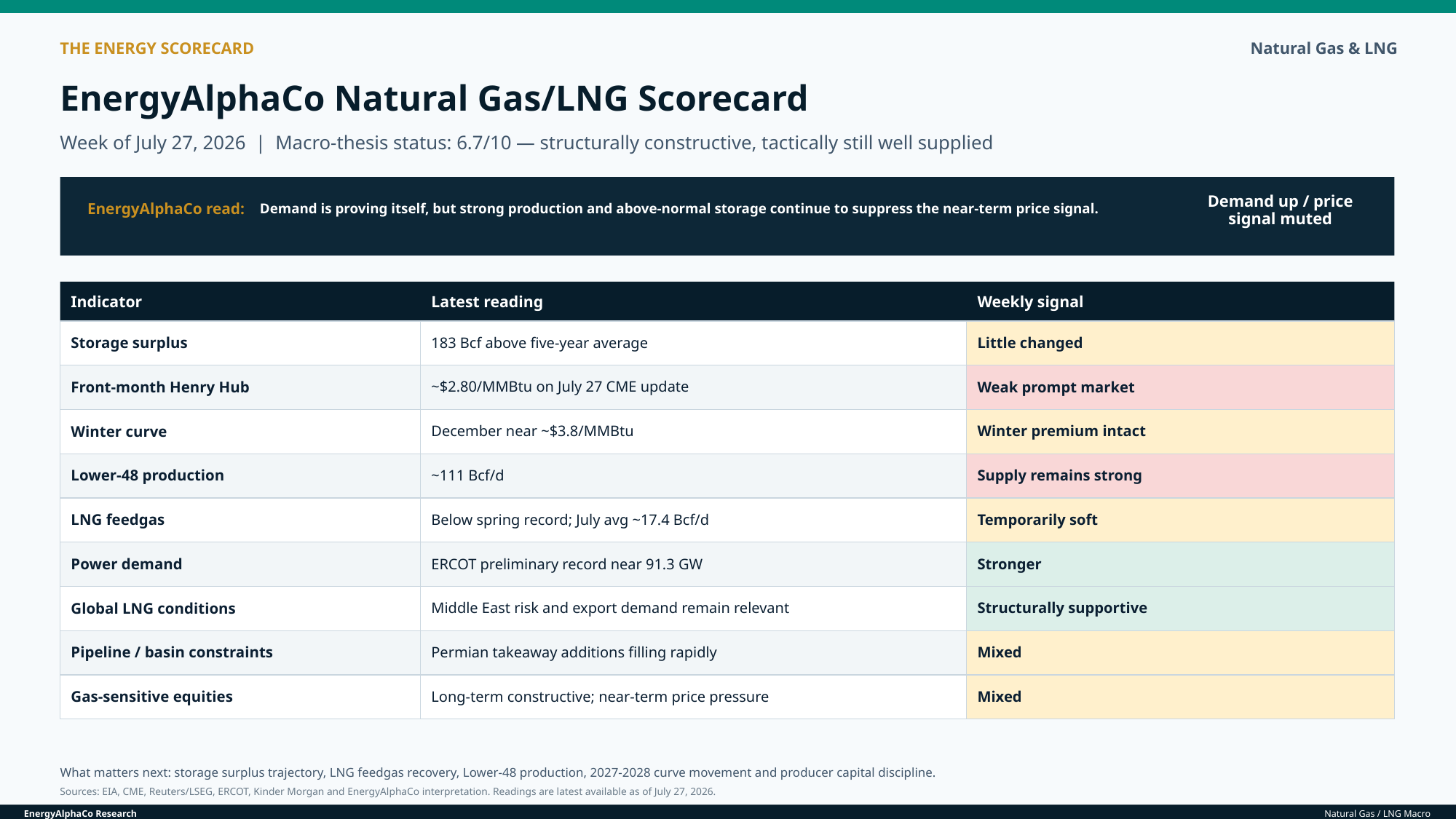
Week of July 27, 2026 | EnergyAlphaCo macro-thesis rating: 6.7/10 — structurally constructive, tactically still well supplied

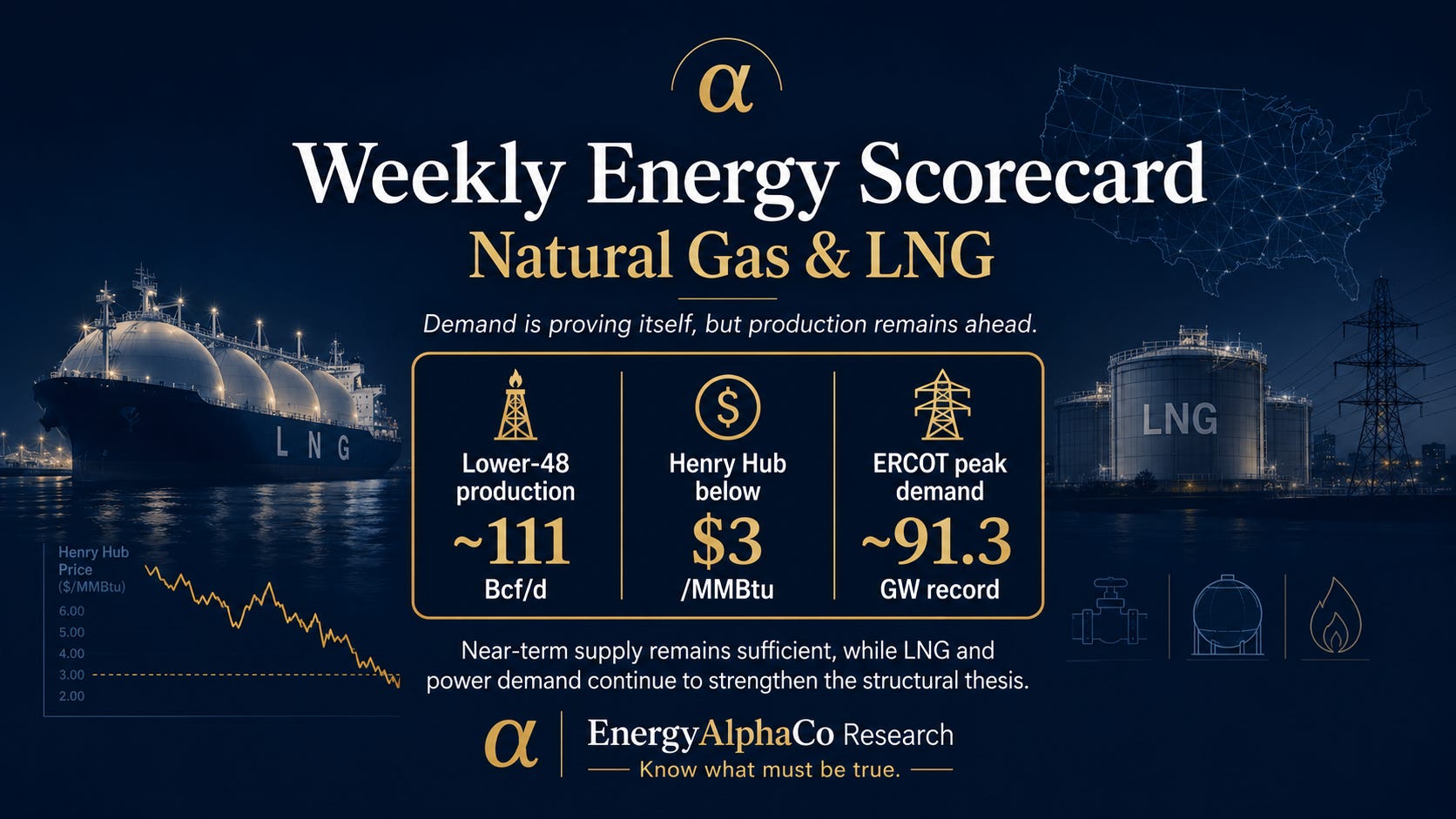
Demand is proving itself, but production remains ahead
Executive assessment
The U.S. gas market remains caught between two increasingly divergent realities.
Near-term fundamentals are still soft. Working storage is 183 Bcf above the five-year average, Lower-48 production is running near 111 Bcf/d, and the prompt Henry Hub contract remains below $3/MMBtu. Those readings show that current supply is still sufficient to absorb strong summer power demand and elevated exports.
The structural thesis nevertheless strengthened. ERCOT established a preliminary demand record near 91.3 GW, natural gas remained central to peak-grid reliability, and Middle Eastern risk again highlighted the strategic value of U.S. LNG. The market is not short today, but the infrastructure system is being asked to serve steadily larger LNG and electricity loads.
EnergyAlphaCo read: Demand is proving itself, but strong production and above-normal storage continue to suppress the near-term price signal.
The week in one sentence
The U.S. is building the demand foundation for a tighter 2027-2029 gas market, but the current price signal remains muted until storage contracts more decisively, LNG feedgas recovers, or production growth slows.
What changed this week
Storage: Working gas in storage reached 3,056 Bcf as of July 17, following a 32 Bcf injection. Inventories were 183 Bcf above the five-year average. The surplus is not large enough to kill the long-term thesis, but it remains a prompt-market headwind.
Henry Hub: The front-month contract remained below $3/MMBtu. CME showed the prompt contract near $2.80/MMBtu on July 27, while the winter curve retained a meaningful premium. The market is pricing seasonal risk, not yet structural scarcity.
Production: Lower-48 production remains near 111 Bcf/d. Strong production is the principal reason record power demand has not translated into a stronger Henry Hub response.
LNG feedgas: U.S. LNG feedgas remains below its spring record. July flows have been closer to 17.4 Bcf/d versus an April peak around 18.8 Bcf/d. The LNG thesis is intact, but current feedgas is not yet applying maximum pressure to storage.
Power demand: ERCOT set a preliminary peak-demand record near 91.3 GW during the July heat wave. Natural gas remained essential to meeting peak demand, while solar and batteries also contributed meaningfully to grid reliability.
Infrastructure: Permian takeaway additions are filling rapidly. That is constructive for midstream cash flow but can be bearish for Henry Hub because it allows more associated gas to reach downstream markets.
Thesis-change ledger
What strengthened the thesis
ERCOT established a major new demand record.
Natural gas remained critical to peak-grid reliability.
Corpus Christi Stage 3 and Golden Pass remain structural feedgas additions.
Global LNG risk reinforced the strategic value of U.S. export capacity.
Midstream volume growth supports the infrastructure buildout thesis.
What weakened the thesis
Storage remained 183 Bcf above the five-year average.
Prompt Henry Hub remained below $3/MMBtu.
Lower-48 production stayed near record levels.
LNG feedgas remained below its spring peak.
Permian takeaway additions release more associated gas into downstream markets.
Equity implications
Dry-gas producers
The setup remains mixed. Gas-focused producers retain substantial upside if the 2027-2029 curve moves higher, but sub-$3 prompt pricing limits near-term free cash flow. Balance-sheet strength, hedge exposure, maintenance capital and realized basis matter more than commodity optimism.
LNG operators and developers
Operating LNG terminals benefit from global tightness and high utilization. Developers require a separate dilution, financing and construction-risk audit. Approved capacity is not the same as current feedgas demand.
Midstream and high-yield energy
The gas infrastructure buildout remains constructive for companies with firm contracts, strong counterparties, disciplined project returns and manageable leverage. High yield alone should not be treated as value.
What EnergyAlphaCo is watching next
Storage surplus trajectory: does the surplus move below 125 Bcf or remain near 175-200 Bcf?
LNG feedgas: can flows return above 18 Bcf/d and establish new highs?
Golden Pass and Corpus Christi: do commissioning milestones become stable feedgas demand?
Lower-48 production: does output continue to rise despite weak prompt pricing?
2027-2028 Henry Hub curve: does strength broaden beyond winter months?
Producer capital discipline: do higher prices translate into FCF/share or another growth cycle?
Permian takeaway and Haynesville activity: does associated gas overwhelm dry-gas discipline?
Bottom line
This week strengthened the structural demand case but did not yet validate a near-term commodity breakout.
The U.S. is clearly using more electricity, and gas remains one of the primary ways the grid handles peak demand. LNG exports also remain strategically important. But production and storage are still ahead of the demand signal today.
The next phase of the thesis begins when global LNG tightness, U.S. power demand and LNG project commissioning translate into sustained record feedgas and a visible decline in storage relative to normal. Until then, gas-sensitive equities should be selected based on free-cash-flow resilience, balance-sheet strength, inventory quality, realized pricing and fully diluted per-share value.
Sources
U.S. Energy Information Administration, Weekly Natural Gas Storage Report, week ended July 17, 2026.
CME Group, Henry Hub Natural Gas Futures, July 27, 2026 market update.
Reuters/LSEG market reporting on U.S. natural-gas prices, production and LNG feedgas, July 2026.
ERCOT and Texas power-market reporting on the preliminary July 22, 2026 demand record.
Kinder Morgan second-quarter 2026 reporting and related market coverage on natural-gas transportation volumes and Permian takeaway.
Investment-risk and ownership disclosure
This material is provided for informational and educational purposes only and does not constitute individualized investment advice, a recommendation to buy or sell any security, or an offer or solicitation to transact in securities. Energy and commodity investments involve substantial risk, including commodity-price volatility, operational failures, project delays, regulatory changes, leverage, capital intensity and equity dilution. Forecasts and scenarios may prove incorrect.