
Five Energy Signals That Mattered This Week
Hormuz stayed broken. Russian refinery outages reached export markets. U.S. gas supply kept winning. And the AI-power thesis got a much-needed reality check.
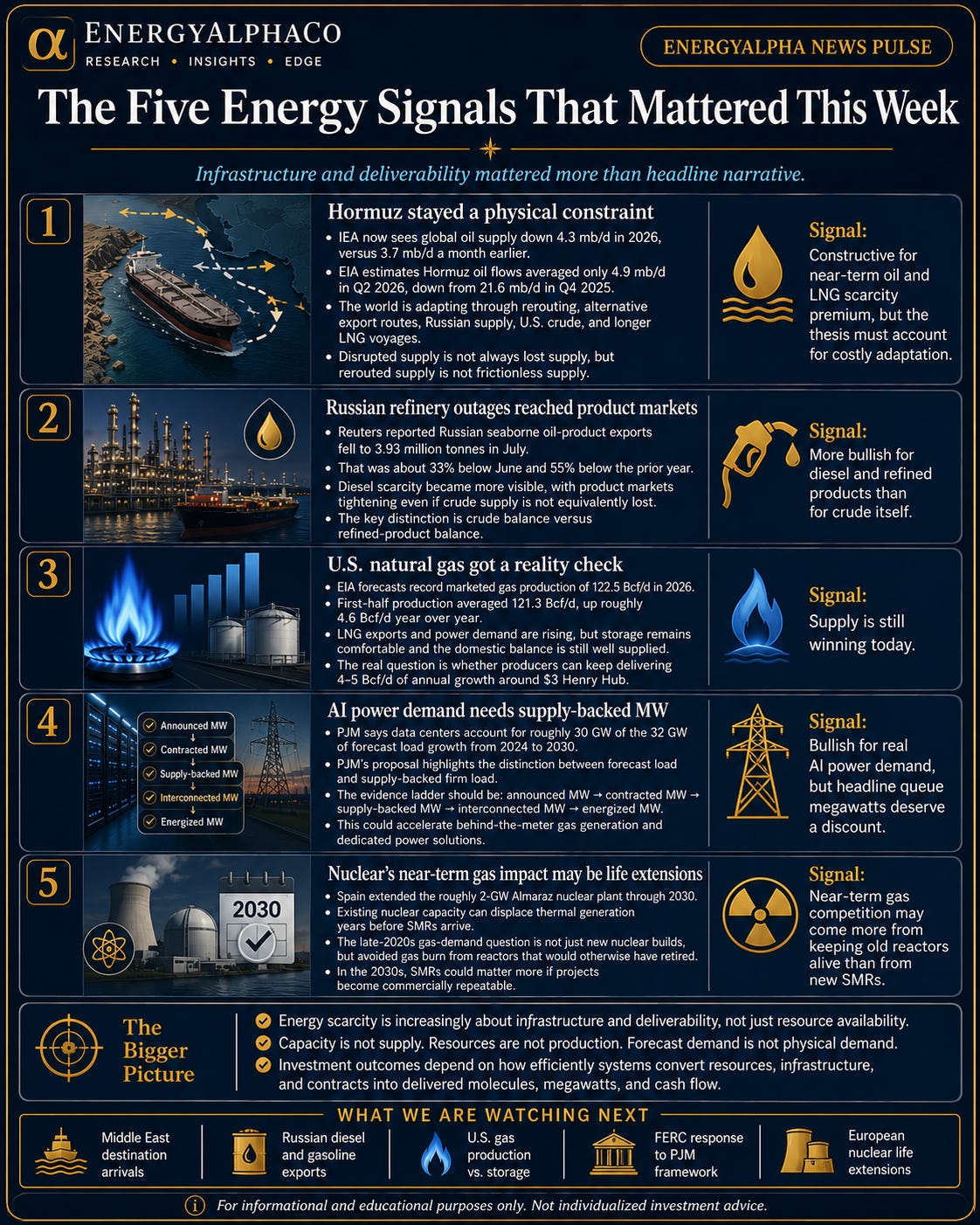
Energy markets produced plenty of headlines this week.
The more useful exercise is separating the headlines from the developments that actually changed—or tested—an investment thesis.
Five signals stood out.
Together, they tell a more complicated story than simply “energy is getting tighter.”
Global oil and LNG markets are still dealing with severe physical constraints. Refined-product scarcity is becoming increasingly visible. But markets are also adapting: trade routes are changing, alternative barrels are finding buyers, and high prices are encouraging supply responses.
Meanwhile, the U.S. natural-gas market delivered almost the opposite message. Despite rising LNG exports and electricity demand, production remains strong enough that storage is comfortable and Henry Hub remains weak.
And in power markets, the AI story continues to strengthen—but the distinction between forecast megawatts and firm megawatts is becoming impossible to ignore.
Here are the five signals I think mattered most.
1. Hormuz is no longer just a geopolitical risk. It is a measurable physical constraint.
The biggest energy story of the week remains the Strait of Hormuz.
But the important development was not another diplomatic statement or tanker attack.
It was the accumulation of physical evidence that the disruption is persisting long enough to alter global energy flows and agency forecasts.
The IEA now expects global oil supply to decline by 4.3 million barrels per day in 2026, versus a 3.7-million-barrel decline forecast only a month earlier. Oil demand, however, is also weakening sharply: the IEA forecasts a 1.6 mb/d contraction in 2026.
EIA separately estimates oil flows through Hormuz averaged only 4.9 mb/d in Q2 2026, down from 21.6 mb/d in Q4 2025.
The market is adapting. Saudi Arabia is increasingly using alternative export routes. India has increased purchases from Russia and Latin America. Asian refiners are buying more U.S. crude. LNG vessels are taking longer routes around Africa.
But adaptation has a cost.
That leads to the first important Thesis Audit distinction:
Disrupted supply is not necessarily lost supply. But rerouted supply is not equivalent to frictionless supply either.
Longer voyages require more vessels. Insurance costs rise. Freight rises. Working inventories increase. Some producers must discount barrels trapped behind the chokepoint, while barrels already outside it acquire scarcity value.
The most important question is therefore no longer simply:
When does Hormuz reopen?
It is:
How much energy can the global system continue moving while Hormuz remains impaired—and at what cost?
EnergyAlphaCo read
I remain constructive on the near-term oil and LNG scarcity premium, but the strongest version of the bullish thesis needs to account for adaptation.
If alternative routes, Russian supply, U.S. crude exports and Atlantic LNG replace enough Gulf molecules, the disruption can persist without creating an equivalent global shortage.
If those substitution channels begin failing, the market becomes considerably tighter.
Thesis test: follow destination arrivals, not just tanker departures.
2. Russia’s refinery problem finally crossed into the global product market.
For several weeks, Russian refinery attacks were easy to overstate.
A refinery strike does not automatically mean lost global oil supply.
In fact, shutting a refinery can have the opposite effect on crude:
less domestic refining → more crude available for export.
That is why we have been reluctant to count every damaged Russian refinery as bullish crude supply loss.
This week the evidence changed.
Reuters reported that Russian seaborne oil-product exports fell to 3.93 million tonnes in July, down roughly 33% from June and 55% year over year.
At the same time, diesel scarcity has become increasingly visible internationally. European diesel prices moved above jet fuel this week, while U.S. and European diesel markets have been reacting to Russian refinery disruptions and Middle East constraints.
This moves the evidence chain forward:
refinery attacks
→ lower refinery runs
→ domestic shortages
→ reduced product exports
→ tighter international product markets.
That final step matters.
EnergyAlphaCo read
The oil market increasingly needs to be separated into two balances:
Crude balance
and
Refined-product balance.
They can move in opposite directions.
Russia can export more crude because its refineries are damaged while simultaneously exporting less diesel.
That creates a market where crude inventories can rebuild while diesel cracks remain extremely strong.
It also explains why focusing only on Brent or WTI can miss where the actual scarcity resides.
Thesis test: Russian product exports and global diesel inventories.
If Russian exports remain depressed through August and September while refinery outages persist, the downstream shortage becomes much more structural.
If product exports recover quickly, July may prove to have been the peak disruption.
3. U.S. natural gas delivered a reality check: supply is still winning.
This was probably the most important counter-signal of the week for EnergyAlphaCo.
The structural U.S. gas thesis remains attractive: LNG export capacity is expanding, electricity consumption is rising, and data centers could become a significant new source of demand.
But today’s market is not tight.
EIA now forecasts U.S. marketed natural-gas production averaging a record 122.5 Bcf/d in 2026. Production averaged 121.3 Bcf/d in the first half, up roughly 4.6 Bcf/d year over year.
Haynesville has been one of the important contributors to that growth.
Meanwhile, EIA’s August outlook sees U.S. LNG exports averaging about 16.5 Bcf/d in Q3 2026, temporarily restrained by maintenance, while the domestic balance remains well supplied.
The latest storage build reinforced the point: inventories remain comfortably above their five-year norm.
The temptation for a structural gas bull is to explain this away.
I think that would be a mistake.
The data are telling us that the U.S. supply response remains stronger than demand growth today.
EnergyAlphaCo read
That does not necessarily invalidate a 2028 tightening thesis.
It makes the thesis more precise.
The question is no longer:
Will LNG and power demand grow?
They almost certainly will.
The better question is:
Can U.S. producers continue manufacturing 4–5 Bcf/d of annual supply growth around $3 Henry Hub?
If they can, the shortage thesis moves right.
If low prices eventually slow drilling and production growth while LNG feedgas and power demand continue rising, today’s comfortable storage position can disappear surprisingly quickly.
This is exactly why thesis auditing matters.
A bullish long-term view should become more demanding, not less, when near-term evidence moves against it.
Thesis test: production growth versus LNG + power-demand growth.
For now:
Supply is winning.
4. AI electricity demand looks increasingly real—but PJM just reminded investors that forecast MW are not firm MW.
The AI-power thesis produced perhaps its most important regulatory development yet this week.
PJM filed a proposal with FERC addressing the extraordinary wave of new large loads attempting to connect to its system.
PJM says data centers account for roughly 30 GW of the 32 GW of forecast load growth between 2024 and 2030.
But PJM’s proposed framework introduces a critical distinction.
Large new loads that do not bring sufficient new power supply could become subject to curtailment during system emergencies.
In other words, PJM is beginning to distinguish between:
forecast load
and
supply-backed firm load.
That distinction belongs directly in the EnergyAlphaCo AI-power framework.
There was plenty of evidence on the other side this week that demand itself is real. EIA expects U.S. electricity consumption to set new records in both 2026 and 2027 as commercial demand—including data centers—continues rising.
The question increasingly isn’t whether AI companies want electricity.
It is whether the physical power system can deliver it.
EnergyAlphaCo read
The evidence ladder should now look something like this:
announced MW
→ contracted MW
→ supply-backed MW
→ interconnected MW
→ energized MW
→ actual electricity consumption.
That middle step—supply-backed MW—may become one of the most important metrics in the entire AI-energy thesis.
It could also accelerate dedicated generation.
If data-center developers need to bring their own power to obtain firm service, the incentive increases for:
behind-the-meter gas generation,
dedicated combined-cycle plants,
nuclear PPAs,
batteries and renewables paired with firm capacity,
and other power solutions that add actual generation rather than merely claim grid capacity.
That could ultimately be bullish natural gas.
But it would be wrong to count all 30 GW of forecast PJM data-center demand as future gas burn.
Thesis test: how much AI load becomes supply-backed and energized?
That number matters far more than the headline queue.
5. Nuclear’s near-term gas impact may come from keeping old reactors alive—not waiting for SMRs.
Advanced nuclear received plenty of encouraging headlines this week.
DOE added up to another $1 billion of support for X-energy’s first Texas Xe-100 project. TerraPower continued building out the manufacturing chain behind Natrium.
Those developments matter for the 2030s.
But the more consequential near-term signal may have come from Spain.
Spain extended operation of the roughly 2-GW Almaraz nuclear plant through 2030.
Why does that matter to gas investors?
Because existing nuclear capacity can displace thermal generation years before a new SMR enters service.
Spain’s broader nuclear debate illustrates an increasingly important issue for European gas demand: if countries extend existing reactors rather than shutting them on schedule, some of the gas-fired generation previously expected to replace nuclear output may simply never materialize.
That matters because Europe is simultaneously adding enormous quantities of wind and solar.
The result could be:
less structural gas consumption
but
greater value for flexible gas during periods of low renewable output or nuclear outages.
EnergyAlphaCo read
This changes how I think about the nuclear-versus-gas debate.
It is probably wrong to frame it simply as:
nuclear wins → gas loses.
The timing matters.
Through the late 2020s, the bigger threat to European gas demand may be life extensions at existing reactors, not new advanced nuclear.
In the 2030s, SMRs and other advanced reactors could become a much larger competitive force if the first projects prove commercially repeatable.
For gas investors, the right metric is therefore not simply new nuclear capacity.
It is:
avoided gas-fired generation from nuclear capacity that would otherwise have retired.
Thesis test: does Almaraz remain an exception, or does Europe’s nuclear retirement schedule continue moving right?
The Bigger Picture
The five signals this week point toward one overarching theme:
Energy scarcity is increasingly about infrastructure and deliverability—not simply resource availability.
There is plenty of oil in the world.
The problem is getting certain barrels through Hormuz.
There is plenty of Russian crude.
The problem is turning some of it into diesel and getting those products into international markets.
The United States has enormous natural-gas resources.
For now, producers are demonstrating that they can grow supply faster than LNG and power demand.
AI companies have enormous appetite for electricity.
The problem is turning forecast load into firm, interconnected, energized megawatts.
And nuclear plants can produce enormous quantities of reliable electricity.
The challenge is keeping existing reactors operating while proving that the next generation can be manufactured economically at scale.
That is why the EnergyAlphaCo framework keeps returning to the same distinction:
Capacity is not supply.
Resources are not production.
Contracts are not cash flow.
Forecast demand is not physical demand.
Investment returns are created—or destroyed—in the conversion between those stages.
What We Are Watching Next
The next week has several unusually clean thesis tests.
Oil: Do Middle East destination arrivals confirm that more barrels are escaping Hormuz than visible tanker data suggest?
Refined products: Do Russian diesel and gasoline exports remain depressed?
Natural gas: Does U.S. production remain near record levels while storage stays comfortably above normal?
AI power: Does FERC move toward accepting PJM’s supply-backed large-load framework?
Nuclear: Does Spain’s Almaraz extension remain isolated, or does it become another step toward broader European nuclear life extensions?
Those answers matter more than most of next week’s headlines.
Because the question is never simply whether a thesis sounds plausible.
It is whether the evidence keeps supporting it.