
Comstock Resources: The Western Haynesville Test
Can a tighter U.S. natural-gas market, Western Haynesville inventory and Pinnacle infrastructure outrun capital intensity, hedge drag and leverage?

This report is informational and educational only. The author owns shares of CRK. See the disclosure at the end of this report. CRK is scheduled to report second-quarter 2026 results on July 30, 2026. Any publication after that date should be refreshed for subsequent disclosures.
Investment conclusion
Comstock Resources is one of the most direct public-market expressions of a higher Henry Hub price and stronger Gulf Coast gas demand. It also carries an unusually demanding execution burden. The company is spending heavily to raise production and delineate the deeper Western Haynesville while approximately $3.0 billion of net debt sits ahead of the common stock. The investment case therefore cannot be reduced to “natural gas goes higher.” Comstock must convert higher benchmark prices into realized cash margins, lower leverage and greater value per fully diluted share.
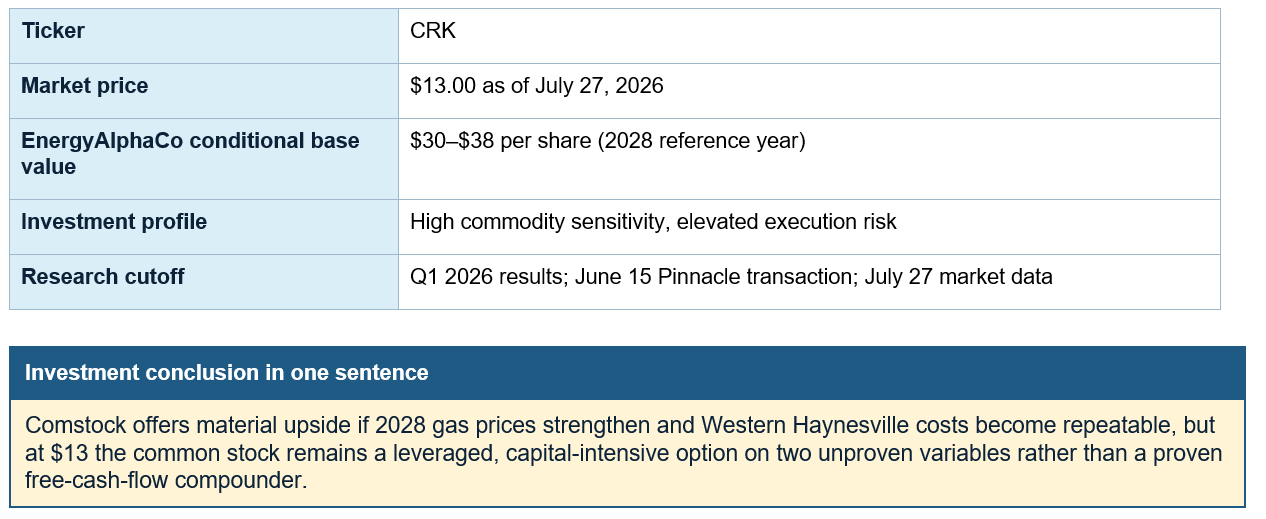
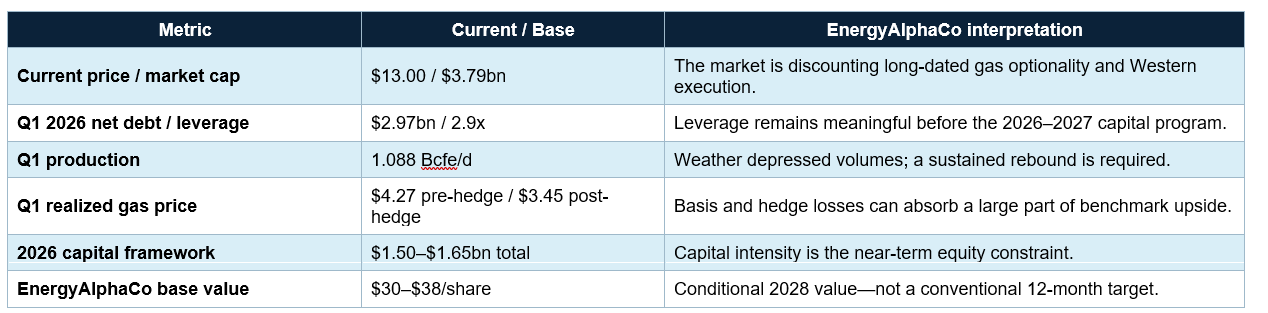
At ~$13.00 at the time of this article, Comstock’s equity value is approximately $3.79 billion. Using first-quarter net debt as a starting reference, enterprise value is roughly $6.8 billion before updating the post-transaction accounting for Pinnacle. The June Sixth Street transaction provides a company-reported marker of approximately $1.6 billion for Comstock’s retained 73% interest in Pinnacle. On a simplified EnergyAlphaCo basis, the current price implies roughly $5.2 billion for the upstream business after subtracting that marker—about five times last-twelve-month EBITDAX before separating midstream earnings. The market is not valuing the upstream assets at zero; it is discounting the 2028 scarcity case, the cost of Western Haynesville development and the risk that capital outspend lasts longer than expected. [2][5][12]
The cash-flow test is demanding. Comstock generated $899.6 million of operating cash flow in 2025 and spent approximately $1.34 billion of cash capital, with asset sales helping bridge the gap. In the first quarter of 2026, GAAP operating cash flow was $272.0 million, while the company’s measure excluding working-capital changes was $191.9 million. Capital expenditures and acquisitions totaled $415.8 million. Whichever cash-flow definition is used, the quarter did not produce free cash flow. The 2026 plan calls for $1.4–$1.5 billion of upstream development and exploration spending plus $100–$150 million for Western Haynesville midstream. [1][2][3]
EnergyAlphaCo’s revised independent financial and valuation model base case assumes $3.75 Henry Hub in 2026, $4.25 in 2027 and $4.75 in 2028. It assumes production rises from the 2026 guidance midpoint of 1.325 Bcf/d to 1.6 Bcf/d by 2028, while realized basis, hedge drag and unit costs improve. The model still produces approximately $784 million of negative levered pre-tax free cash flow in 2026 and $138 million of negative free cash flow in 2027 before turning positive by approximately $513 million in 2028. Net debt peaks near $3.9 billion in 2027 and falls to approximately $3.4 billion in 2028. These are EnergyAlphaCo estimates, not company guidance. [11]
The revised base SOTP (Sum of the Parts) applies 5.5 times 2028 upstream EBITDAX, adds $1.8 billion for Comstock’s Pinnacle equity interest, subtracts $3.38 billion of net debt and divides by 300 million fully diluted shares. The resulting point estimate is $32.74 per share; EnergyAlphaCo uses a base range of approximately $30–$38. The conservative case is approximately $16.57, while the downside case falls to approximately $2.48. The stock therefore offers attractive conditional asymmetry, but it is not protected from a delayed gas cycle or failed cost improvement.
The company in one paragraph
Comstock Resources is a dry-gas-focused exploration-and-production company concentrated in the Haynesville and Bossier shales of North Louisiana and East Texas. The June 2026 presentation reports 806,980 net acres, including 540,410 in the Western Haynesville and 266,570 in the legacy area. Management identifies 3,383 net drilling locations—2,546 Western and 837 legacy—but those locations are not equivalent to SEC proved reserves or independently verified economic inventory. At year-end 2025, Comstock reported 7.0 Tcfe of proved reserves, 41% developed, an approximately 16-year reserve life and $4.46 billion of pre-tax PV-10 at the SEC gas price of $3.07/Mcf. Jerry Jones-controlled entities beneficially owned 70.9% of the outstanding shares as of April 7, 2026. [1][4][6]
Why the opportunity may exist
Comstock combines a simple commodity exposure with a complicated valuation. Investors can see the potential demand: LNG exports are expanding, Texas power demand is rising, and the Anderson County power-generation hub could eventually become a large local gas consumer. They can also see the near-term burden: high Western Haynesville well costs, substantial capital spending, hedge ceilings, a wide first-quarter basis differential and leverage that rises if the cash-flow turn is delayed.
The opportunity may exist because the market appears unwilling to capitalize a 2028–2030 gas-shortage thesis before it shows up in storage, the forward curve and producer cash flow. That skepticism is not irrational. The July 2026 EIA outlook expects record U.S. gas production to meet rising demand and forecasts Henry Hub near $3.70 in 2026 before slipping below $3.50 in 2027. Chronometer Partners reaches a much more aggressive conclusion, forecasting an unprecedented shortage beginning in the second half of 2028. EnergyAlphaCo treats that letter as a scenario to audit, not as established fact. [8][9]
The market may also be reluctant to credit the company’s inventory count because Western Haynesville economics remain incompletely disclosed. Management has shown initial rates, drilling days and cost per lateral foot. It has not provided enough standardized well-by-well decline curves, EURs, full-cycle finding costs and development returns to establish that the entire 2,546-location Western inventory is economic at a moderate gas price. That missing evidence is the core of the Thesis Audit.
The original bull case
The bull case has five components. First, LNG exports and power demand tighten the U.S. gas balance beginning late in the decade. Second, the Haynesville becomes increasingly valuable because it is close to Gulf Coast LNG terminals and new Texas demand. Third, Comstock’s large Western Haynesville position provides decades of drilling optionality. Fourth, operating learning reduces the cost of the unusually deep, high-pressure wells. Fifth, higher gas prices and Pinnacle infrastructure turn today’s capital outspend into rapid deleveraging and a materially higher equity value.
Third-party research generally follows this logic but often moves too quickly from acreage to value. One outside estimate assigns approximately 66 Tcf of resource and reaches roughly $55 per share using $5 gas, long reserve duration and a simplified DCF. The estimate is useful as a statement of the outside bull case, but it should not be treated as evidence. It relies on inferred recoverable resource rather than company-reported proved reserves, assumes development economics across a large undrilled inventory, and does not fully reconstruct decline replacement, maintenance capital, cash interest, hedge effects, basis, timing and fully diluted shares. [10]
The Thesis Audit
The audited thesis is not “gas prices go up.” CRK must pass four tests at the same time:
Higher Henry Hub prices must reach Comstock after basis, transportation and hedge settlements.
Western Haynesville wells must become repeatable enough to justify their capital intensity.
Free cash flow must reduce net debt rather than merely fund another production-growth cycle.
Per-share value must rise after stock compensation, PSUs and any future financing are counted.
1. The near-term gas market does not yet validate the shortage thesis
Comstock’s long-term demand positioning is credible, but the current gas market remains better supplied than the strongest bull narrative implies. The EIA’s July outlook combines record production with rising demand and still forecasts moderate benchmark pricing through 2027. That does not disprove a 2028 tightening; it means investors must survive the bridge. A mild winter, delayed LNG commissioning, slower data-center development or faster associated-gas growth could postpone the cash-flow inflection while Comstock continues to spend.
The Anderson County power hub is strategically important but should not be modeled as contracted demand today. Comstock says the 5.2 GW facility could require almost 1 Bcf/d by 2031. NextEra describes the broader projects as subject to definitive documents, development, construction and commissioning. EnergyAlphaCo treats the hub as valuable optionality and a future milestone—not a current take-or-pay revenue stream. [7]
2. The disclosed inventory is large; the economic inventory is unproven
The company’s 3,383 net-location count is a meaningful indication of scale. The 7.0 Tcfe proved-reserve base and 16-year reserve life are also substantial. But the valuation should not multiply every disclosed location by a uniform EUR or assume every acre will earn a high return at $4 gas. The Western Haynesville spans a large area, contains geological variation and requires very deep wells. Lease-hold drilling can also differ from optimized development drilling.
The correct investor question is not how many locations exist. It is how many locations can be developed at a competitive fully burdened cost while preserving balance-sheet flexibility. That number will be established through repeated well costs and production curves, not through acreage maps alone.
3. Western Haynesville initial rates are encouraging, but cost remains the execution gap
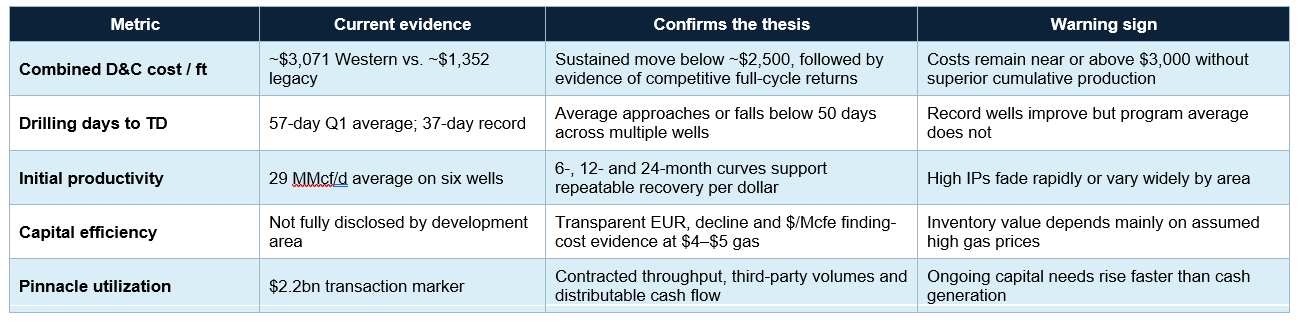
Comstock turned six Western Haynesville wells to sales through April 14, 2026 with an average lateral length of 10,874 feet and an average initial rate of 29 MMcf/d. The ten legacy wells shown in the same presentation averaged 12,312 feet and 31 MMcf/d. The Western results support commercial productivity, but initial rate is not a substitute for EUR, decline behavior or return on capital. [3][4]
The cost comparison is more revealing. The company’s Q1 charts show Western drilling cost of approximately $1,534 per lateral foot and completion cost of approximately $1,537, or roughly $3,071 combined. Legacy Haynesville drilling and completion were approximately $700 and $652 per foot, or roughly $1,352 combined. The Western figure was therefore more than twice the legacy cost per foot. Western wells may ultimately recover more gas, but the company has not yet disclosed enough standardized long-term data to prove that the additional recovery fully offsets the additional capital.
Average Western drilling performance also remained variable. Q1 drilling averaged 57 days to total depth and 478 feet per day, versus 52 days and 516 feet per day in the third quarter of 2025. A record well reached total depth in 37 days at 741 feet per day, demonstrating potential. The investment case depends on moving the average toward the record—not valuing the acreage from the record alone.
4. Production growth is useful only if it produces free cash flow
First-quarter production fell to 1.088 Bcfe/d from 1.279 Bcfe/d a year earlier, primarily because of weather disruptions. Management expects stronger well additions to restore production and guides to 1.25–1.40 Bcfe/d for 2026. A rebound would improve unit costs and cash generation, but it must be judged against the $1.50–$1.65 billion total capital framework. [2][3]
The 2025 cash-flow statement illustrates the risk of confusing activity with value. Operating cash flow was $899.6 million, cash capital spending was approximately $1.34 billion and asset-sale proceeds were $428.9 million. The company can fund a temporary outspend through liquidity and asset monetization, but per-share value will not compound until operating cash flow covers sustaining and development capital with enough left to reduce upstream debt.
5. Realized pricing can differ materially from the Henry Hub headline
In Q1 2026, the NYMEX reference price was $4.94/Mcf and Comstock realized $4.27 before hedging, a $0.67 differential. After $80.4 million of cash hedge losses, realized price fell to $3.45; including marketing income, it was $3.50. Approximately 72% of gas was hedged. The quarter shows why a high Henry Hub print does not translate one-for-one into Comstock free cash flow. [2][3]
At March 31, the remaining 2026 hedge book included 88 million MMBtu of swaps at $3.51 and 126.5 million MMBtu of collars with a $3.50 floor and $4.35 ceiling. The 2027 collars cover 146 million MMBtu with a $3.50 floor and $4.44 ceiling. These positions protect part of the downside but cap part of the upside during the period when Comstock is funding its heaviest capital program.
6. Pinnacle is a real asset, but the transaction did not repay upstream debt
Sixth Street invested $600 million for 27% of Pinnacle, implying a $2.2 billion enterprise value. Comstock retained 73%, which the company describes as worth approximately $1.6 billion, and retains operating control. After specified return hurdles, Comstock’s ownership can rise to 80.5%. The transaction is a credible third-party value marker and reduces Pinnacle’s annual fixed charges by an expected $40 million. [5]
The use of proceeds matters. The June 15 Form 8-K states that the cash was used to redeem $445 million of Pinnacle preferred equity plus accrued dividends, retire Pinnacle debt, pay transaction costs and provide working capital. It should not be modeled as a direct reduction in Comstock’s upstream revolver or senior notes. EnergyAlphaCo’s revised model therefore begins with Q1 reported net debt and values Pinnacle separately in the SOTP.
The $2.2 billion transaction value also depends on future Western Haynesville throughput. It validates investor demand for the infrastructure; it does not independently validate the economics of every upstream drilling location. Pinnacle should be monitored for third-party volumes, contractual cash flow, capital needs and distributions—not only headline enterprise value.
7. Leverage creates nonlinear upside and downside
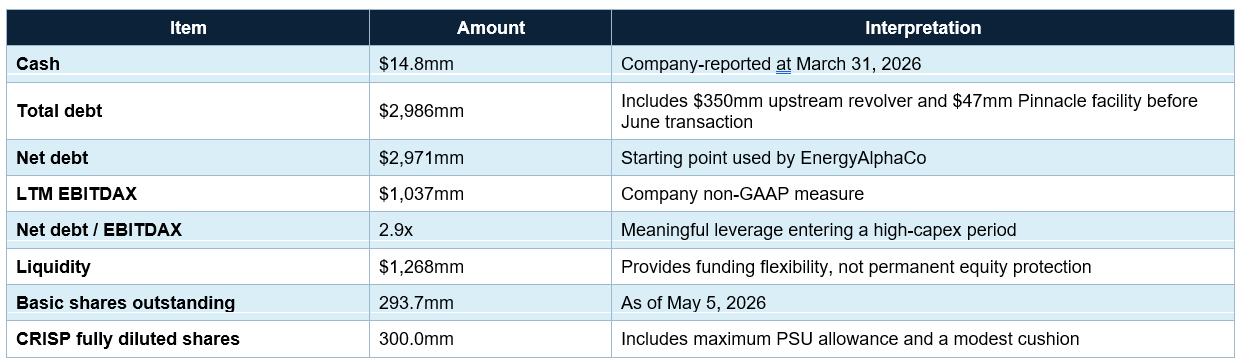
At March 31, Comstock reported $2.986 billion of debt, $14.8 million of cash and approximately $2.971 billion of net debt. Last-twelve-month EBITDAX was $1.037 billion, producing reported net leverage of 2.9 times. Liquidity was approximately $1.27 billion. The upstream revolver matures in November 2027, while the senior notes mature in 2029 and 2030. [2][3]
Liquidity provides time, but it does not eliminate equity risk. In the model base forecast, the 2026–2027 capital program causes net debt to rise before higher gas prices produce a turn in 2028. If gas is lower, costs remain high or production disappoints, both the cash-flow numerator and the balance sheet deteriorate. If gas and execution improve together, the opposite occurs: EBITDAX rises, debt falls and a better multiple is applied to a larger cash-flow stream.
8. Ownership aligns capital, but control and dilution still require a discount
Jerry Jones-controlled entities own 70.9% of the outstanding stock. That position provides long-duration capital and reduces pressure to optimize for a single quarter. It also concentrates voting control, meaning minority holders have limited influence over board composition and strategic direction. [6]
Executive incentives are directionally aligned with returns: the 2025 annual plan weighted return on equity, EBITDAX, leverage improvement, well-cost efficiency, relative TSR and reserve replacement at 15% each, with other strategic objectives at 10%. Long-term PSUs depend on relative TSR. The framework rewards cost and leverage improvement, but reserve replacement and Western Haynesville objectives can also encourage activity. Investors should judge the results by cash returns per diluted share.
Shares outstanding were 293.7 million as of May 5. The company had 2.2 million PSUs outstanding that could issue as many as 4.4 million shares, depending on performance. Unvested restricted stock is already issued and included in shares outstanding. EnergyAlphaCo uses 300 million fully diluted shares, providing a modest cushion for maximum PSU settlement and continuing compensation.
Operating and financial model
Our independent financial and valuation model asks what the existing upstream and Pinnacle platform can produce without assuming a new acquisition, new equity issuance or immediate realization of the most aggressive gas-shortage forecast. The estimates are deliberately transparent and can be updated after each quarter.
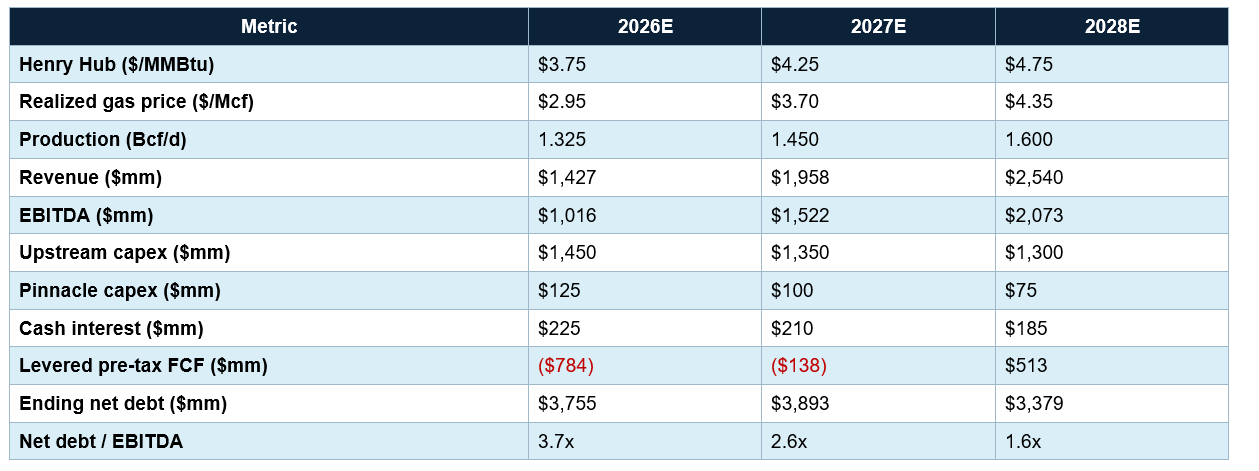
The model’s most important message is timing. Even with a constructive 2028 gas assumption, Comstock does not become a strong free-cash-flow story immediately. The 2026–2027 growth and delineation program absorbs cash and raises debt before 2028 pricing and production create a meaningful surplus. The equity can still work before then as the forward curve changes, but the underlying balance sheet does not improve merely because investors expect a future shortage.
The model estimates exclude working-capital volatility and cash taxes and do not predict exact quarterly timing. They are intended to show the interaction among realized price, volumes, operating cost, capital, interest and net debt. [11]
Henry Hub and natural-gas sensitivity
Comstock’s operating leverage is large. At 1.6 Bcf/d, every $1.00/Mcf change in realized price changes annual revenue by approximately $584 million before hedge settlements, variable taxes, activity changes and basis effects. At 1.9 Bcf/d, the same realized-price change is worth approximately $694 million. Because debt sits ahead of the common stock, the per-share value response is nonlinear.

Illustrative SOTP sensitivity uses a $0.40/Mcf realization drag, $0.74/Mcfe cash operating cost, $35 million of cash G&A, a 5.5 times upstream multiple, $1.8 billion of Pinnacle equity value, $3.38 billion of net debt and 300 million fully diluted shares. It holds debt and costs constant and therefore is not a full scenario forecast. [11]
The commodity-to-equity rule
A bullish Henry Hub forecast is not enough. The expected per-share return requires the price to be realized after basis and hedges, production to be maintained at an acceptable capital cost, and the resulting cash to reduce debt.
Western Haynesville execution test
Western Haynesville is the asset that can turn Comstock into a much larger producer—or convert commodity upside into prolonged capital consumption. The following thresholds are EnergyAlphaCo monitoring standards, not company guidance.
Balance sheet and dilution
The balance-sheet rule
Do not credit Comstock with a higher multiple because leverage is expected to fall. Credit the company only after reported upstream net debt declines and the fully diluted share count remains controlled.
Valuation scenarios
EnergyAlphaCo uses a sum-of-the-parts framework because the upstream business and Pinnacle have different economics. Our model applies a scenario multiple to 2028 upstream EBITDAX, adds a scenario value for Comstock’s Pinnacle equity stake, subtracts net debt and divides by 300 million fully diluted shares. The scenario outputs are conditional reference values, not precise forecasts.

The downside case assumes the gas market remains loose, Western costs remain high and capital outspend continues. The conservative case produces a value modestly above the current price, but still fails to generate positive 2028 levered free cash flow. The base case requires a durable move toward $4.75 Henry Hub, production of 1.6 Bcf/d, improving Western costs and a net-debt peak below approximately $4 billion.
The bull and exceptional cases require more than higher gas. They assume the company can scale production, finance the program without material equity issuance, lower leverage rapidly and support higher upstream and midstream values. Those outcomes are possible; they should not be presented as ordinary twelve-month targets.
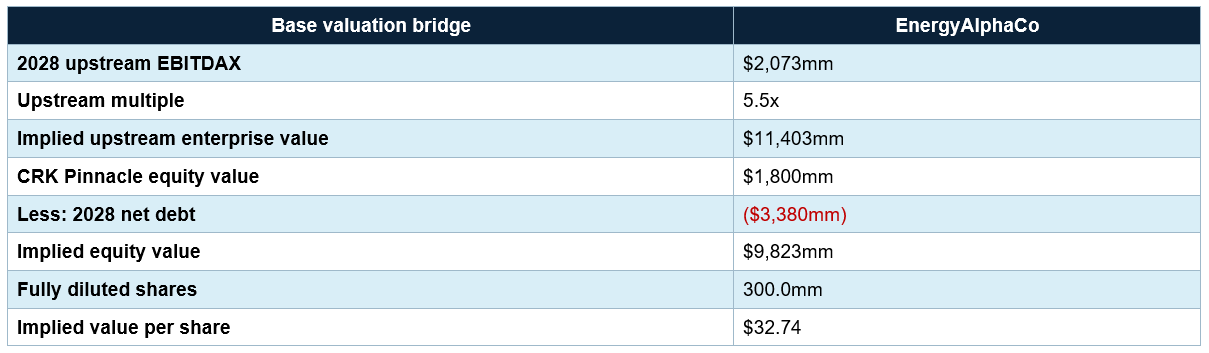
The revised base value is lower than early working versions because the final model includes cash interest in levered free cash flow, uses a 300 million fully diluted denominator and does not treat the Sixth Street proceeds as upstream debt repayment. Those changes make the valuation more conservative and internally consistent.
What must be true
The 2028 gas market must tighten enough to support a durable realized price near the base-case level, not only a short winter spike.
Comstock’s basis and hedge drag must moderate so that higher Henry Hub prices reach cash margins.
Western Haynesville average well costs must decline materially and cumulative production must justify the premium to legacy Haynesville capital.
Production must rise toward 1.5–1.6 Bcf/d without total capital moving materially above the stated framework.
Upstream net debt must peak below approximately $4 billion and begin falling as the gas-price cycle improves.
Pinnacle must generate contractual, distributable value rather than remain primarily a capital-funding vehicle for Comstock’s upstream program.
The fully diluted share count must remain near the model allowance; higher prices should not be offset by avoidable equity issuance.
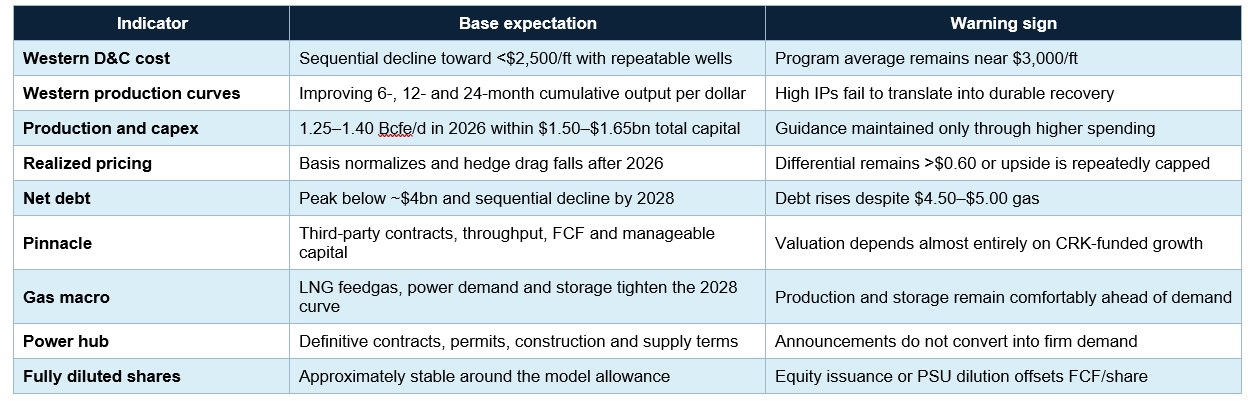
What investors should monitor
Thesis breakers
Western Haynesville combined D&C cost remains near or above $3,000 per foot after the 2026 learning program without clearly superior cumulative production.
Comstock continues to outspend cash flow in a sustained $4.50–$5.00 Henry Hub environment.
Upstream net debt exceeds approximately $4 billion or leverage remains near 3 times during an improving commodity cycle.
The company cannot provide credible evidence that a substantial portion of the Western inventory earns competitive full-cycle returns.
LNG, data-center or power-generation demand is delayed enough that the expected 2028 tightening moves materially later.
Basis differentials and hedge ceilings prevent higher Henry Hub prices from reaching realized cash margins.
Pinnacle requires material additional capital without generating proportionate contracted cash flow or distributions.
Equity issuance, PSU settlement or other claims on value materially exceed the fully diluted allowance.
Final assessment
Comstock is not a conventional low-cost gas producer trading on current free cash flow. It is a leveraged development and commodity-timing thesis. The legacy Haynesville supports the company’s operating credibility, the Western Haynesville provides unusually large optionality, and the Sixth Street transaction confirms that Pinnacle has material strategic value. Those strengths are real.
The missing proof is equally real. Western wells still cost more than twice the legacy program per lateral foot, the 2026–2027 capital plan is likely to consume cash under moderate gas prices, and the hedge book can mute part of the upside. The current stock price discounts much of that risk, but it does not eliminate it.
EnergyAlphaCo classifies CRK as a high commodity sensitivity, and elevated execution risk. A core classification should require three developments: repeatable Western Haynesville returns, a visible turn to positive free cash flow and reported upstream net-debt reduction. Until then, the stock should be treated as a conditional claim on a tighter 2028 gas market and successful execution.
The final test
Can Comstock convert a structurally tighter U.S. natural-gas market and Western Haynesville inventory into durable free cash flow, lower leverage and materially higher fully diluted per-share value? The answer is potentially yes—but the base case requires both the commodity and the company to cooperate.
Sources and methodology notes
[1] Comstock Resources, 2025 Annual Report on Form 10-K, filed February 19, 2026.
[2] Comstock Resources, Quarterly Report on Form 10-Q for the quarter ended March 31, 2026, filed May 6, 2026.
[3] Comstock Resources, First Quarter 2026 Results presentation and earnings release, May 5, 2026.
[4] Comstock Resources, Investor Presentation, June 2026.
[5] Comstock Resources, Form 8-K and press release regarding Sixth Street’s $600 million investment in Pinnacle Gas Services, June 15, 2026.
[6] Comstock Resources, 2026 Proxy Statement, filed April 22, 2026.
[7] NextEra Energy and Comstock Resources announcements regarding the Texas power-generation hub, March 20–23, 2026.
[8] U.S. Energy Information Administration, Short-Term Energy Outlook, July 2026.
[9] Chronometer Partners LP, “Why U.S. Natural Gas Prices Go a Lot Higher in 2028,” June 22, 2026 with July 2026 update. Third-party research used as context only.
[10] Uploaded third-party CRK research from various analysts. Used only to identify outside theses and assumptions; not treated as evidence.
[11] EnergyAlphaCo independent financial and valuation model — Comstock Resources / CRK, final version dated July 27, 2026. All outputs are EnergyAlphaCo estimates.
[12] CRK market price and market capitalization as of July 27, 2026.
Methodology notes
Company-reported drilling-location counts are not treated as SEC proved reserves or verified economic inventory.
Free cash flow is defined in this report as EBITDA less upstream capital, Pinnacle capital and cash interest, before working-capital changes and cash taxes, unless otherwise specified.
The model values upstream EBITDAX separately from Comstock’s Pinnacle equity stake to reduce direct double counting.
The Sixth Street transaction value is a market reference, not an independent appraisal or guarantee of future distributions.
Fully diluted shares are an EnergyAlphaCo economic estimate and should be updated after each quarterly filing.
Scenario values are conditional 2028 reference outcomes, not conventional twelve-month price targets.
Investment-risk disclosure
This material is for informational and educational purposes only. It does not constitute individualized investment advice, an offer to buy or sell securities, or a recommendation suitable for any particular investor. Natural-gas and energy equities can be highly volatile and may be affected by commodity prices, weather, production performance, reserve estimates, drilling costs, decline rates, infrastructure, hedges, leverage, capital-market access, regulation, litigation, environmental events and other risks.
Commodity forecasts, production estimates, maintenance-capital assumptions, Pinnacle values and model scenarios are inherently uncertain and may be materially wrong. Readers should perform their own due diligence and consider their financial circumstances and risk tolerance. The author owns shares of Comstock Resources (NYSE: CRK).