
Atlas Lithium: What Must Be Proven Before a Full Thesis Audit?
A permitted project, an unusually strong feasibility study—and a funding package that still must move from expectation to cash.
Initial classification: Watchlist / High Risk
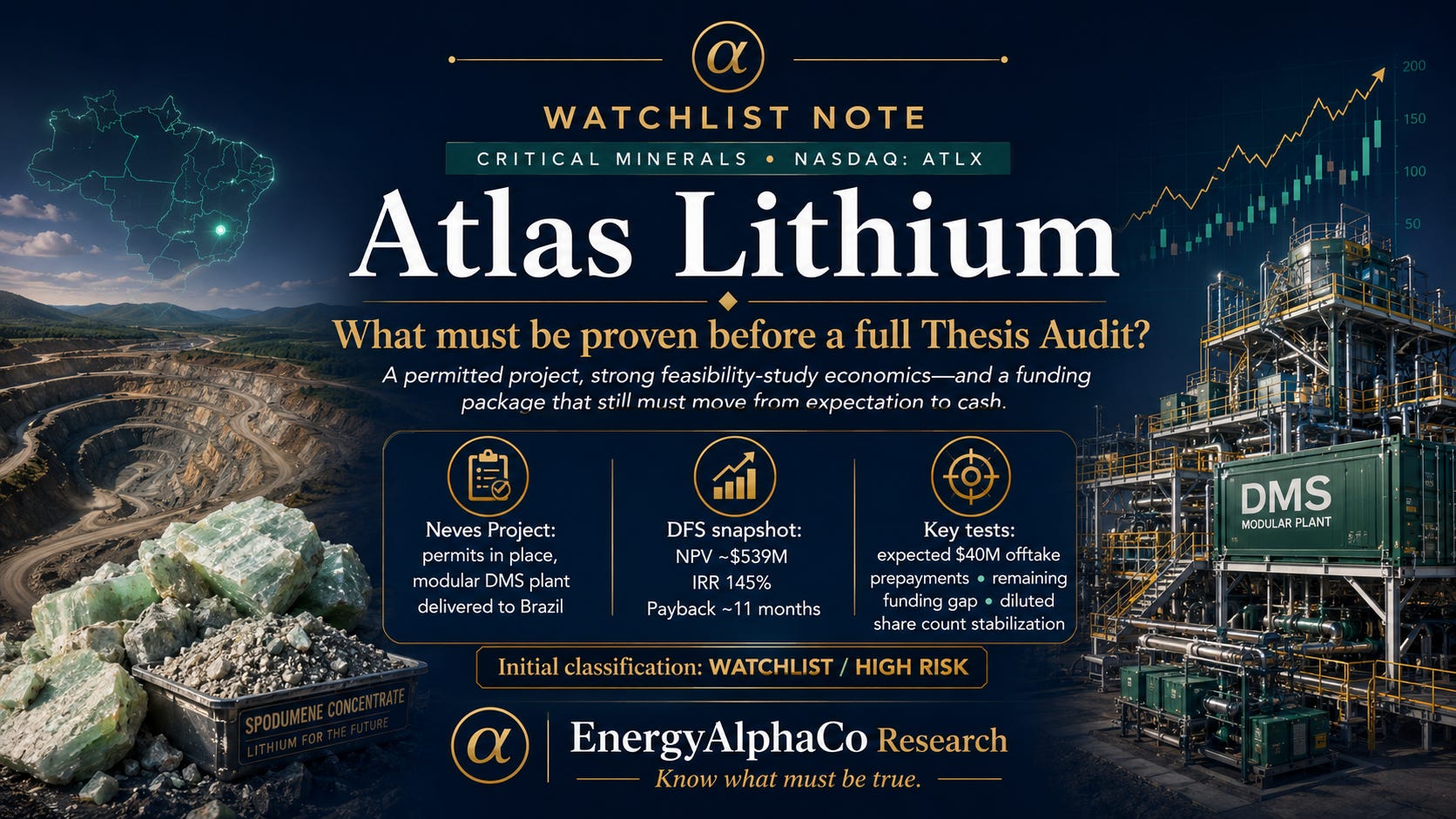

Why Atlas Lithium is on the watchlist
Atlas Lithium has reached the stage where the central debate is no longer whether it has identified a potentially economic lithium deposit. The more important question is whether it can finance, build and commission the Neves Project without allowing dilution and cash burn to consume too much of the project’s apparent value.
The company’s May 2025 feasibility study reported an after-tax net present value of approximately $539 million, a 145% after-tax internal rate of return and an 11-month payback period. Atlas has since received the expansion permit required to implement the larger project plan, delivered its modular dense-media-separation plant to Brazil and contracted several Brazilian engineering and construction firms.
Those are meaningful de-risking steps. They do not yet amount to a financed mine.
The company in one paragraph
Atlas Lithium is a pre-revenue lithium developer focused on the 100%-owned Neves Project in Minas Gerais, Brazil. The current plan is built around an open-pit mine and modular dense-media-separation plant producing 5.5% lithium-oxide spodumene concentrate. Atlas also controls a broader lithium exploration portfolio of approximately 557 square kilometers and owns roughly one-fifth of Atlas Critical Minerals. For equity investors, however, the near-term value rests primarily on Neves: financing, construction, commissioning, concentrate quality and the number of ATLX shares outstanding when cash flow begins.
The basic investment question:

This distinction matters. A project can be economically attractive at the asset level while producing a disappointing equity outcome if it is financed on unfavorable terms or if the share count rises faster than project value.
What looks interesting
1. Neves has passed several genuine development milestones
The Neves Project has received its mining concession and the expansion permit needed to build and operate the processing plant and sell concentrate. The modular DMS plant has already been manufactured and transported to Brazil. Atlas has also engaged Promon Engenharia, TSX Engineering, Cerne Construções, RETC Infraestrutura and Alfa Engenharia for engineering, mine design, facilities, earthworks and plant assembly scopes.
These steps reduce permitting and equipment-procurement uncertainty. The remaining challenge is integrating the work under a funded construction schedule with clear cost accountability.
2. The feasibility study shows substantial asset-level leverage
The feasibility study assumes average plant throughput of approximately 1.1 million tonnes of ore per year, initial mine life of 6.5 years and production of roughly 150,000 tonnes of SC5.5 concentrate annually. It estimates initial capital of approximately $57.6 million and an average product cost of about $489 per tonne of concentrate.
The headline economics are compelling, but they are not commodity-price neutral. The $539 million after-tax NPV and 145% IRR use a flat SC5.5 price of $1,700 per tonne. That is an explicit model assumption, not a guaranteed realized price. A full Thesis Audit must rebuild the economics across lower and higher spodumene-price scenarios and include royalties, taxes, ramp losses, working capital and any remaining owner’s costs.
3. Strategic counterparties provide external validation
Mitsui invested $30 million in Atlas Lithium in 2024 and entered into an offtake arrangement covering an initial shipment and potential longer-term Phase 2 volumes. Two additional strategic buyers invested $5 million each and are expected—subject to the applicable agreements and conditions—to provide $20 million of offtake prepayments apiece.
The distinction between strategic interest and funded construction is critical. The equity case should be updated only when the $40 million is received or the company discloses sufficiently detailed binding terms, conditions and timing.
4. Government attention could improve financing options—but is not funding
Neves was identified in a U.S.–Japan critical-minerals initiative as a project that could be considered for potential financial support. That recognition may improve Atlas Lithium’s strategic relevance and widen the financing conversation. It is preliminary and non-binding. No government loan, grant or guarantee should be included in valuation until definitive documentation is announced.
What must be proven
The $40 million must become cash, not remain an expectation
Atlas’ presentation describes two expected $20 million offtake prepayments. The Watchlist test is straightforward: receipt, binding conditions, repayment mechanism, pricing formula, security package, delivery obligations and remedies for delay must be disclosed. Prepayments are not free capital; they generally create future delivery or repayment obligations and may affect realized pricing and working capital.
The complete sources-and-uses schedule must reconcile
The feasibility study’s approximately $57.6 million initial-capital estimate should not be treated as identical to the cash still required from today. Investors need a current bridge showing expenditures already made, remaining direct construction costs, contingency, owner’s costs, taxes, working capital, mine pre-stripping, commissioning inventory and corporate cash needs through positive free cash flow.
Dilution must stop outrunning project progress
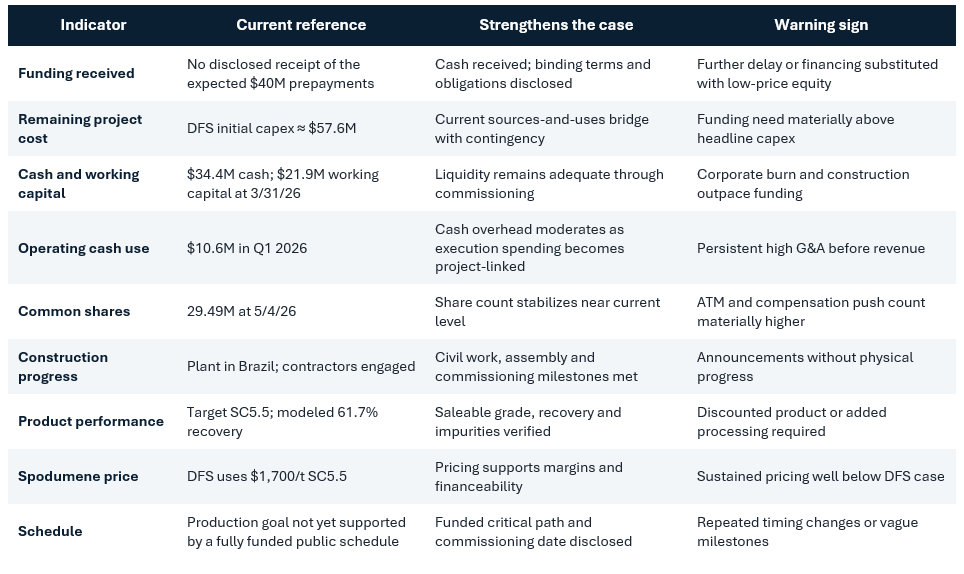
ATLX had approximately 16.0 million common shares outstanding at the end of 2024, 27.1 million on March 3, 2026 and 29.5 million on May 4, 2026. At March 31, the company also reported 508,163 vested options, 75,000 warrants and 189,500 restricted stock units. Its $75 million shelf includes up to $40 million that may be sold through the ATM program.
The first-quarter share issuance is especially relevant: Atlas issued 801,413 common shares, including 658,335 for stock-based compensation and services and 143,078 through the ATM. A future Thesis Audit must use the share count expected at first production—not a stale basic count—to determine value per share.
Cash burn and construction spending must become more transparent
Atlas reported $34.4 million of cash and $21.9 million of working capital at March 31, 2026. Operating activities used $10.6 million during the quarter, while investing activities used another $1.3 million. The cash balance alone therefore does not prove that project construction is fully funded, particularly while corporate expenses continue and capital spending is set to increase.
The plant must deliver saleable product at modeled recovery and cost
The DMS design targets SC5.5 concentrate and uses a modeled average lithium recovery of 61.7%. The technical report also notes that mica and iron-bearing material may require additional separation if they affect product quality. Commissioning must establish concentrate grade, recovery, throughput, impurity levels and realized operating costs under commercial conditions.
What could make us pass
The expected offtake prepayments are delayed, reduced or conditioned on milestones that require substantial equity funding first.
The current sources-and-uses schedule reveals a materially larger funding requirement than the headline $57.6 million capital estimate.
ATLX relies heavily on the ATM at depressed prices, pushing the fully diluted share count materially above the present roughly 30 million baseline.
Construction begins without a disclosed contingency and working-capital buffer, increasing the risk of an emergency financing during commissioning.
The production schedule slips again without measurable physical progress, committed capital or a credible revised critical path.
Commercial concentrate fails to achieve target grade, recovery or impurity specifications, weakening realized pricing or raising processing costs.
The lithium-price environment remains well below the DFS assumption for long enough to impair financing availability or project returns.
Government-support headlines continue without binding capital while investors treat them as financed value.
Key metrics to monitor
What would justify a full Thesis Audit?
EnergyAlphaCo should advance ATLX to the full Thesis Audit once the financing and construction picture becomes sufficiently concrete to model. The ideal trigger would be a definitive announcement covering the offtake prepayments or another material funding source, paired with an updated project schedule and sources-and-uses statement.
At that point, the full audit should reconstruct:
Remaining capital and corporate liquidity through first sale and steady-state production.
The economic cost of each financing source, including offtake pricing, repayment and security terms.
Fully diluted shares at first production under several funding paths.
Cash flow across downside, conservative, base, bull and exceptional-execution spodumene-price scenarios.
Per-share value after debt, contingent obligations, taxes, royalties, working capital and Atlas Critical Minerals ownership.
Construction, ramp and operating milestones that confirm or invalidate each scenario.
Initial classification

Final assessment
Atlas Lithium is more advanced than a typical early-stage lithium explorer. Neves has a feasibility study, mining rights, operational and expansion permits, a modular plant in-country, strategic counterparties and multiple execution firms under contract. Those facts justify serious attention.
But the next increment of value will not come from another statement that the project has strong demand or strategic importance. It must come from financing that is received on acceptable terms, construction that can be measured and a share count that stops expanding faster than the project is being de-risked.
That is why ATLX belongs on the EnergyAlphaCo Watchlist now—and why the full Thesis Audit should wait for the funding disclosure that will determine who captures the project’s apparent value: existing shareholders, new capital providers or offtake partners.
Sources
Atlas Lithium, Form 10-Q for the quarter ended March 31, 2026 (filed May 2026).
SGS Geological Services, S-K 1300 Technical Report Summary—Neves Lithium Project, effective May 15, 2025.
Atlas Lithium, Brief Corporate Overview, April/June 2026.
Atlas Lithium, “Atlas Lithium Granted Expansion Permit for Its Neves Project,” June 29, 2026.
Atlas Lithium, project-execution partner announcements, April 27 and May 18, 2026.
U.S.–Japan critical-minerals project identification announcement, March 2026.
Disclosure
This material is for informational and educational purposes only and does not constitute individualized investment advice. EnergyAlphaCo may discuss securities in which the author has a financial interest. The author is considering owning shares of Atlas Lithium. Company projections and feasibility-study outputs are not guarantees of future performance. Development-stage mining investments involve substantial commodity-price, financing, permitting, construction, operating, political and dilution risks.