
Are the Lithium Bears Wrong?
Sodium-ion, energy storage, battery economics, compounding demand and the difference between lithium in the ground and lithium that can actually be financed and delivered.
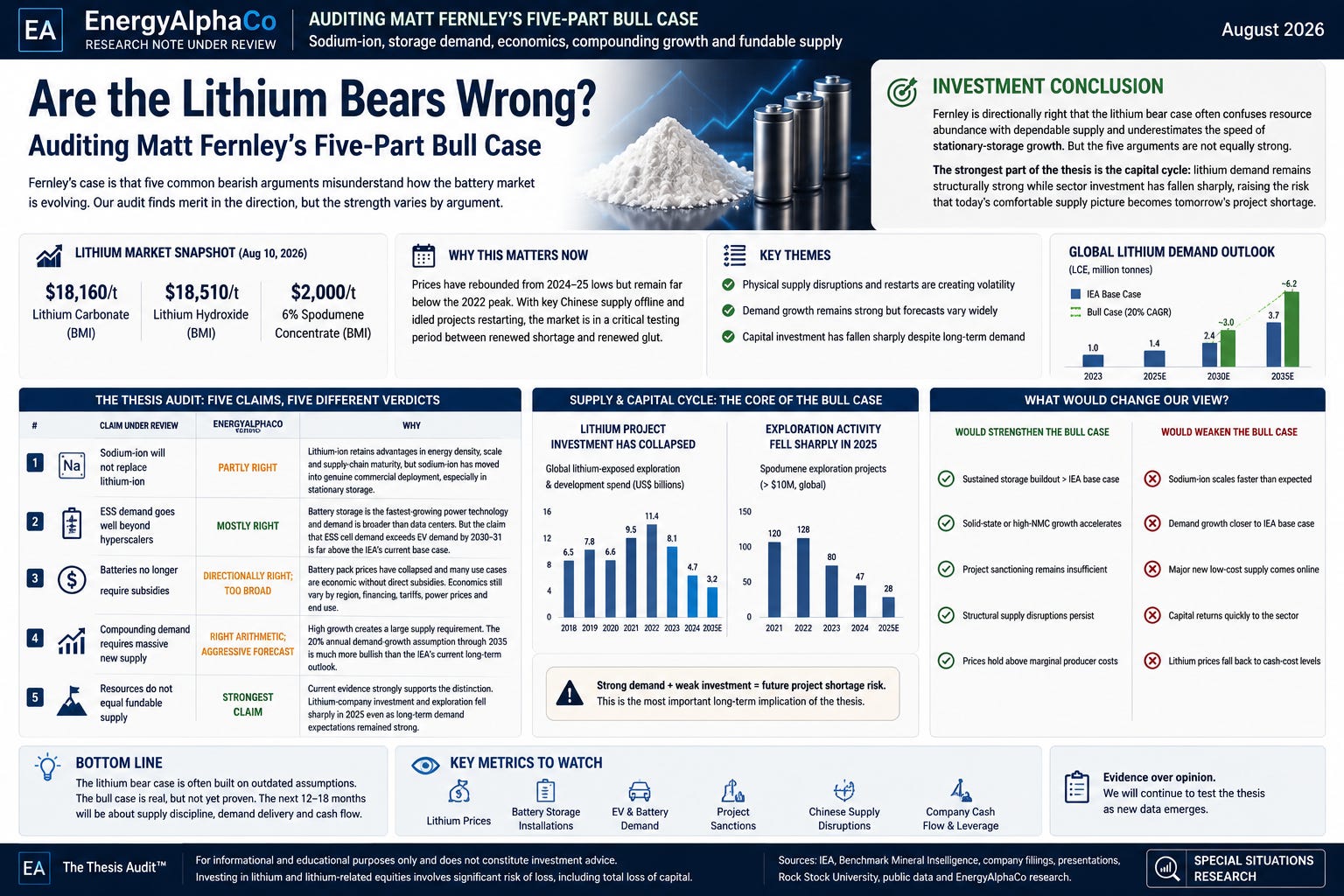
Investment conclusion: Fernley is directionally right that the lithium bear case often confuses resource abundance with dependable supply and underestimates the speed of stationary-storage growth. But the five arguments are not equally strong. Sodium-ion is a more credible competitive threat than the video suggests; the claim that stationary storage overtakes EV battery demand by 2030–31 is substantially more aggressive than the IEA’s current outlook; and the long-term 20% lithium-demand CAGR is a bull-case assumption, not a verified base case. The strongest part of the thesis is the capital cycle: lithium demand remains structurally strong while sector investment has fallen sharply, raising the risk that today’s comfortable supply picture becomes tomorrow’s project shortage.
The thesis under review
This Research Note Under Review examines the recent Rock Stock University video “5 Reasons the Lithium Bears Are Wrong,” presented by Matt Fernley, a geologist, materials analyst and partner at RK Equity. Fernley’s case is that five common bearish arguments misunderstand how the battery market is evolving: sodium-ion will not displace lithium-ion at scale; stationary energy storage is a much larger demand driver than the market appreciates; battery economics have improved enough to reduce dependence on subsidies; compounding lithium demand will require enormous new supply; and large geological resource estimates overstate the amount of lithium that can actually be financed and brought into production.
EnergyAlphaCo’s purpose is not to endorse or rebut Fernley as a personality. It is to audit the chain of evidence. The question that matters for investors is narrower: which of these claims survive independent verification, which depend on aggressive assumptions, and what would they imply for lithium pricing, developer financing risk and fully diluted per-share value if they prove correct?
Why this argument matters now
Lithium is no longer sitting at the extreme lows that defined much of 2024 and 2025. Benchmark Mineral Intelligence assessed lithium carbonate at about $18,160 per tonne, lithium hydroxide at about $18,510 per tonne and 6% spodumene concentrate at about $2,000 per tonne on August 10, 2026. Those levels are well above the worst of the downturn, but still far below the 2022 bubble. The market has therefore moved from a simple “glut versus recovery” debate into a harder question: how much supply returns at these prices, and can the industry finance enough new supply to meet the demand that arrives after the current restarts?
The latest supply news makes that tension visible. CATL’s Jianxiawo lithium mine in Jiangxi remained closed as of August 7 while environmental approval was still pending, despite the company having cleared an important safety-permit hurdle earlier in the summer. The closure has been a major swing factor in Chinese price expectations. At the same time, higher prices are encouraging previously idled supply to restart. That combination argues against treating either a renewed shortage or a renewed glut as predetermined.
The Thesis Audit: five claims, five different verdicts
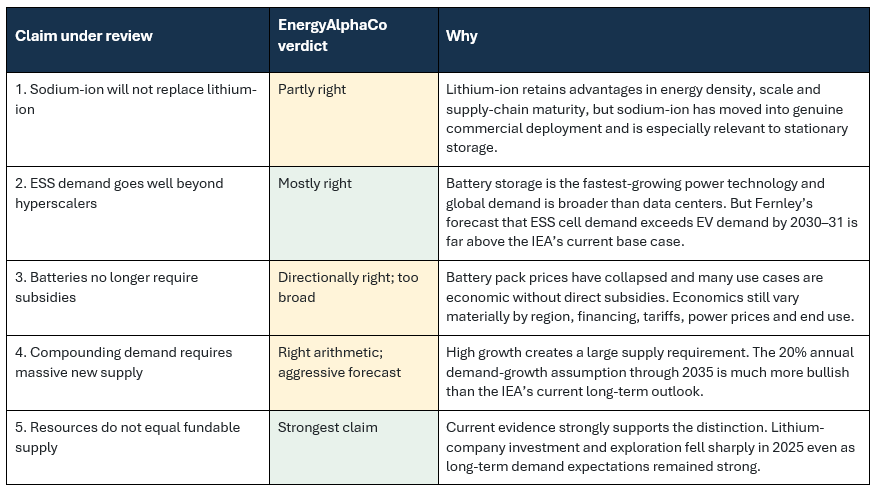
1. Sodium-ion: the bears are too aggressive, but Fernley is too dismissive
Fernley argues that sodium-ion batteries are structurally inferior to lithium iron phosphate (LFP) batteries because of lower energy density and therefore will not replace lithium-ion across mass-market applications. The first half of that statement is supported by current technology data; the second is too categorical.
The IEA’s 2026 battery work places the latest sodium-ion cells at up to roughly 175 Wh/kg, versus about 205 Wh/kg for leading LFP cells and 265 Wh/kg for NMC. CATL likewise advertises 175 Wh/kg for its Naxtra sodium-ion passenger-vehicle battery. That is a meaningful energy-density disadvantage versus LFP, but not the “multiples heavier” gap implied by the video. Fernley’s own volumetric figures also do not mathematically support a universal two-times size penalty.
More importantly, sodium-ion is no longer just a laboratory alternative. CATL has announced a three-year, 60 GWh sodium-ion energy-storage cooperation agreement with HyperStrong, plans initial sodium-ion storage deliveries in 2026, and has subsequently announced additional European sodium-ion storage partnerships. The IEA now describes 2026 as a potentially pivotal year for sodium-ion commercialization.
EnergyAlphaCo interpretation: The right conclusion is not “sodium-ion replaces lithium,” and it is not “sodium-ion is irrelevant.” Lithium-ion should remain the dominant chemistry through the foreseeable investment horizon, especially where energy density matters. But stationary storage is precisely the application where energy density matters less, which makes sodium-ion a credible source of demand substitution at the margin. A lithium bull case that depends on every incremental storage gigawatt-hour remaining lithium-based is too aggressive.
2. ESS demand: Fernley identifies the right second engine, but likely overstates the timing
The strongest demand-side point in the video is that investors remain too EV-centric. Stationary battery storage is not merely a hyperscaler story. It is increasingly part of the basic architecture required to integrate solar and wind, manage peak loads, provide short-duration flexibility and stabilize power systems.
The IEA calls battery storage the fastest-growing power technology today. Global additions reached 108 GW in 2025, up about 40% from 2024, and installed capacity is now roughly eleven times the 2021 level. LFP batteries account for around 90% of deployments. Separately, the IEA says global battery demand exceeded 1.5 TWh in 2025, with storage emerging as a major driver of growth. Reuters reported at the start of 2026 that energy storage was expected to account for roughly 31% of lithium consumption in 2026, up from about 23% in 2025, based on industry forecasts cited in the report.
That supports Fernley’s core claim that the market should not reduce lithium demand to EV sales alone. It does not, however, independently validate his forecast that stationary storage demand for cells will exceed EV demand by 2030–31. The IEA estimates EV battery deployment at about 1.2 TWh in 2025 and almost 3 TWh by 2030. Its public forecasts continue to show EVs as the dominant battery application through 2030, even as storage grows faster.
This distinction matters because the equity consequences are different. If storage merely becomes a large second engine, lithium demand can remain structurally strong without requiring a heroic forecast. If storage actually overtakes EV demand by the beginning of the next decade, then long-term lithium demand and price assumptions would need to be revised materially higher.
3. Battery economics: the direction is correct; the “no subsidies” claim is too universal
Fernley is right that battery economics have changed dramatically. BloombergNEF’s 2025 survey put the volume-weighted average lithium-ion battery pack price at $108/kWh, down 8% year over year. Average pack prices in China were about $84/kWh, while stationary-storage pack prices fell to roughly $70/kWh. This is an extraordinary reduction from the early years of the industry.
One numerical point in the transcript does require correction or at least source clarification. Fernley cites a 2016 battery-pack cost of $365/kWh. BloombergNEF’s historical survey reports an average pack price closer to $273/kWh in 2016. The direction of the argument is unchanged—the decline has been enormous—but the starting figure should not be presented as independently verified without identifying a different methodology or source.
The broader statement that batteries are now economic “without subsidies” also needs qualification. In many Chinese EV and stationary-storage applications, current battery costs clearly support economics that would have been impossible a decade ago. But end-market economics still depend on electricity prices, financing, tariffs, vehicle segment, charging assumptions, utilization and grid-market design. Lazard’s 2026 work also shows that standalone storage costs have recently risen in some markets as tariffs restrict access to low-cost Chinese cells.
Fernley’s related argument—that lithium prices could rise materially without destroying battery economics—is more plausible than the bear case often implies. Lithium is a meaningful input, but it is not the entire battery. The 2025 battery-price decline occurred even as some battery-metal costs increased, because chemistry mix, manufacturing scale and competitive pressure offset part of the raw-material increase.
What matters for lithium investors: The battery demand curve is not perfectly price-inelastic, but today’s pack economics provide more room for lithium-price normalization than they did when batteries cost several hundred dollars per kWh. That makes a return to sustainable incentive pricing compatible with continued battery adoption. It does not justify assuming a return to 2022 lithium prices.
4. Compounding demand: the arithmetic is powerful, but 20% for a decade is a bull case
Fernley’s fourth argument is mathematically important. High compound growth rates create enormous absolute supply requirements even when the market begins from a relatively small base. That is exactly why commodity investors can misread a market that appears oversupplied today: the relevant question is not simply how much lithium exists, but how much incremental annual production must be added several years from now.
The independent data confirm strong growth, but not Fernley’s full long-term rate. The IEA estimates global battery demand grew more than 35% in 2025 to above 1.5 TWh and says lithium demand has increased by roughly 25% per year on average over the past two years. Its 2026 Critical Minerals Outlook nevertheless projects lithium demand rising a little more than threefold through 2040 under stated policies. That is a powerful structural growth rate, but materially below a 20% annual CAGR sustained through 2035.
Fernley’s forecast of a lithium market above 9 million tonnes LCE by 2035 should therefore be treated as a third-party bull-case estimate rather than a verified industry baseline. The same applies to the calculation that 35–40 new operations comparable with the world’s largest mines will be required. The arithmetic is directionally useful, but the number of “new mines” depends on project size, brownfield expansions, recovery rates, recycling, chemistry substitution and the share of future supply that comes from brines, hard rock, clays and direct-lithium-extraction projects.
For EnergyAlphaCo, the better framing is scenario-based. A moderate long-term demand CAGR can still create a meaningful supply deficit if the investment pipeline is underfunded. A 20% CAGR would create a much more severe shortage, but it should not be embedded in a developer valuation as if it were a base-case certainty.
5. Resources versus fundable supply: this is the thesis investors should take most seriously
Fernley’s final argument is the strongest because it separates geology from finance. Lithium is not geologically rare in the way some specialty minerals are. That fact says very little about how much battery-grade product can be delivered on time, at the required specification, at a competitive cost and with a capital structure that leaves value for common shareholders.
The latest IEA data strongly support this distinction. Critical-mineral investment fell 9% in 2025. Battery-metal capital spending fell by more than 20%, the largest decline in more than a decade, and lithium-focused companies cut investment by around 40%. Lithium exploration spending fell by roughly 45%. Yet the IEA still expects supply deficits for lithium to persist through 2035 based on the current announced-project pipeline, even though the projected gap has narrowed from earlier estimates.
PLS CEO Dale Henderson has framed the same problem as the difference between resource tonnes and “investable tonnes”—supply that has the quality, economics, execution capability and commercial alignment required to attract capital and actually reach the market. That is a more useful framework for equity investors than headline resource tonnage.
CATL’s Jianxiawo mine is a live reminder that even an existing strategic asset can disappear from supply for regulatory reasons. New projects face an even longer checklist: permitting, infrastructure, metallurgy, financing, construction, commissioning, customer qualification and working capital. The market can discover lithium faster than it can build dependable supply.
The point the lithium bears may still be right about
A fair audit also has to acknowledge that the near-term bear case has not disappeared. Reuters’ June review of the market noted that higher 2026 prices were already encouraging the restart of idled capacity, and several banks and consultancies expected prices to soften again as supply responded. This is how commodity cycles work: a price signal that is high enough to finance new supply eventually creates the supply that weakens the price signal.
The lithium bull case therefore cannot simply be “demand is growing.” Demand has grown rapidly throughout much of the downturn. The key variables are the slope of the cost curve, the amount of idled capacity that can return cheaply, the timing of Chinese lepidolite and African spodumene supply, the financing threshold for greenfield projects, and whether storage demand can absorb the supply response before the market returns to surplus.
This is also why the current price level matters. At roughly $2,000/t for 6% spodumene in early August, the market has already re-rated materially from the 2025 lows. Investors buying lithium equities today are not buying the same commodity setup that existed at the bottom. The burden of proof has shifted from “can prices recover?” to “can prices remain high enough, long enough, to finance the next wave without triggering an overwhelming supply response?”
Commodity-to-equity implications
The most important conclusion for lithium equities is that sector exposure should not be treated as homogeneous. A rising lithium price helps nearly every producer’s revenue line, but it can affect equity value very differently depending on the balance sheet, project status and financing requirement.
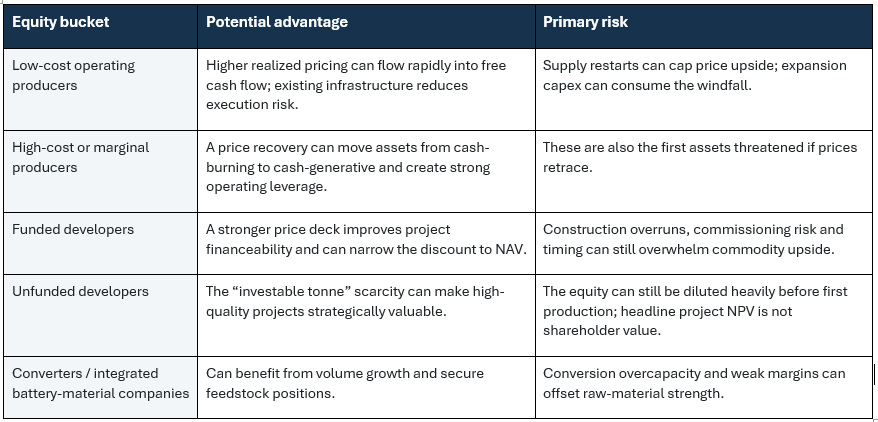
For development-stage equities, the critical distinction is between project value and per-share value. A developer can own a technically attractive resource and still destroy common-shareholder value if it must issue excessive equity to fund construction. The most attractive projects should therefore combine low operating costs, manageable capital intensity, credible metallurgy, infrastructure access, binding customer support and a funding plan that minimizes dilution.
What must be true for the bullish thesis to work
Stationary-storage deployments must remain a major second engine of battery demand even if data-center enthusiasm cools.
EV battery demand must continue growing fast enough that storage growth adds to, rather than merely replaces, transport-related lithium demand.
Sodium-ion must remain a complementary chemistry rather than take a dominant share of stationary storage.
Lithium prices must remain high enough to incentivize new supply but not so high that they accelerate substitution, recycling or demand destruction.
The current collapse in lithium-sector investment must persist long enough to create a genuine development gap in the early 2030s.
High-quality developers must be able to secure project finance, offtake or strategic capital without excessive common-equity dilution.
Chinese, African and Australian supply responses must be slower or more capital-intensive than the most bearish supply models assume.
EnergyAlphaCo monitoring scorecard
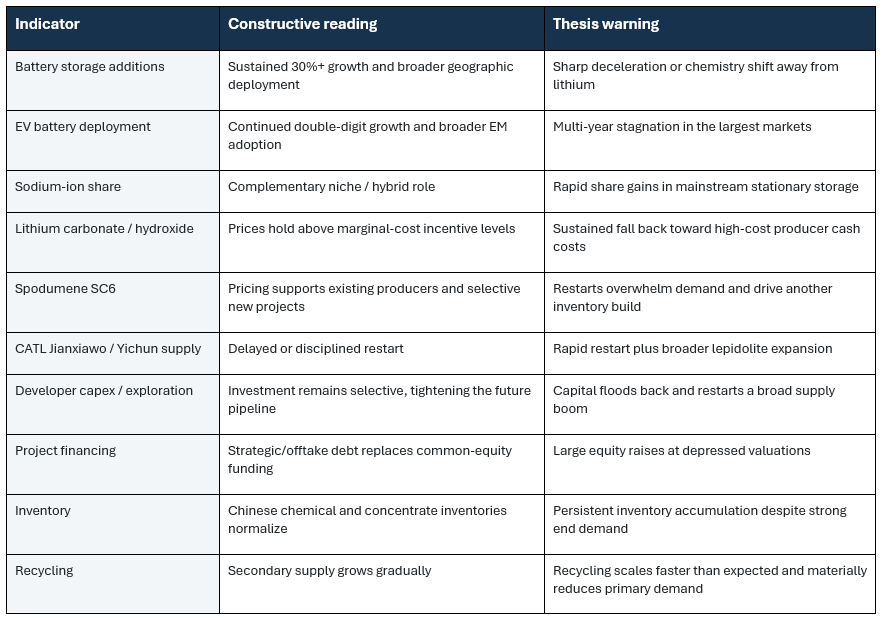
Thesis breakers
Sodium-ion becomes the preferred chemistry for a large portion of stationary storage faster than expected.
ESS deployment growth slows materially as power markets saturate or project economics deteriorate.
EV demand disappoints for several years rather than experiencing a normal cyclical slowdown.
Chinese lepidolite, African spodumene and restarted Australian capacity consistently arrive faster than demand can absorb them.
Battery efficiency or materials intensity falls much faster than expected, reducing lithium required per delivered kWh.
Recycling supplies a material portion of lithium demand earlier than expected.
Capital returns aggressively to lithium development before deficits emerge, rebuilding the future supply pipeline.
Developers respond to higher prices with large dilutive equity raises, leaving project NAV growth disconnected from per-share value.
Final assessment
Fernley’s video is valuable because it attacks several lazy versions of the lithium bear case. Lithium is abundant in the earth’s crust, but that is not the same as saying the battery market will always have enough low-cost, permitted, financed and qualified supply. Battery storage is becoming a major independent demand source. Battery costs have fallen enough that lithium prices can normalize without automatically breaking end-market economics. And high compound growth rates can overwhelm a supply pipeline that looks comfortable when viewed only through today’s balance.
The audit also shows why the bull case should not be accepted wholesale. Sodium-ion is advancing faster than the video’s dismissal suggests. Stationary storage overtaking EV demand by 2030–31 is not supported by the IEA’s current base case. A 20% lithium-demand CAGR through 2035 is an aggressive scenario. And current lithium prices have already recovered enough to encourage supply restarts, so investors should not assume the market is still pricing a cycle bottom.
EnergyAlphaCo verdict: The lithium bears may be wrong for the right reason. The world probably does have plenty of lithium resources. The investable question is whether enough of those resources can be converted into dependable, financeable supply on the timeline required by EVs and an increasingly important stationary-storage market. That capital-and-execution gap—not geological scarcity—is the most compelling long-term bull case for lithium.
For equity investors, the implication is equally important: the best lithium exposure is unlikely to be the company with the largest headline resource or the highest sensitivity to a heroic price deck. It should be the company that can convert conservative lithium assumptions into free cash flow and fully diluted per-share value while surviving the inevitable commodity cycle between now and first production.
Sources and methodology
The third-party video/transcript was used to identify the thesis and its assumptions. EnergyAlphaCo independently checked material claims against current public sources. No proprietary RK Equity charts, tables or research materials are reproduced.
International Energy Agency — Global Critical Minerals Outlook 2026: Executive Summary
International Energy Agency — Global Critical Minerals Outlook 2026: Market Overview
International Energy Agency — Global Critical Minerals Outlook 2026: Outlook
International Energy Agency — Global EV Outlook 2026: Electric Vehicle Batteries
International Energy Agency — Global Energy Review 2026: Battery Storage
BloombergNEF — Lithium-Ion Battery Pack Prices Fall to $108/kWh (December 9, 2025)
CATL — CATL and CHANGAN Launch Mass-Production Sodium-Ion Passenger Vehicle (February 5, 2026)
PLS — Fastmarkets Conference 2026 Corporate Presentation: Investable Tonnes
Reuters — Lithium bust is over but will battery metal boom again? (June 2026)
Reuters — Energy storage boom strengthens demand outlook for beaten-down lithium (January 2026)
Benchmark Mineral Intelligence — Lithium Price Watch, August 2026
Investment-risk disclosure
This material is for informational and educational purposes only and does not constitute individualized investment advice, a recommendation, or an offer to buy or sell any security. Commodity prices, project economics and equity valuations can change materially and rapidly. EnergyAlphaCo may discuss securities in which the author has a financial interest. This article evaluates a third-party thesis originally presented by Matt Fernley and Rock Stock Channel / RK Equity; no affiliation with or endorsement by Matt Fernley, RK Equity or Rock Stock Channel is implied. All conclusions are EnergyAlphaCo’s independent interpretation based on the cited public information available as of August 14, 2026.