
After the Print: Comstock Resources Q2 2026: Production Rebounds, but the Self-Funding Test Remains
Tracking what changed in the CRK Thesis Audit after the earnings release, presentation and management call.

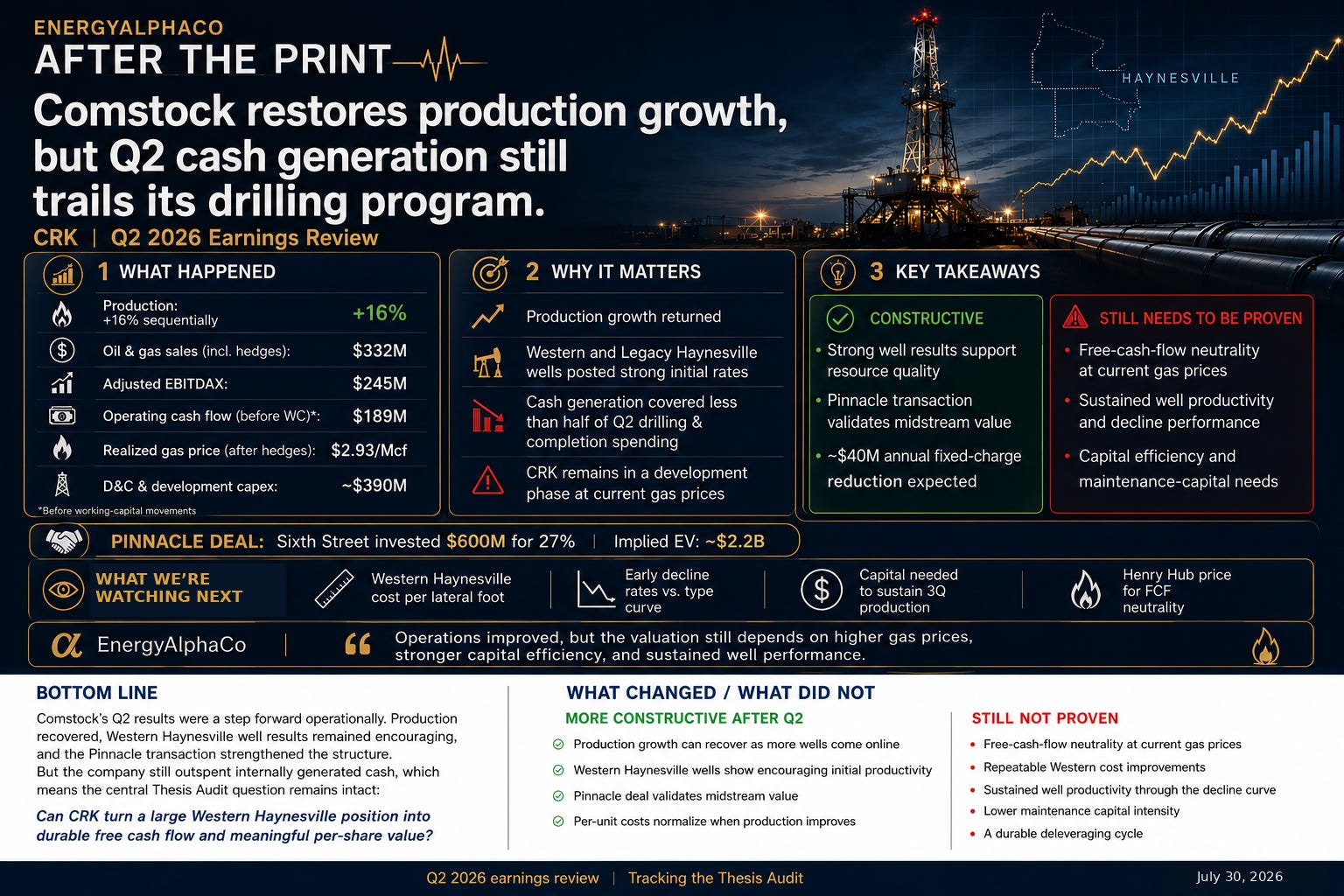
Note: EnergyAlphaCo summary graphic. Company-reported figures are from Comstock’s Q2 2026 materials; conclusions are EnergyAlphaCo interpretation.
Bottom line: Q2 strengthened the resource and production case, but it did not yet prove that Western Haynesville development can become self-funding at current natural-gas prices.
Investment conclusion
Comstock Resources delivered a better operating quarter than its first-quarter results suggested. Production increased 16% sequentially, unit operating costs returned to a more normal level, and both Western and Legacy Haynesville wells continued to post strong initial rates. The Sixth Street investment in Pinnacle also supplied an external valuation marker for the midstream system and removed Pinnacle’s debt and preferred-equity burden.
The quarter was not enough to close the central gap in the CRK thesis. Operating cash flow before working-capital changes was $189 million, while upstream development spending was approximately $390 million. At the Q2 realized gas price, Comstock’s internally generated cash covered less than half of the development program. The company therefore remains in a capital-consuming delineation and growth phase rather than a durable free-cash-flow phase.
The earnings call clarified why Western Haynesville drilling costs rose and outlined a credible path to better execution: larger-diameter laterals, higher-temperature motors, a 10,000-PSI rig and, eventually, multi-well pad development. But management also indicated that larger completions may offset part of the drilling savings. The near-term objective is therefore not simply a lower headline D&C cost. It is a better economic well: similar or modestly lower total cost with higher recoverable reserves and more repeatable execution.
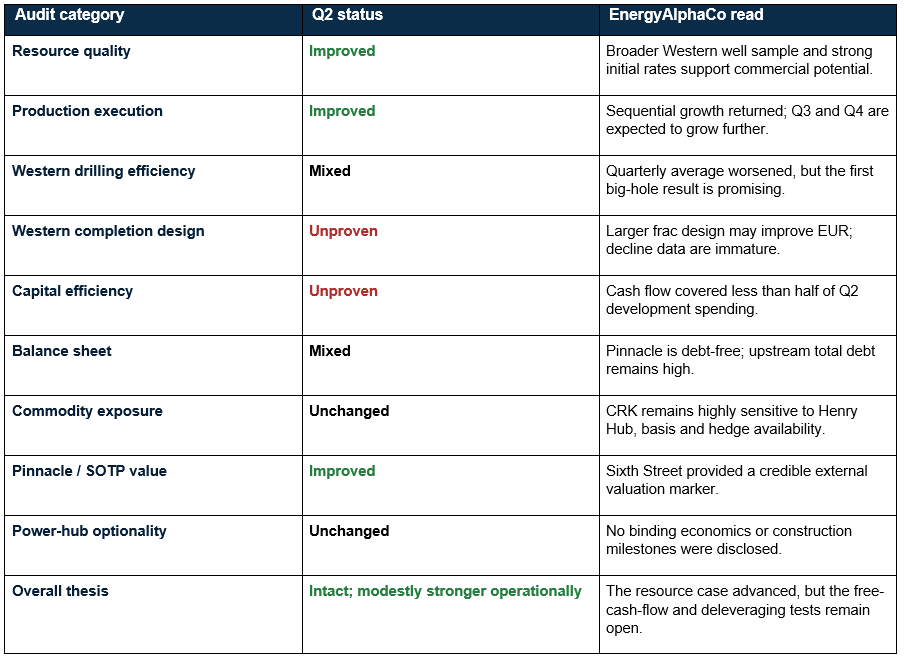
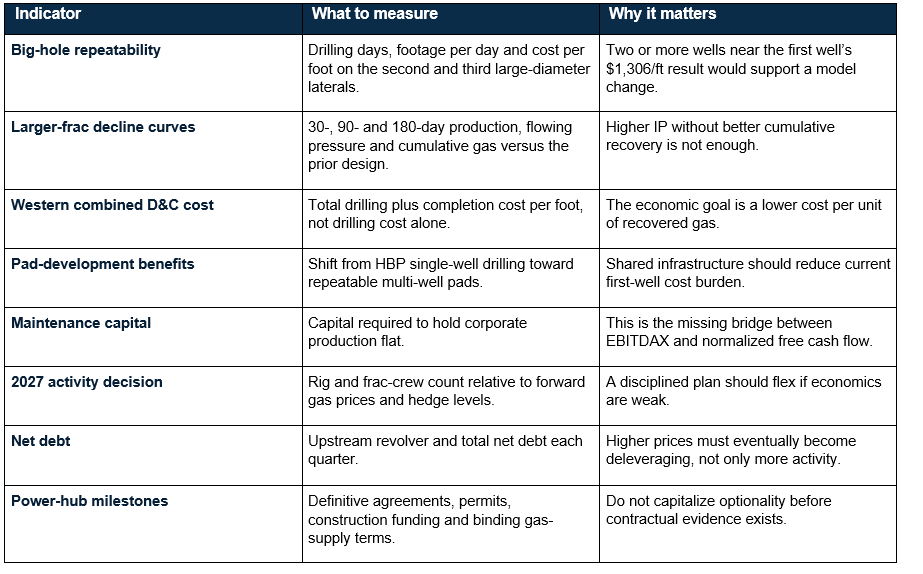
EnergyAlphaCo’s assessment is modestly more constructive on resource quality and operating optionality, but unchanged on free cash flow, leverage and valuation. We are not raising the formal scenario valuation based on Q2. The next proof points are repeatable big-hole drilling results, sustained performance from the larger-frac wells, clearer maintenance-capital requirements and evidence that stronger gas prices translate into debt reduction rather than a permanently larger capital program.
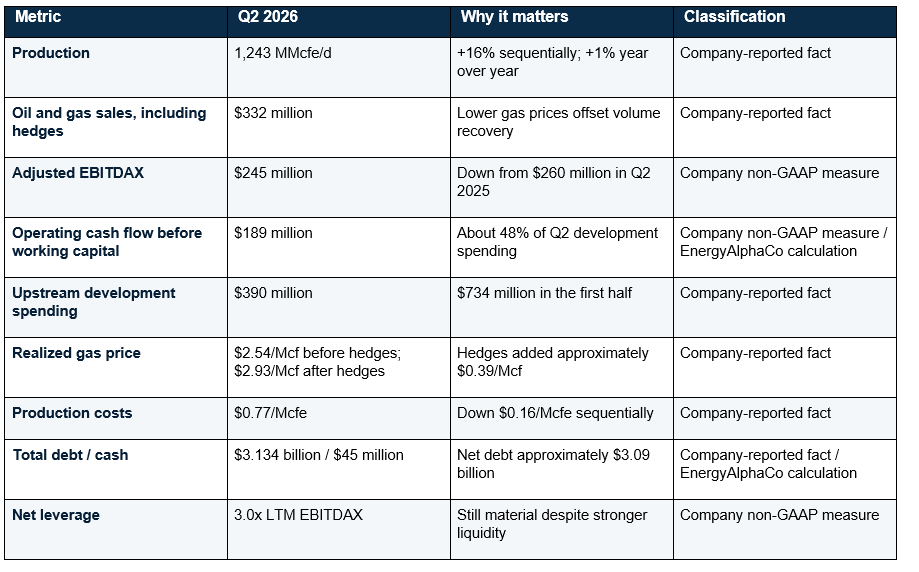
The quarter in one table
What changed—and what did not
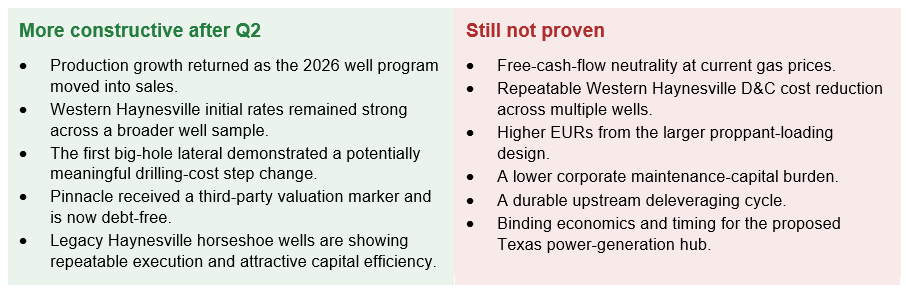
Production recovered, but the cash-flow gap remains
Comstock produced 113.1 Bcfe during the quarter, or approximately 1.24 Bcfe/d. The sequential increase restored production growth and improved per-unit cost absorption. Management guided Q3 production to 1.30-1.40 Bcfe/d and said Q3 and Q4 should show similar sequential growth, with the fourth quarter returning toward the production levels achieved in the first half of 2024.
That production cadence is constructive, but it is being purchased with a large development program. Q2 upstream development spending was $390 million, compared with $189 million of operating cash flow before working-capital movements. The implied shortfall was approximately $202 million before property acquisitions and any Pinnacle capital spending. On a year-to-date basis, operating cash flow before working capital was $380 million against $734 million of development spending.

Management did not provide a precise Henry Hub forecast. It did, however, give investors a useful capital-allocation signal: the company was disappointed with summer gas prices and would want stronger prices, particularly prices it could hedge, to support the same level of 2027 activity. That is a more disciplined answer than committing to growth regardless of the commodity tape. The test will be whether the 2027 plan actually flexes with economics.
Western Haynesville: the call improved the explanation, not yet the economics
The headline Q2 Western Haynesville data were mixed. Eleven wells turned to sales in 2026 averaged 31 MMcf/d from 10,331-foot laterals, and the five newest wells ranged from 30 to 35 MMcf/d. The production response remains encouraging. But drilling efficiency and cost moved in the wrong direction sequentially.
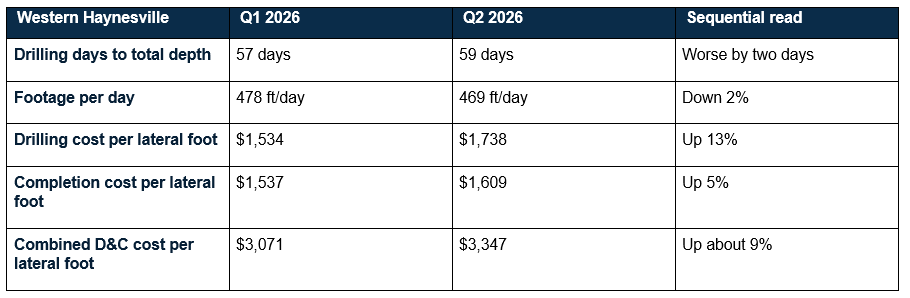
What management said drove the increase
Depth: the four Q2 Western wells were approximately 1,200 feet deeper on average than the five Q1 wells. Greater depth raises temperature and increases downhole-tool wear.
Steering difficulties: two wells required additional trips and bottom-hole-assembly runs, lifting the quarterly drilling average.
Completion design: Q2 completions used higher proppant loading; the quarter also included shorter laterals and a higher share of single-well pads, which raised cost per foot.
Current development stage: much of the program is still holding acreage by production. Single wells are carrying pad and infrastructure costs that could later be shared across multi-well development.
The big-hole lateral is the most important new proof point
The first large-diameter Western lateral—the Dollye Jones well—was drilled for approximately $1,306 per lateral foot, about 25% below the Q2 average and the lowest cost cited for a comparable well at a true vertical depth of roughly 16,400 feet. Management is drilling a second and third big-hole lateral, has five on the current schedule, and has identified roughly another dozen candidates if the early result proves repeatable.
The operating logic is plausible. An 8.5-inch lateral allows faster mud circulation, lower downhole temperatures, longer tool life and easier steering than the 6.75-inch slim-hole design. Comstock also expects to deploy higher-temperature drilling motors within the next several months and its first 10,000-PSI rig around October. Eliminating even one trip can save two to three days, according to management.

Larger fracs may improve EUR—but they complicate the cost story
The first systematic batch of larger-frac Western wells came online in Q2. Management said the wells used approximately 5,000 to 6,000 pounds of proppant per foot, compared with the prior 4,000-pound design, while retaining the tighter stage and cluster spacing introduced earlier. Initial flowing pressures are reportedly strong, and the wells are being produced under conservative drawdown.
This is potentially important for recoveries, but the data are still immature. Management explicitly acknowledged that the decline profile and EUR uplift need time to prove out. It also said total D&C cost may remain roughly similar—or only modestly lower—because drilling savings could be partly reinvested in larger completions. That is not necessarily a negative. A similar-cost well with materially higher EUR can create more value. But investors should not assume that a lower drilling cost automatically produces an equally large reduction in total well cost.
Legacy Haynesville is quietly becoming the near-term efficiency engine
The earnings discussion understandably focused on the Western Haynesville, but the Legacy program delivered the cleaner near-term execution result. Q2 benchmark long-lateral wells averaged 24 days to total depth and 1,017 feet per day, a 10% improvement from Q1. Drilling cost was approximately $710 per lateral foot and completion cost was $680 per foot.
The horseshoe design is central to that performance. Comstock has drilled 19 horseshoe wells and turned 11 to sales, with a 31 MMcf/d average initial rate. The company estimates the design reduces drilling cost by about 35% compared with developing stranded 5,000-foot laterals. Rotary-steerable technology is improving repeatability through the 180-degree turn, and the company now identifies 113 future horseshoe locations.
For the Thesis Audit, Legacy Haynesville matters because it can support 2026-2027 production while Western Haynesville economics mature. It is the lower-risk source of near-term volumes and may help prevent the Western delineation program from carrying the entire corporate production burden.
Pinnacle: external value validation, but not an upstream deleveraging event
Sixth Street invested $600 million for a 27% noncontrolling common interest in Pinnacle, implying a roughly $2.2 billion enterprise value. Comstock retains 73% and may increase its ownership to 80.5% after specified return hurdles. The proceeds retired Pinnacle’s preferred securities and debt, leaving the subsidiary debt-free and reducing annual fixed charges by approximately $40 million.
This is a meaningful structural improvement and supports a sum-of-the-parts framework. It also validates that a sophisticated outside investor assigns substantial value to the gathering and processing platform. But the transaction should not be described as a direct reduction of upstream debt. Comstock ended Q2 with $545 million drawn on the upstream revolver and $3.134 billion of total debt. The transaction simplified and deleveraged Pinnacle; the upstream balance sheet still requires future free cash flow.
Balance sheet and hedges: liquidity is adequate; leverage remains the equity constraint
Comstock reported $45 million of cash, $3.134 billion of total debt, approximately $1.15 billion of liquidity and a 3.0x total net-debt-to-LTM-EBITDAX ratio. The balance sheet is not an immediate liquidity crisis, but it remains a central equity-value constraint because a large portion of enterprise value accrues first to debt holders.
The hedge book helped materially in Q2. Hedging gains increased the realized gas price from $2.54/Mcf to $2.93/Mcf and contributed approximately $43 million of cash settlements. Comstock disclosed 780 MMcf/d of hedges for each 2026 quarter—320 MMcf/d of swaps at $3.51 and 460 MMcf/d of collars with a $3.50 floor and $4.35 ceiling. The disclosed 2027 hedge volume falls to 400 MMcf/d of collars with a $3.50 floor and $4.44 ceiling.
That creates a two-sided setup. Comstock retains greater upside exposure if the gas market strengthens in 2027, but it also has less absolute hedge protection if prices remain weak. The equity thesis therefore becomes more sensitive to the timing of LNG, power-sector and data-center demand relative to the company’s development spending.
Natural-gas demand: management remains bullish, but the model should stay disciplined
Management reiterated a structurally bullish demand view, pointing to LNG growth, the proposed Anderson County power-generation hub and potential data-center demand. It argued that the industry may need more than 13 Bcf/d of incremental supply by 2031 before including data centers. That is management’s market outlook, not a verified company result, and EnergyAlphaCo does not treat it as evidence by itself.
The more investable takeaway came from management’s 2027 planning comments. Comstock wants to be technically ready to respond to the demand wave, but it also said the 2027 activity level will be evaluated later in the year based on gas prices and hedge opportunities. That is the correct framework. The company should not accelerate Western development merely because long-term demand may be strong; it should accelerate when prices, contracts or hedges support acceptable full-cycle returns.
The proposed Texas power-generation hub remains optionality rather than base-case value. Management referenced a possible start in late 2027 or 2028, but the call did not provide a definitive gas-supply contract, construction commitment, capital-sharing framework or project-level return. Until those milestones exist, the project should remain outside a conservative valuation case.
Valuation impact: no change yet
EnergyAlphaCo is not changing the formal conditional 2028 base-case reference value of approximately $33 per fully diluted share based on this quarter. That value is not a conventional 12-month price target. It assumes a stronger gas market, higher production, positive free cash flow, lower net leverage and continued value recognition for Pinnacle.
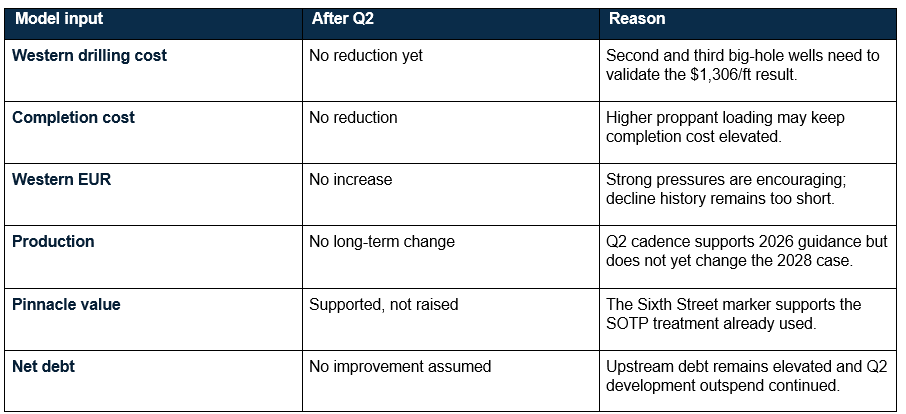
Q2 supports the existing resource and Pinnacle assumptions, but it does not justify lowering Western Haynesville D&C costs in the model or increasing EUR assumptions. We would need a repeatable big-hole result set and meaningful production history from the larger-frac wells before changing those inputs.
The updated Thesis Audit
What investors should monitor next
Thesis breakers
The big-hole result proves non-repeatable and Western drilling costs remain near or above the current quarterly average.
The larger-frac wells fail to deliver better cumulative recovery or require materially higher completion spending without a commensurate EUR benefit.
Corporate production growth requires sustained development outspend even at materially stronger gas prices.
Net debt rises through a stronger commodity cycle or management prioritizes growth over deleveraging without contracted returns.
Western basis or takeaway constraints prevent stronger Henry Hub prices from reaching Comstock’s realized price.
The proposed power-generation hub does not advance to binding contracts or imposes material capital requirements on Comstock.
The disclosed Western location inventory proves materially less economic or less developable than management’s current estimate.
Final assessment
Q2 was a genuine operating step forward. Production recovered, Western Haynesville initial rates remained strong, Legacy horseshoe execution improved and Pinnacle received credible third-party value confirmation. The earnings call also gave investors a clearer technical roadmap for reducing Western drilling risk.
But the central financial test remains open. Comstock is still spending substantially more on development than it generates in operating cash flow at current prices. The Western program has moved from “is the gas there?” toward “can the company develop it at a repeatable full-cycle return?” That is progress, but it is not the same as proof.

Sources and methodology
Comstock Resources, Inc., Second Quarter 2026 Results presentation, July 29, 2026.
Comstock Resources, Inc., Form 8-K and Q2 2026 earnings release, July 29, 2026.
Comstock Resources Q2 2026 earnings conference-call transcript, July 30, 2026, provided for review by the user.
EnergyAlphaCo CRK Thesis Audit and independent financial and valuation model. All model outputs and valuation references are EnergyAlphaCo estimates, not company guidance.
Investment-risk disclosure
This material is for informational and educational purposes only and does not constitute individualized investment advice, an offer to buy or sell securities, or a recommendation regarding any security. Energy investments involve substantial commodity-price, operating, financial, regulatory and market risk. Scenario values are conditional estimates, not forecasts or price targets. The author owns shares of Comstock Resources and therefore has a financial interest in the security discussed. Readers should conduct their own due diligence and consider their own objectives and risk tolerance.