
Accendra Health: The Debt Has Been Restructured. Now the Cash Flow Must Arrive.
Q2 extended the maturity runway, but the $385 million debt-reduction headline translated into only about $56 million of net deleveraging. The next two quarters must prove that the remaining home-healt
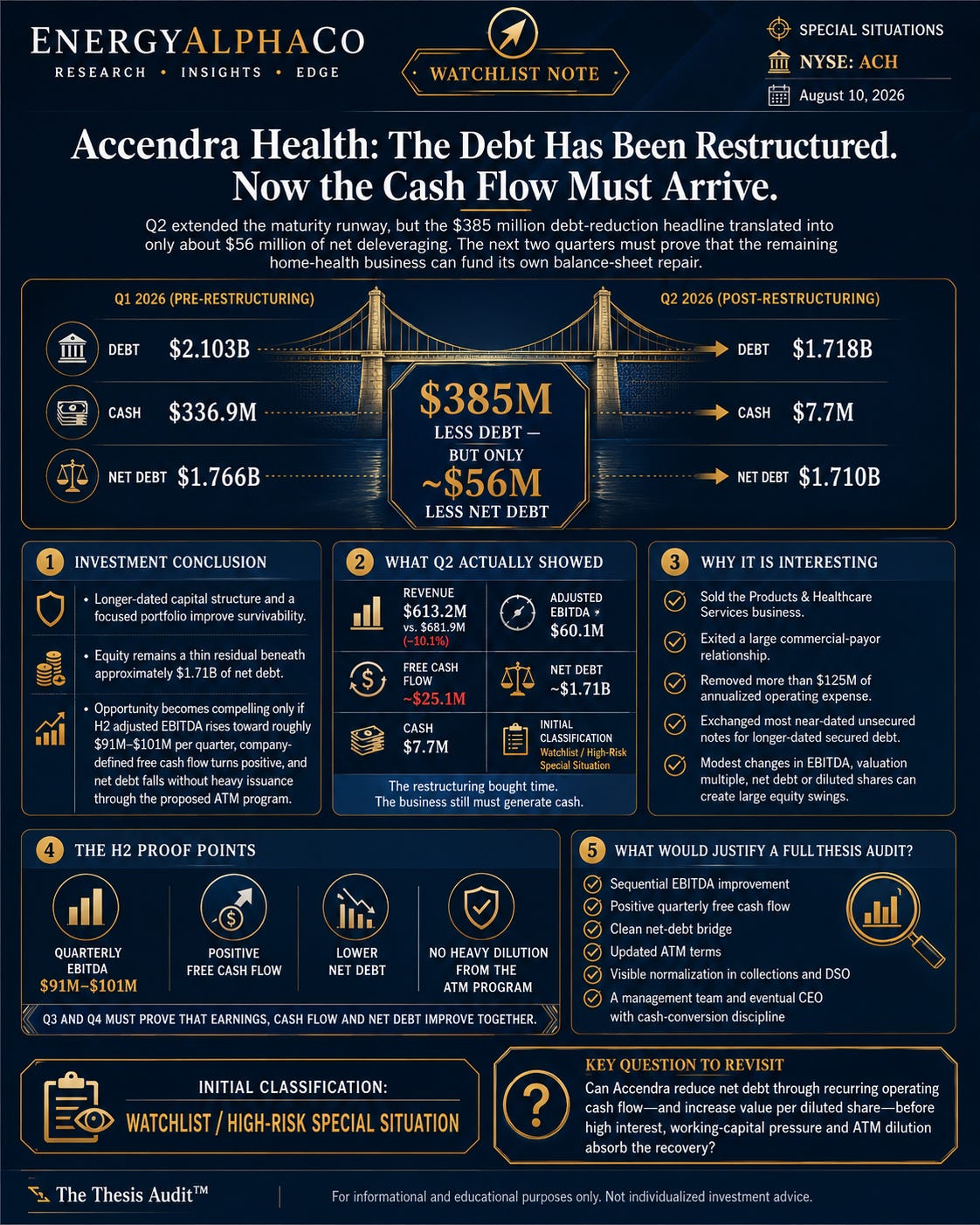
Initial classification: Watchlist / High-Risk Special Situation

Why Accendra is on the watchlist
Accendra Health is an unusually asymmetric special situation. The company has sold its Products & Healthcare Services business, exited a large commercial-payor relationship, removed more than $125 million of annualized operating expense and exchanged most of its near-dated unsecured notes for longer-dated secured debt. Those actions materially changed the survival and refinancing discussion.
They did not yet prove that the remaining business creates value for common shareholders. Q2 revenue and adjusted EBITDA were below management’s expectations, free cash flow was negative, receivables performance deteriorated, new debt carries coupons of 9.0% and 9.75%, and management expects to activate a small at-the-market equity program. With the common equity now representing only a small fraction of enterprise value, modest changes in EBITDA, valuation multiple, net debt or diluted shares can produce very large changes in value per share.
The company in one paragraph
Accendra Health is the renamed, continuing home-based-care business formerly housed within Owens & Minor. Through the Apria and Byram brands, it provides equipment, supplies, technology and services for diabetes, sleep therapy, home respiratory therapy, ostomy, wound care, urology and related needs. The company reports as one segment and derives most revenue from commercial payors, including Medicare Advantage plans. The investment case rests less on headline healthcare demand than on reimbursement execution, product mix, cost-to-serve, patient-equipment capital intensity and the ability to convert adjusted EBITDA into cash after interest.
The basic investment question
THE QUESTION Can the simplified Accendra business generate enough recurring cash flow to reduce net debt faster than high cash interest, operating volatility and equity dilution consume the common shareholders’ upside?
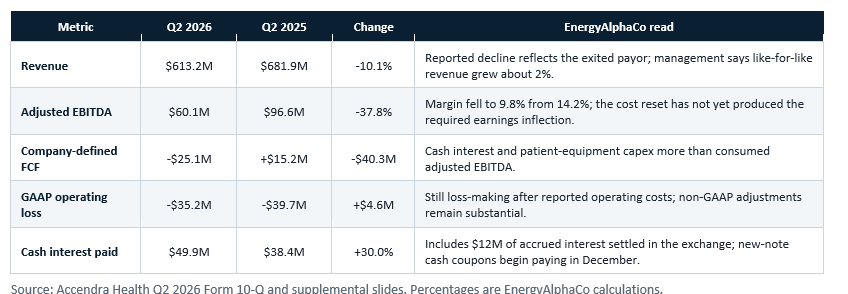
The reported revenue decline overstates the deterioration in the retained portfolio because the prior-year comparison includes the exited commercial payor. Excluding that payor, management reported approximately 2% Q2 growth. Diabetes grew 4%, while ostomy and urology grew at high-single-digit rates. Like-for-like sleep growth improved to approximately 5.5%. Home respiratory and wound care remained weak even after adjusting for the exited relationship.
The earnings issue is more difficult to dismiss. Cost of net revenue rose to 57.0% of revenue from 52.4%, and SG&A rose to 39.7% of revenue from 39.3%. Management attributed the shortfall to slower revenue growth, delayed cost reductions and a collections-rate adjustment that reduced Q2 revenue and EBITDA by approximately $10 million and H1 by roughly $20 million. The company says mitigation efforts are progressing, but the improvement had not yet been proven in reported cash flow.
The $385 million debt headline requires an equity reality check
Accendra highlighted that carrying-value debt declined from approximately $2.103 billion at March 31 to $1.718 billion at June 30, a reduction of about $385 million. Cash, however, fell from approximately $336.9 million to $7.7 million over the same period. Net debt therefore declined from about $1.766 billion to $1.710 billion—only approximately $56 million.
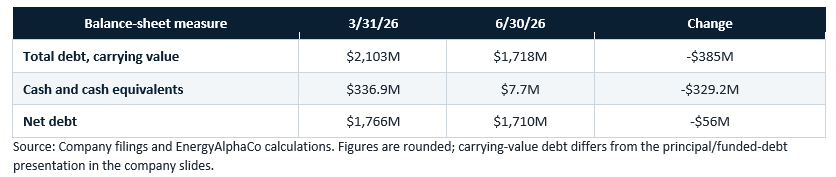
This does not make the transaction unhelpful. Accendra captured approximately $115 million of discount in the exchange, eliminated the revolver balance, extended weighted-average debt life from roughly 2.7 years to 5.5 years and pushed most note maturities to 2032-2033. At June 30, it had no current maturities and $271 million of revolver availability after letters of credit.
But the economic cost of that runway is high. The new first-lien notes carry a 9.0% coupon and the second-lien notes 9.75%. Management guides to $158-$162 million of 2026 cash interest—approximately 52% of the $310 million midpoint of adjusted EBITDA guidance. The $511 million Term Loan B still matures in March 2029, and the revolver has potential springing maturities beginning in December 2028. The company bought time; it did not eliminate refinancing risk.
The credit market also remained skeptical at quarter-end. Accendra estimated the fair value of total debt at approximately $1.464 billion versus a $1.718 billion carrying amount. The second-lien 2033 notes were valued at roughly $476 million against about $698 million of principal, approximately 68 cents on the dollar. That is not a direct equity valuation, but it is a useful warning that the new maturity profile should not be confused with a repaired credit.
Free cash flow needs a stricter definition
Accendra’s reported non-GAAP free cash flow is calculated as adjusted EBITDA plus a non-cash equipment write-off, less patient-service-equipment capital expenditures and cash interest. For H1, that bridge produced negative $27.1 million. It is useful because it includes cash interest and the most important recurring equipment investment, but it is not the conventional calculation of cash from operations less total capital expenditures.
The company’s measure does not directly capture all working-capital movements, cash taxes, restructuring and transaction payments, or all non-PSE capital spending. The 10-Q reported $76.1 million of cash used by operating activities in H1. Some of that reflected clearly nonrecurring separation, tax and financing items, but the gap reinforces why net debt and revolver usage must be monitored alongside the non-GAAP FCF figure.
Receivables are especially important. Net accounts receivable increased 25% from year-end, reported DSO rose from 12.4 to 17.8 days, and DSO excluding the receivables-sale program rose from 29.8 to 37.1 days. Accendra estimates that one additional DSO day absorbs approximately $6.7 million of liquidity. The company sold $466 million of receivables during H1, with $130 million of sold-but-uncollected receivables off the balance sheet at June 30. That program is a legitimate liquidity tool, but it makes simple cash and accounts-receivable comparisons incomplete.
The H2 guidance bridge is demanding and measurable
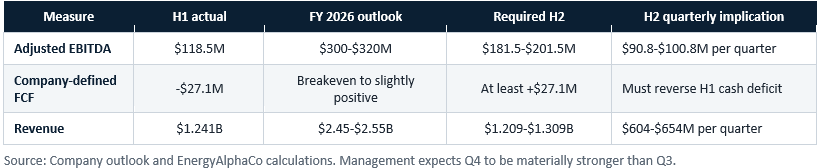
Reaching the EBITDA range requires H2 adjusted EBITDA of approximately $181.5-$201.5 million, or $90.8-$100.8 million per quarter. That is roughly 51%-68% above Q2’s $60.1 million. Management has already said Q4 should be much stronger than Q3, so the bridge is back-end loaded. Investors should not wait until year-end to test it: Q3 must show visible progress in collections, cost ratios and operating margin even if the full step-up is reserved for Q4.
Why the equity can still work
1. The remaining business has recurring, medically necessary demand
Diabetes, sleep, respiratory, ostomy and urology products are tied to chronic conditions and recurring supplies. If Accendra improves reimbursement execution and capacity utilization, the revenue base should be more durable than the distressed equity valuation implies.
2. The cost reset creates operating leverage—if it reaches reported margins
More than $125 million of annualized costs have reportedly been removed, and another phase of targeted reductions began early in Q3. The key is not the announced run rate; it is whether cost of net revenue and SG&A decline as percentages of revenue without damaging service, collections or growth. Much of the cost action offsets the exited payor and separation rather than automatically becoming incremental EBITDA.
3. Genuine deleveraging has unusually large per-share impact
Using approximately 77.8 million illustrative fully diluted shares—Q2 weighted-average shares plus the roughly 1.1 million awards excluded as anti-dilutive—each $100 million of organic net-debt reduction would add about $1.29 per share of residual equity value if enterprise value were unchanged. That is a sensitivity, not a price target. Debt repayment funded by issuing common shares does not create the same one-for-one benefit for existing holders because the denominator rises.
4. Leadership change could be constructive, but it is not yet underwritable
CEO Ed Pesicka intends to retire by year-end 2026, and no successor had been announced with Q2 results. A new leader with deep reimbursement, operations and deleveraging experience could improve execution and credibility. The transition also introduces risk during the exact period in which the H2 earnings bridge must be delivered. The successor, mandate, compensation and capital-allocation priorities are therefore part of the thesis—not a footnote.
The proposed ATM changes the per-share analysis
Management expects to activate a “small” at-the-market equity program and use proceeds to reduce debt. The final size and terms were not disclosed in the Q2 prepared remarks, and the company’s approximately 78 million share guidance explicitly excludes future issuances. At a share price of approximately $1.39 in afternoon trading on August 10, even a modest dollar amount would be material to the current share count.

The correct test is whether any issuance produces a net benefit after dilution. Equity-funded debt repayment can lower interest expense and reduce refinancing risk, but selling a large percentage of the company at a distressed price may transfer a disproportionate share of future recovery value to new buyers.
The NOL plan is protection, not operating value
Management expects net operating loss carryforwards entering 2027 to exceed $200 million and has adopted a tax-asset-preservation plan intended to reduce the risk that ownership changes impair those attributes. The logic is understandable, particularly at a depressed market capitalization. The NOLs should not be valued dollar-for-dollar: they create value only if Accendra produces taxable income, retains the deductions and can use them within applicable limitations. Investors should monitor the plan’s ownership threshold, exemptions, duration and effect on strategic alternatives.
High-level valuation frame
At approximately $1.39 per share, an illustrative 77.8 million fully diluted share count implies equity value of roughly $108 million. Adding approximately $1.710 billion of net debt produces an enterprise value near $1.82 billion, or about 5.9 times the $310 million midpoint of 2026 adjusted EBITDA guidance. That multiple is not obviously distressed for a business that has not yet demonstrated positive free cash flow and carries a very high interest burden; the common stock is inexpensive only if the EBITDA and deleveraging assumptions prove correct.

The same leverage works in reverse. If sustainable EBITDA is closer to $250 million, even a 6.0x enterprise multiple would imply value below current net debt. If Accendra produces roughly $100 million of recurring annual free cash flow, as management believes it can in a less disrupted year, the equity could rerate rapidly—but that statement is an aspiration until collections, capex, cash interest and net debt confirm it.
What must be proven
H2 adjusted EBITDA reaches approximately $181.5-$201.5 million, with Q3 showing clear sequential progress even though management expects Q4 to be stronger.
Company-defined H2 free cash flow exceeds roughly $27 million and reported net debt declines without another large drawdown in cash or revolver availability.
The collections-rate adjustment fades, DSO and accounts receivable normalize, and improved reported revenue is supported by cash receipts rather than only non-GAAP adjustments.
The more-than-$125 million cost reset lowers cost of net revenue and SG&A as percentages of sales without impairing service levels or organic growth.
Like-for-like growth in sleep and diabetes persists while respiratory and wound care stop declining.
The ATM is limited, transparent and demonstrably accretive to existing shareholders after lower interest and refinancing risk are considered.
The board selects a CEO whose operating priorities, incentives and capital allocation are aligned with organic deleveraging and fully diluted per-share value.
The company develops a credible plan for the 2029 Term Loan B and potential 2028 revolver springing maturity well before those dates become urgent.
What could make EnergyAlphaCo pass
Q3 adjusted EBITDA remains near Q2’s $60 million level or management reduces the $300-$320 million full-year range again.
Free cash flow stays negative after the one-time transaction items fade, forcing revolver borrowing or additional asset sales to fund ordinary operations.
Net debt falls mainly because cash or newly issued equity is used, rather than because the retained business generates cash.
The ATM becomes large relative to the current share count or is executed aggressively near distressed prices.
Collections, DSO and receivables-sale dependence fail to normalize, undermining confidence in reported revenue and cash conversion.
The successor CEO initiates another expensive strategic reset before the current cost and collection programs are stabilized.
The 2032 or 2033 secured notes weaken materially, signaling that the extended maturity runway is not translating into improving credit confidence.
Customer concentration, reimbursement changes or service disruption erode the recurring-demand advantage of the remaining business.
Key metrics to monitor
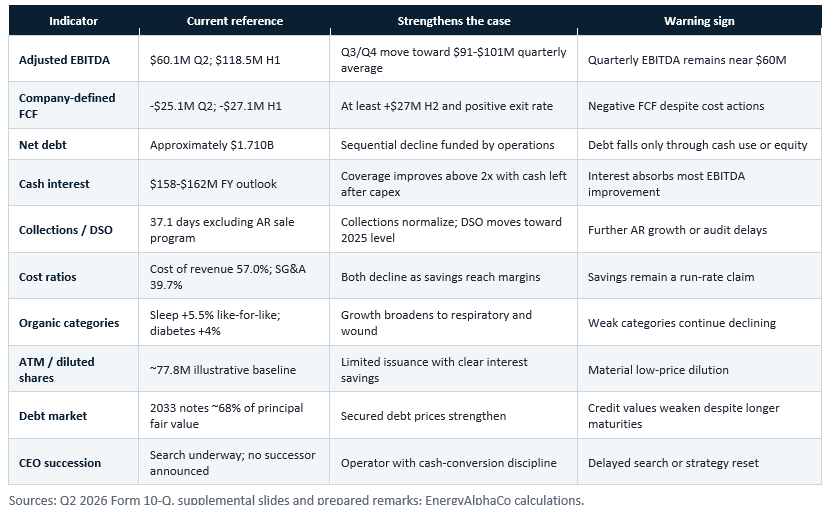
What would justify a full Thesis Audit?
A full Accendra Thesis Audit should begin after Q3 results if the company provides enough evidence to determine whether the H2 inflection is real. The minimum evidence set should include sequential EBITDA improvement, positive quarterly free cash flow, a clean net-debt bridge, updated ATM terms and visible normalization in collections and DSO.
The full audit should then reconstruct:
A normalized revenue and margin model by product category, including the effect of the exited payor and collection-rate adjustments.
Maintenance patient-equipment capex, other capital spending, working capital and true cash flow after all recurring costs.
Annual cash interest, maturity/refinancing scenarios and covenant headroom.
Fully diluted shares under no-ATM, limited-ATM and heavier-ATM funding paths.
Downside, conservative, base, bull and exceptional-execution enterprise-value scenarios.
Per-share value after net debt, dilution and any remaining separation or contingent obligations.
Management incentives and whether the new CEO is rewarded for net-debt reduction and per-share value rather than adjusted EBITDA alone.
Initial classification

Final assessment
Accendra has completed much of the restructuring work that previously obscured the investment case. The P&HS divestiture is closed, the large payor exit is largely complete, the cost base has been reset and most unsecured maturities have been exchanged into longer-dated secured debt. That is the encouraging structural element.
The reality check is that common shareholders received only about $56 million of net deleveraging during a quarter advertised around a $385 million debt reduction. Cash is now minimal, interest expense is high, H1 free cash flow was negative, collections remain inefficient and the company is considering issuing equity at prevailing prices.
The thesis has therefore changed. The question is no longer primarily whether Accendra can execute a balance-sheet transaction. It is whether the remaining business can produce enough EBITDA and cash to delever organically.
Q3 and Q4 provide an unusually clean test: quarterly EBITDA must move materially above Q2, H2 free cash flow must turn positive, and net debt must decline without sacrificing the existing shareholders’ share of the recovery. If those three developments occur together, the equity optionality is substantial. If they do not, the longer maturity runway may simply postpone the next capital-structure problem.
Sources
Accendra Health, Form 10-Q for the quarter ended June 30, 2026, filed August 10, 2026. Source link
Accendra Health, Second Quarter 2026 Continuing Operations Supplemental Slides, August 10, 2026. Source link
Accendra Health, Q2 2026 Earnings Call Prepared Remarks, August 10, 2026. Source link
EnergyAlphaCo Covered-Company Pulse, “Accendra’s $385M debt-reduction headline overstates the equity deleveraging,” August 10, 2026.
Market data for ACH, accessed during afternoon trading on August 10, 2026. Price references are intraday and may change.
Disclosure. Informational and educational only; not individualized investment advice. EnergyAlphaCo may discuss securities in which the author has a financial interest. ACH is highly leveraged and subject to operating, reimbursement, liquidity, refinancing, dilution and execution risks. Adjusted EBITDA and FCF are company-defined non-GAAP measures. Illustrative valuations are not price targets.